
Mount Sinai
Egypt·Africa
Mount Sinai, also known as Jabal Musa, is a significant mountain on the Sinai Peninsula in Egypt. It is revered as the biblical Mount Sinai, the site where the prophet Moses is said to have received the Ten Commandments from God according to Judaism, Christianity, and Islam. The mountain is surrounded by higher peaks and is a popular destination for religious pilgrimage.
Key Facts
- ›Located on the Sinai Peninsula in Egypt, it is one of several claimed locations for the biblical Mount Sinai.
- ›According to religious texts, it is where Moses received the ten Commandments from God.
- ›The mountain stands at 2,285 meters (7,497 ft) and is part of a mountain range where it is surrounded by higher peaks.
- ›Geologically, its rocks formed during the late stage of the Arabian-Nubian Shield's evolution, featuring alkaline granites and volcanic rocks.
- ›The summit features a mosque and a Greek Orthodox chapel built on older ruins, enclosing the rock believed to be the source of the Tablets of Stone.
- ›Associated with the Islamic prophet Mūsā ibn ʿImrān (Moses), it is mentioned in the Quran under various names.

Jabal Musa
- Site Where Moses Received the Ten Commandments From God.
- Mentioned In the Quran As ṭūR Saināʾ, ṭūR SīNīN, Aṭ-ṭūR, and Al-Jabal.
- the Adjacent WāD ṭUwā Is Considered Sacred, With A Part Called Al-BuqʿAh Al-MubāRakah .
- Ascending To the Summit For Sunrise Or Sunset.
- Hiking the Routes Siket El Bashait and Siket Sayidna Musa.
- Staying Overnight In Camps Below the Summit.
- Visiting the Mosque and the Greek Orthodox Chapel At the Summit.
- Seeking Guidance From Hired Guides For the Ascent.
Moses
Mandatory To Hike With A Guide.
About Mount Sinai
Mount Sinai, also known by its Arabic name Jabal Musa, is a mountain located on the Sinai Peninsula in Egypt. It is revered as one of the primary locations identified with the biblical Mount Sinai, the sacred site where, according to the scriptures of Judaism, Christianity, and Islam, the Hebrew prophet Moses received the Ten Commandments from God. This makes it a profoundly important destination for pilgrims and a site of immense religious and historical significance.
Location and Geology
The mountain stands at an elevation of 2,285 meters (7,497 ft) and is situated near the city of Saint Catherine. It is part of a mountain range and is notably surrounded by higher peaks, including Mount Catherine, which is the highest mountain in Egypt. The geological composition of Mount Sinai is characterized by a ring complex of alkaline granites intruded into various rock types, including volcanics, formed during the late stages of the Arabian-Nubian Shield's evolution.
Religious and Spiritual Significance
Mount Sinai holds deep religious importance across three major Abrahamic faiths. For Judaism and Christianity, it is the site of the divine revelation to Moses. Islam also reveres the mountain, associating it with the prophet Mūsā ibn ʿImrān (Moses), and the Quran refers to it by several names, including Ṭūr Saināʾ and aṭ-Ṭūr. The area surrounding the mountain, specifically the Valley of Tuwa, is considered sacred.
Pilgrimage and Access
Today, Mount Sinai is a popular pilgrimage site, with visitors often ascending to witness the sunrise or sunset from its summit. Two principal routes lead to the peak: the longer, gentler Siket El Bashait, and the steeper Siket Sayidna Musa, which involves climbing approximately 3,750 steps. Hired guides are mandatory for the ascent. At the summit, visitors can find a mosque that is still in use by Muslims, and a Greek Orthodox chapel built on the foundations of an earlier church, which encloses the rock believed to be the source of the biblical Tablets of Stone. 'Moses' cave,' where the prophet is said to have waited to receive the commandments, is also located at the summit. Amenities such as cafes selling refreshments and overnight accommodations are available along the trails.
Source: Wikipedia ↗
Frequently Asked Questions
What is Mount Sinai also known as?
Mount Sinai is also known by its Arabic name, Jabal Musa, which translates to 'Mountain of Moses'.
Where is Mount Sinai located?
Mount Sinai is located on the Sinai Peninsula in Egypt, near the city of Saint Catherine.
What is the elevation of Mount Sinai?
Mount Sinai has an elevation of 2,285 meters (7,497 ft).
What religious significance does Mount Sinai hold?
It is believed to be the biblical Mount Sinai, where Moses received the Ten Commandments from God, making it sacred to Judaism, Christianity, and Islam.
What can be found at the summit of Mount Sinai?
At the summit, there is a mosque used by Muslims and a Greek Orthodox chapel built on the ruins of an older church, which encloses the rock believed to be the source of the Tablets of Stone. 'Moses' cave' is also at the summit.
How can one ascend Mount Sinai?
There are two main routes: a longer, shallower path called Siket El Bashait, and a steeper, more direct path called Siket Sayidna Musa, which involves climbing steps. Guides are mandatory for the ascent.
Related Sacred Mountains
Mount Kenya
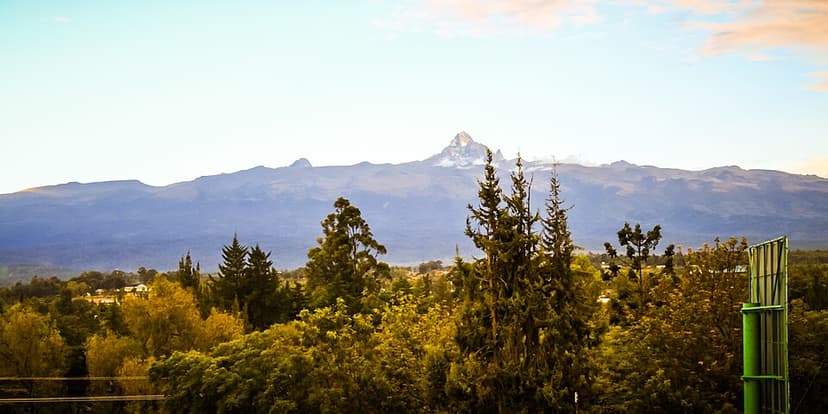
Mount Kenya is the second-highest mountain in Africa and a significant stratovolcano, revered by indigenous communities as the dwelling place of God. Its majestic peaks, glaciers, and diverse ecological zones hold deep spiritual and cultural importance for the Kikuyu, Ameru, Embu, and Maasai peoples, who have lived on its slopes for centuries. Designated as a UNESCO World Heritage Site, the mountain is a vital sanctuary for endangered species and a critical water source for the region.

Mount Kilimanjaro
Mount Kilimanjaro is the highest mountain in Africa and the world's highest free-standing mountain, standing at 5,895 meters above sea level. This dormant volcano in Tanzania is a significant natural wonder, known for its glaciers, diverse ecosystems, and as a major global hiking destination. Its name's origin is debated, but local Chagga people refer to its peaks as Kipoo and Kimawenze.

Mount Carmel
Mount Carmel is a coastal mountain range in northern Israel, significant for its rich history as a site of human evolution, ancient civilizations, and diverse religious traditions. Its name, likely meaning "garden-land" or "vineyard of God," reflects its lush vegetation and spiritual importance across Canaanite, Israelite, Christian, Baháʼí, and Druze faiths. The mountain is renowned for its caves, ancient altars, and association with the prophet Elijah, making it a focal point for pilgrimage and historical study.