
Sawley Abbey
Sawley Abbey was a Cistercian monastery founded in 1149 and dissolved in 1536. Situated in Lancashire, England, it was a daughter-house of Newminster Abbey and played a role in local history, including involvement in the Pilgrimage of Grace. Today, the abbey ruins are a Grade I listed building and a Scheduled Ancient Monument managed by English Heritage and are open to the public.
Key Facts
- ›Founded in 1149 as a daughter-house of Newminster Abbey.
- ›Dissolved in 1536 during the reign of King Henry VIII.
- ›The ruins are a Grade I listed building and Scheduled Ancient Monument.
- ›Controlled by English Heritage and open to the public.
- ›Historically located in Lancashire, England, but previously in the West Riding of Yorkshire.
- ›Had a scholarly tradition, with an abbot becoming Chancellor of Oxford University and an English translation of Robert Grosseteste's work possibly originating there.

- Remains of the Church With Walls Up To 8 Metres High
- Chapter House Ruins
- Monks' Dorter and Library Foundations
- Calefactory, Refectory, and Kitchen Foundations
- Remains of Cloister Courtyard
- Earthworks Indicating Former Structures Such As Infirmary, Bakery, and Brewery
William De Percy Ii, Swain, Son of Swain, Robert of Newminster, Abbot Benedict, Roger De Pont L'éVêQue, Pope Alexander Iii, Matilda, Wife of William De Beaumont, William De Percy, 6th Baron Percy, Elias De Giggleswicke, Whalley Abbey Monks, William Greenfield, Henry De Percy, 1st Baron Percy of Alnwick, Stephen of Sawley, William De Remmyngton, Robert Grosseteste, Thomas Bolton, William Trafford, John Paslew, Sir Thomas Percy, Sir Stephen Hamerton, Nicholas Tempest, Robert Aske, Sir Richard Tempest, Sir Arthur Darcy, Henry Darcy, James Hay, Fulke Grenville, William Weddell, Thomas De Grey, 2nd Earl De Grey, John R Walbran, George Robinson, 1st Marquess of Ripon, John E Fattorini, Matthew Parker
- Foundation In 1149
- Pope Alexander Iii Took the Abbey Under His Protection In 1172
- Re-Foundation In 1189 With Support From Matilda De Beaumont
- Consternation and Disputes With Stanlow Abbey Monks Moving To Whalley In 1296
- Excommunication of Abbot and Monks For Seven Years Around 1306
- Poverty Due To Scots Raiding Parties In the Early 14th Century
- Dissolution Ordered In 1536
- Monks Returned With Rebel Support During the Pilgrimage of Grace In October 1536
- Disbanded Without Battle After Negotiations At Doncaster
- Rebellion In January 1537 Led To the Loss of Hope For the Abbey's Survival
- Final Surrender and Desertion By February 1537
- Last Abbot Executed As Punishment
- Acquisition By Arthur Darcy Post-Dissolution
- Site Cleared and Remains Revealed By Earl De Grey and John R Walbran In the 19th Century
- Featured In the Tudors Tv Series In 2009
About Sawley Abbey
Sawley Abbey was a significant Cistercian monastery located in the village of Sawley, Lancashire, England. Established in 1149 as a daughter-house of Newminster Abbey, it operated for nearly four centuries until its dissolution in 1536 under King Henry VIII. The abbey played a role in the turbulent events of the Pilgrimage of Grace, when rebels supported the monks' temporary return.
History and Significance
The foundation of Sawley Abbey was supported by William de Percy II, whose family held influence in the region. The abbey received land grants from various benefactors, including Swain, son of Swain, and later from Matilda, Countess of Warwick, who was instrumental in its re-foundation in 1189. Despite facing challenges such as climactic conditions affecting crops and economic pressures from nearby Whalley Abbey, Sawley developed a scholarly tradition. Notable figures associated with the abbey include Abbot Stephen of Sawley, a spiritual writer, and William de Remmyngton, who later became Chancellor of the University of Oxford. An English translation of a work by the scholar-bishop Robert Grosseteste is also thought to have originated at Sawley.
Dissolution and Later History
With an annual revenue below £200, Sawley Abbey was among the first monasteries targeted for suppression in 1536. Following initial suppression, the monks returned with the support of rebels during the Pilgrimage of Grace. However, after subsequent rebellions, the abbey was permanently surrendered in February 1537. The last abbot was executed as punishment for his involvement.
After its dissolution, the abbey site was acquired by various landowners, including Arthur Darcy and members of the Darcy and de Grey families. By the mid-19th century, much of the abbey's remains were obscured. Under the direction of John R Walbran, Earl de Grey had the site cleared, revealing the church floor and chapter house. The ruins, now a Grade I listed building and Scheduled Ancient Monument, are managed by English Heritage and are open to the public, offering insights into monastic life and medieval architecture.
Source: Wikipedia ↗
Frequently Asked Questions
When was Sawley Abbey founded?
Sawley Abbey was founded in 1149. It was established as a daughter-house of Newminster Abbey.
What religious order was Sawley Abbey part of?
Sawley Abbey was a monastery of Cistercian monks. The Cistercian order is a branch of the Benedictine order.
What is the current status of Sawley Abbey?
The abbey is now a ruin and is managed by English Heritage. The site is open to the public for visits.
Why was Sawley Abbey dissolved?
Sawley Abbey was dissolved in 1536 as part of King Henry VIII's dissolution of the monasteries. Its annual revenue was below £200, making it an early target for suppression.
Are there any notable figures associated with Sawley Abbey?
Yes, Stephen of Sawley, abbot from 1224 to 1233, was a respected spiritual writer. William de Remmyngton, associated with the abbey, later became Chancellor of the University of Oxford.
What significant historical events are linked to Sawley Abbey?
The abbey was involved in the Pilgrimage of Grace in 1536 when rebels supported the monks' return after its initial suppression. It was later permanently surrendered in 1537 during Bigod's rebellion.
Related Monasteries

Ankerwycke Priory
Ankerwycke Priory was a small and relatively poor Benedictine nunnery established around 1160 in Buckinghamshire, England. Dedicated to St. Mary Magdalene, it held lands across several counties. Dissolved in 1536, its revenues were transferred to Bisham Abbey, and the priory site later saw the construction of a manor house. Today, only a small section of ruins remains, situated in Berkshire.
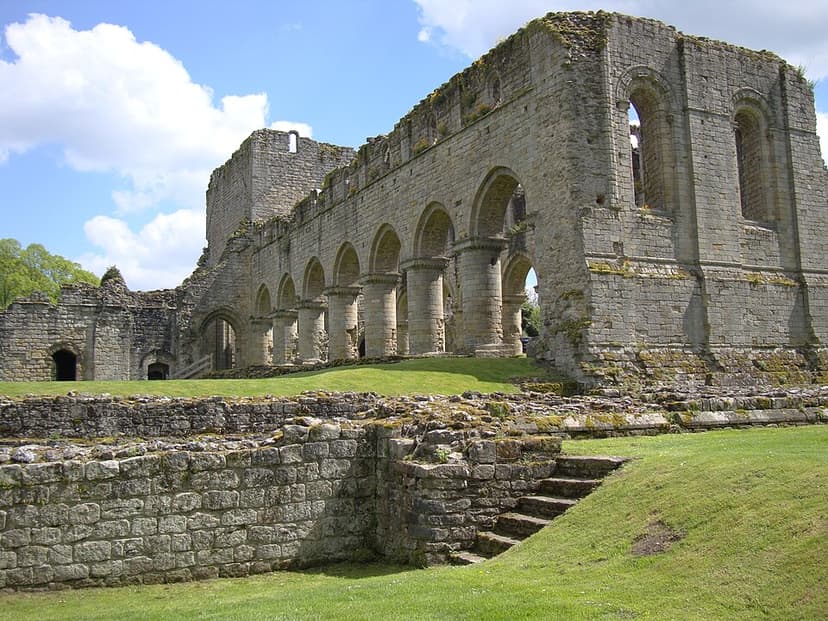
Buildwas Abbey
Buildwas Abbey was a significant Cistercian monastery in Shropshire, England, founded in 1135. It experienced periods of substantial growth and wealth, becoming a center of learning with a notable library. Despite facing challenges from economic crises and conflict, it played a role in royal administration, particularly concerning Ireland and Wales, before its suppression in 1536. Today, substantial remains of the abbey church and monastic buildings are maintained by English Heritage.

Byland Abbey
Byland Abbey was a Savigniac and later Cistercian monastic institution founded in 1135 in North Yorkshire, England. Despite an unstable early history with multiple relocations, it eventually settled at its final site near Coxwold. Once established, it became a significant religious and economic center, renowned for its sheep rearing and wool exports, and boasting a church described as one of the finest 12th-century structures in Europe. Though dissolved in 1538, extensive ruins remain, including the west front of the church with its notable rose window, and the site is maintained by English Heritage.