
Byland Abbey
Byland Abbey was a Savigniac and later Cistercian monastic institution founded in 1135 in North Yorkshire, England. Despite an unstable early history with multiple relocations, it eventually settled at its final site near Coxwold. Once established, it became a significant religious and economic center, renowned for its sheep rearing and wool exports, and boasting a church described as one of the finest 12th-century structures in Europe. Though dissolved in 1538, extensive ruins remain, including the west front of the church with its notable rose window, and the site is maintained by English Heritage.
Key Facts
- ›Founded as a Savigniac abbey in January 1135, later absorbed by the Cistercian order in 1147.
- ›The community relocated five times before settling at its permanent site near Coxwold.
- ›In 1322, King Edward II was present at the abbey during the Battle of Old Byland.
- ›By the time of its dissolution in 1538, it housed an abbot and 25 monks.
- ›The abbey church was considered one of the finest 12th-century churches in Europe.
- ›Extensive ruins are preserved, including the west front with a large rose window.

Romanesque, Gothic
West Front of the Church, Rose Window, Chapter House Lectern Base, Mosaic Floor Tiles, Extensive Earthworks of Outer Buildings
King Edward Ii, Sir William Pickering, Wombwell Family, Mabel De Clare, Roger De Mowbray, William De Mowbray, Joan of Lancaster
Battle of Old Byland
About Byland Abbey
Byland Abbey is a significant ruined monastic site located in Byland with Wass, North Yorkshire, England, nestled within the North York Moors National Park. Its history began in January 1135 when it was founded as a Savigniac abbey. The community faced considerable early challenges, necessitating five relocations before finally settling at its permanent location near Coxwold. In 1147, the abbey joined the Cistercian order, becoming a prominent institution in the north of England.
Historical Significance and Development
Despite initial disputes with neighboring religious houses, Byland Abbey rose to prominence. By the late 14th century, it was described as "one of the three shining lights of the north." The abbey was particularly noted for its sheep rearing and wool exports, contributing to its economic success, though not on the scale of abbeys like Rievaulx. Its church was considered among the finest 12th-century churches in Europe, with a grand design that included unusual features for Cistercian architecture, such as a nave with twelve bays and a crossing tower.
A notable historical event occurred in October 1322 when King Edward II was at Byland Abbey during the Battle of Old Byland, a conflict that saw the king flee the approaching Scottish forces. By the time of the Dissolution of the Monasteries in November 1538, the abbey housed an abbot and 25 monks. Its site was subsequently granted to Sir William Pickering and later passed to the Wombwell family, who still own it.
Description and Remains
Today, Byland Abbey exists as an extensive ruin, maintained by English Heritage and scheduled as an ancient monument by Historic England. The most striking surviving feature is the west front of the church, which remains largely intact and features the lower half of a massive rose window. The monastic buildings, though reduced to walls in many areas, still reveal the layout of the cloister, chapter house, refectory, and dormitory ranges. The chapter house once contained a unique stone lectern base, the only known example of its kind in Britain. Mosaic floor tiles from the 1230s are also preserved in sections of the south transept and presbytery.
Medieval Ghost Stories
Byland Abbey is also known for its connection to medieval ghost stories. The abbey possessed a manuscript from the 15th century that contains a collection of twelve ghost stories, likely intended for use in sermons. These tales, often set in local Yorkshire, are now regarded as valuable insights into medieval folklore and popular beliefs about the supernatural in north-west Europe.
Source: Wikipedia ↗
Frequently Asked Questions
What is the history of Byland Abbey?
Byland Abbey was founded in 1135 as a Savigniac house and joined the Cistercians in 1147. It experienced early instability, moving five times before settling at its final location. It later became known for its sheep farming and wool exports, with its church considered a significant example of 12th-century architecture. The abbey was dissolved in 1538.
What are the notable architectural features of Byland Abbey?
The most prominent surviving feature is the west front of the church, which stands almost to its full height and includes the lower half of a large rose window. The monastic building ruins, about 5 meters high in places, also showcase remnants of the cloister, chapter house, refectory, and other domestic structures.
What historical events are associated with Byland Abbey?
King Edward II was at Byland Abbey in October 1322 when the Battle of Old Byland occurred, forcing his hasty departure. The abbey was also dissolved in November 1538, marking the end of its monastic life.
Is Byland Abbey open to the public?
Yes, Byland Abbey is maintained by English Heritage and is accessible to the public as a historic site and ruin. Conservation work is ongoing to preserve the remains.
What is the significance of the ghost stories associated with Byland Abbey?
Byland Abbey owned a 15th-century manuscript containing a collection of twelve ghost stories, primarily set locally. These stories, written by a 'monk of Byland,' are considered important evidence of popular folklore and beliefs about ghosts in medieval north-west Europe.
Related Monasteries

Ankerwycke Priory
Ankerwycke Priory was a small and relatively poor Benedictine nunnery established around 1160 in Buckinghamshire, England. Dedicated to St. Mary Magdalene, it held lands across several counties. Dissolved in 1536, its revenues were transferred to Bisham Abbey, and the priory site later saw the construction of a manor house. Today, only a small section of ruins remains, situated in Berkshire.
Buildwas Abbey
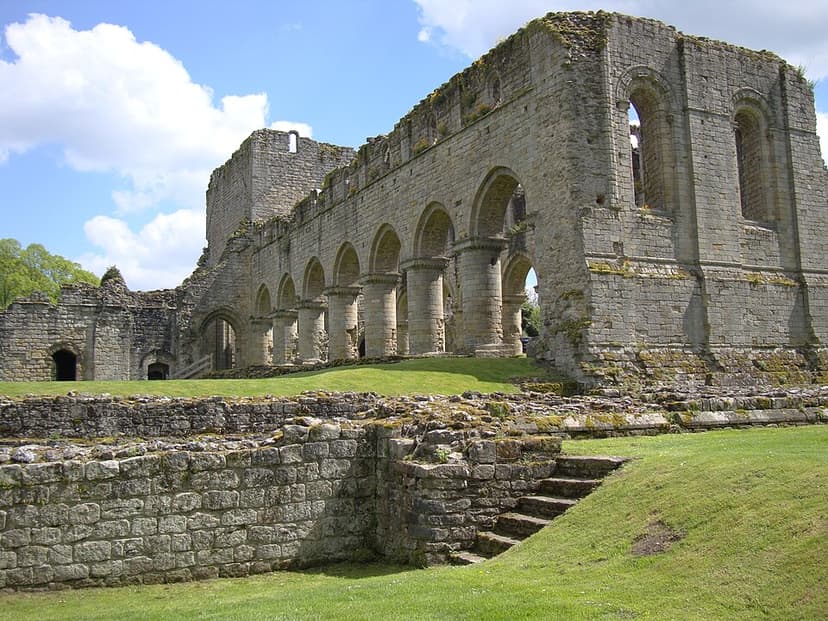
Buildwas Abbey was a significant Cistercian monastery in Shropshire, England, founded in 1135. It experienced periods of substantial growth and wealth, becoming a center of learning with a notable library. Despite facing challenges from economic crises and conflict, it played a role in royal administration, particularly concerning Ireland and Wales, before its suppression in 1536. Today, substantial remains of the abbey church and monastic buildings are maintained by English Heritage.

Canonsleigh Abbey
Canonsleigh Abbey was an Augustinian priory founded around 1170 by Walter de Claville in Devon, England. Initially established for Augustinian canons regular, it was later refounded as a nunnery in 1284 by Maud de Lacy, Countess of Gloucester. The abbey was suppressed in 1539 during the Dissolution of the Monasteries, and today only a 15th-century gatehouse and scattered ruins remain.