
Canonsleigh Abbey
Canonsleigh Abbey was an Augustinian priory founded around 1170 by Walter de Claville in Devon, England. Initially established for Augustinian canons regular, it was later refounded as a nunnery in 1284 by Maud de Lacy, Countess of Gloucester. The abbey was suppressed in 1539 during the Dissolution of the Monasteries, and today only a 15th-century gatehouse and scattered ruins remain.
Key Facts
- ›Founded around 1170 as a priory for Augustinian canons regular.
- ›Refounded as a nunnery in 1284 by Maud de Lacy, Countess of Gloucester.
- ›Suppressed in 1539 during the Dissolution of the Monasteries.
- ›Surviving remains include a 15th-century gatehouse and scattered ruins.
- ›The original Anglo-Saxon name of the site was 'Leigh'.

Gothic
15th-Century Gatehouse, Ruined Buildings, Remains of A Reredorter
- Priory of the Blessed Virgin Mary and Saint John the Evangelist
- Abbey Church of the Blessed Virgin Mary, Saint John the Evangelist and Saint Etheldreda
- Leigh Canonicorum
- Canons' Leigh
Walter De Claville, Walter I De Claville, Maud De Lacy, Countess of Gloucester, Richard De Clare, 6th Earl of Gloucester, Sir Richard Grenville, Roger Blewett
Dissolution of the Monasteries
About Canonsleigh Abbey
Canonsleigh Abbey was an Augustinian priory situated in Canonsleigh, within the parish of Burlescombe, Devon, England. Its history spans from its founding in the late 12th century to its dissolution in the 16th century.
History and Foundations
The priory was established around 1170 by Walter de Claville, the lord of the manor of Burlescombe. He intended it for Augustinian canons regular and named it the Priory of the Blessed Virgin Mary and Saint John the Evangelist. The site itself, originally known as 'Leigh', was a sub-manor of Burlescombe. After the abbey's foundation, it became known as 'Canons' Leigh', and medieval scribes Latinized it to 'Leigh Canonicorum', meaning 'Leigh of the canons'.
By 1284, the number of canons had dwindled to seven. In response, Maud de Lacy, Countess of Gloucester, refounded the establishment as a nunnery in 1285. It was then known as the Abbey Church of the Blessed Virgin Mary, Saint John the Evangelist and Saint Etheldreda. The abbess received a licence to hold weekly markets in 1286. Historical records indicate that the establishment was not particularly wealthy, and the surviving documentation is limited.
Suppression and Later History
Canonsleigh Abbey met its end in 1539 during the Dissolution of the Monasteries under King Henry VIII. Following its suppression, the manors of Canonsleigh and Tynyell were purchased for nearly £1,170 in September 1546 by Sir Richard Grenville and Roger Blewett.
Surviving Remains
Today, the remains of Canonsleigh Abbey are scarce. The most significant surviving structure is a small 15th-century gatehouse, characterized by two large, blocked arches. To the east of the gatehouse, further fragments are visible, including ruined buildings, the remnants of a communal lavatory structure known as a reredorter, and what is believed to be the south wall of the eastern range of buildings.
Digital Resources and Public Access
While the physical remains are limited, digital resources offer insights into the abbey's past and present state. A 360° digital view provides panoramic images of the surviving structures and the surrounding landscape. The Historic England listing for Canonsleigh Abbey encourages public contributions of photographs, videos, and written accounts through the Missing Pieces Project to enrich the official record. Additionally, a digitized edition of the abbey's medieval records, the Cartulary of Canonsleigh Abbey, is available online, offering summaries of charters and other documents. The site is generally accessible to the public for visits, allowing exploration of the ruins and the historical landscape.
Source: Wikipedia ↗
Frequently Asked Questions
When was Canonsleigh Abbey founded?
Canonsleigh Abbey was founded in about 1170. It was initially established as a priory for Augustinian canons regular.
What religious order was Canonsleigh Abbey part of?
Canonsleigh Abbey was first founded for Augustinian canons regular. Later, it was refounded as a nunnery.
What happened to Canonsleigh Abbey?
The Abbey was suppressed in 1539 during the Dissolution of the Monasteries. Its possessions were later sold.
What remains of Canonsleigh Abbey today?
The remains consist of a small 15th-century gatehouse with two large blocked arches. Further fragments include ruined buildings, the remains of a reredorter, and a possible south wall of the eastern range.
Who refounded Canonsleigh Abbey as a nunnery?
Maud de Lacy, Countess of Gloucester, refounded the establishment as a nunnery in 1284. She was the former wife of Richard de Clare, 6th Earl of Gloucester.
Related Monasteries

Ankerwycke Priory
Ankerwycke Priory was a small and relatively poor Benedictine nunnery established around 1160 in Buckinghamshire, England. Dedicated to St. Mary Magdalene, it held lands across several counties. Dissolved in 1536, its revenues were transferred to Bisham Abbey, and the priory site later saw the construction of a manor house. Today, only a small section of ruins remains, situated in Berkshire.
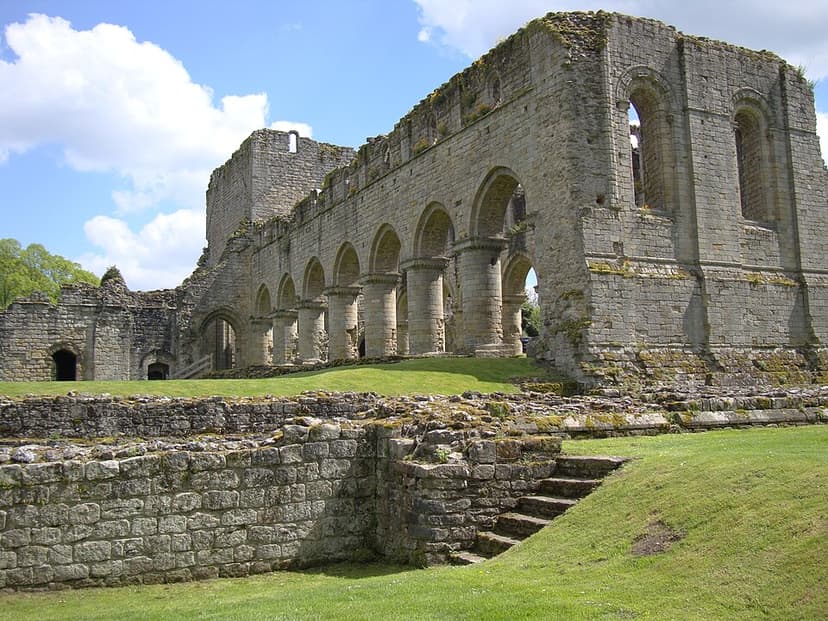
Buildwas Abbey
Buildwas Abbey was a significant Cistercian monastery in Shropshire, England, founded in 1135. It experienced periods of substantial growth and wealth, becoming a center of learning with a notable library. Despite facing challenges from economic crises and conflict, it played a role in royal administration, particularly concerning Ireland and Wales, before its suppression in 1536. Today, substantial remains of the abbey church and monastic buildings are maintained by English Heritage.

Byland Abbey
Byland Abbey was a Savigniac and later Cistercian monastic institution founded in 1135 in North Yorkshire, England. Despite an unstable early history with multiple relocations, it eventually settled at its final site near Coxwold. Once established, it became a significant religious and economic center, renowned for its sheep rearing and wool exports, and boasting a church described as one of the finest 12th-century structures in Europe. Though dissolved in 1538, extensive ruins remain, including the west front of the church with its notable rose window, and the site is maintained by English Heritage.