
Savvino-Storozhevsky Monastery
The Savvino-Storozhevsky Monastery is a significant Russian Orthodox monastery located in Zvenigorod, west of Moscow. Founded in 1398 by Prince Yuri of Zvenigorod at the request of Saint Savva, it served as a spiritual center and a defensive outpost. The monastery later became a favored suburban residence for Tsar Alexis and continued to be visited by Russian royalty for blessings before coronations, solidifying its importance as a major religious and historical landmark.
Key Facts
- ›Founded in 1398 by Prince Yuri of Zvenigorod at the behest of Saint Savva.
- ›Saint Savva, a disciple of Sergius of Radonezh, is interred in the Nativity Cathedral.
- ›Served as a military picket defending the Grand Duchy of Moscow in the 15th-17th centuries.
- ›Became a suburban residence for Tsar Alexis in the 17th century, with palaces and fortified walls constructed.
- ›All subsequent Russian monarchs visited the monastery for pre-coronation blessings.
- ›Experienced significant damage and desecration during the Soviet era, with relics returned in 1998.

Russian Medieval, Baroque
Nativity Cathedral, Tsar Alexis' Palace, Large Belfry, Sentry Tabernacle
Storozhi Monastery of St. Savva
Saint Savva of Storozhi, Prince Yuri of Zvenigorod, Tsar Alexis, Princess Sophia
- Founded By Prince Yuri of Zvenigorod and Saint Savva
- Granted Villages, Land, and Forest Tenures By Prince Yuri
- Became Tsar Alexis' Suburban Residence
- Confrontation With Italian Corps During Napoleonic Wars
- Seizure of Relics and Desecration By Bolsheviks
- Relics Returned To the Monastery
About Savvino-Storozhevsky Monastery
The Savvino-Storozhevsky Monastery is a prominent Russian Orthodox monastery situated in Zvenigorod, a town approximately 48 kilometers west of Moscow. Its spiritual significance is tied to the feast of the Nativity of the Theotokos, and it stands as a key landmark of the region.
History and Foundations
The monastery's origins trace back to 1398 when Prince Yuri of Zvenigorod invited Saint Savva, one of the first disciples of Sergius of Radonezh, to establish a monastic community. Initially, a wooden church dedicated to the Nativity of the Blessed Virgin Mary was built on the Storozhi hill. Saint Savva himself dug a small cave for prayer, and the community grew. In 1402, Prince Yuri granted the monastery villages, lands, and forests. Saint Savva was later interred in the white stone cathedral of the Virgin's Nativity in 1407, a structure that, despite a 1970s restoration, retains its historical form and features frescoes dating back to the 1420s.
Royal Residence and Defense
From the 15th to the 17th centuries, the monastery also served a defensive role as a military picket protecting the Grand Duchy of Moscow from the west. In the mid-17th century, Tsar Alexis chose the monastery as his suburban residence, commissioning an ashlar residence for himself and a smaller palace for his wife. He also ordered the churches to be fortified with stone walls and towers, echoing the architectural style of the Troitse-Sergiyeva Lavra. Notable additions from this period include a large belfry with a clocktower and a new gate church consecrated to the Holy Trinity. Princess Sophia later commissioned the Church of the Transfiguration and oversaw the rebuilding of Tsar Alexis' palace.
Imperial Significance and Napoleonic Wars
Following Tsar Alexis's era, the Savvino-Storozhevsky Monastery became one of Russia's most important religious sites. All subsequent Russian monarchs, from tsars and tsarinas to emperors and empresses, visited the monastery to pray and receive blessings before their coronations. The pathway from the Moscow Kremlin to Zvenigorod was historically known as the Tsar Road, now the Rublevskoe shosse. During the Napoleonic Wars in 1812, a skirmish occurred near the monastery walls. Local legend recounts that Prince Eugene Bograne, the commander of the Italian corps, was visited by Saint Savva in a dream, who promised him safe passage home if the monastery was spared from plunder, a promise Bograne reportedly kept.
20th Century and Restoration
The 20th century brought significant hardship to the monastery. In 1918, attempts by the Bolsheviks to seize Saint Savva's relics resulted in violence. The monastery was looted, including Saint Savva's tomb, and the monks were forced out, leaving the cathedral in disrepair. The main bell was destroyed in 1941. In 1985, the complex was assigned to the Danilov Monastery in Moscow, and a significant step towards its revival occurred in 1998 when Saint Savva's relics were returned.
Tourism and Cultural Connections
Today, the Savvino-Storozhevsky Monastery is a popular tourist attraction and a destination for pilgrims, easily accessible from Moscow. A hotel operated by the monastery provides accommodation. The Tsarina's palace within the complex houses exhibitions managed by the Zvenigorod museum, focusing on local history, royal life, and religious icons. Reflecting a tradition found in some Western European monasteries, the Savvino-Storozhevsky monastery also operates a brewery producing kvas and sbiten, as well as a bakery. Two canteens are available for visitors.
In filmmaking, director Andrei Tarkovsky chose a dacha near the monastery as the location for the opening and closing scenes of his 1972 film "Solaris."
Source: Wikipedia ↗
Frequently Asked Questions
When was the Savvino-Storozhevsky Monastery founded?
The Savvino-Storozhevsky Monastery was founded in 1398. Prince Yuri of Zvenigorod requested Saint Savva, a prominent disciple of Sergius of Radonezh, to establish a monastic community.
What is the historical significance of the monastery?
The monastery holds significant historical importance as it served as a military picket defending Moscow and later became a favored suburban residence for Tsar Alexis. It was a traditional site for Russian royalty to receive blessings before coronations.
Who is buried at the Savvino-Storozhevsky Monastery?
Saint Savva of Storozhi, the monastery's founder, is interred within the white stone cathedral of the Virgin's Nativity. His tomb was made of gold-plated silver.
What happened to the monastery during the 20th century?
During the Soviet era, the monastery was ransacked and pillaged, and the monks were expelled. The main bell was destroyed in 1941, and much of the original frescoes were lost. St. Savva's relics were returned in 1998.
Is the Savvino-Storozhevsky Monastery open to visitors?
Yes, the monastery is a well-known tourist attraction and a site of pilgrimage. It is accessible from Moscow and offers accommodation for visitors. Exhibitions on local history and religious icons are also available.
What are some notable architectural features of the monastery?
Notable features include the original white stone cathedral of the Virgin's Nativity, which still stands. The monastery also boasts a large belfry erected in the 1650s with three tents and a clocktower, built during Tsar Alexis's reign.
Related Monasteries
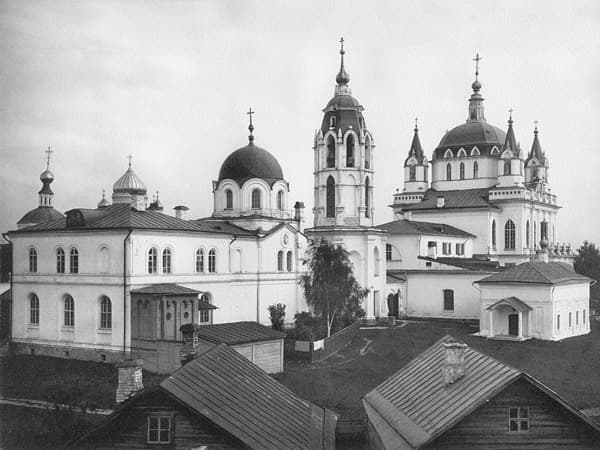
Conception Convent
The Conception Convent, also known as the Zachatyevsky Monastery, is a Russian Orthodox convent located on the Moskva River in Moscow. Originally believed to occupy the site of the oldest nunnery in Moscow, it was reestablished in 1995 after being closed by the Bolsheviks in 1918 and undergoing significant damage and repurposing during the Soviet era. Its reconstruction has seen the rebuilding of its katholikon in a Russian Revival style.
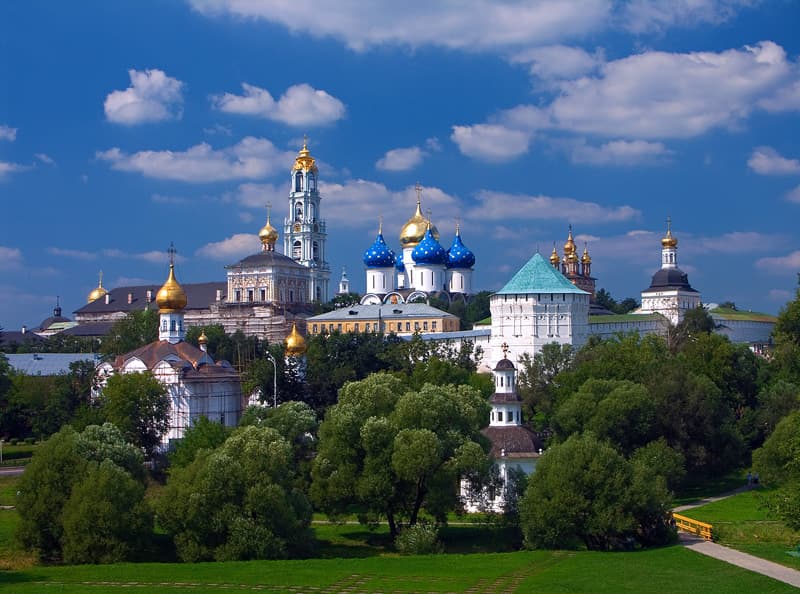
Troitse-Sergiyeva Lavra
The Trinity Lavra of St. Sergius, also known as the Trinity Monastery of St. Sergius, is the most important Russian monastery and the spiritual heart of the Russian Orthodox Church, located in Sergiyev Posad. Founded in 1337 by St. Sergius of Radonezh, it has played a pivotal role in Russian history, serving as a spiritual center, a site of royal baptisms and services, and a fortress during sieges. The monastery boasts a rich architectural heritage and is currently home to over 300 monks.

Vysotsky Monastery
Vysotsky Monastery is a Russian Orthodox monastery situated on the high left bank of the Nara River in Serpukhov. Founded in the 1370s by Vladimir the Bold, it initially served as a vital border fortress defending Moscow's southern approaches. The monastery has a rich history marked by destruction and rebuilding, notable patrons, and significant religious artifacts, making it a prominent spiritual and historical site.