
Danilov Monastery
Danilov Monastery, also known as Svyato-Danilov Monastery, is a historic Russian Orthodox monastery located in Moscow. Traditionally founded in the late 13th century by Prince Daniel of Moscow, it has a complex history involving periods of decline, rebuilding, and significant damage. Since 1983, it has served as the spiritual and administrative headquarters of the Russian Orthodox Church and the official residence of the Patriarch of Moscow and all Rus'.
Key Facts
- ›Traditionally founded in the late 13th century by Prince Daniel of Moscow, son of Alexander Nevsky.
- ›Served as a military camp during conflicts, including the Time of Troubles.
- ›Reopened in 1983 and became the administrative center of the Russian Orthodox Church.
- ›Its katholikon is unique in Moscow for featuring two distinct churches above a ground-floor church.
- ›Its historic bell set was gifted to Harvard University in the 1930s and returned to the monastery in 2007-2008.

17th-Century Defensive, Neoclassical, Baroque
- Katholikon With Unique Multi-Level Churches
- 17th-Century Defensive Towers and Walls
- Residence of the Patriarch of Moscow and All Rus'
Svyato-Danilov Monastery, Holy Danilov Monastery
Prince Daniel of Moscow, Alexander Nevsky, Nikephoros Theotokis, Nikolai Gogol, Nikolai Yazykov, Vasili Perov, Nikolai Rubinstein, Vladimir Solovyov, Charles R. Crane, Viktor Vekselberg
- Founded By Prince Daniel of Moscow
- Used As A Mobile Camp During the Crimean Khan's Approach In 1591
- Site of Clashes During the Time of Troubles
- Damaged In 1610
- Ransacked By the French Army In 1812
- Closed In 1930 and Used As A Nkvd Facility
- Returned To the Moscow Patriarchy In 1983
- Restored In 1988
- Bells Returned From Harvard University In 2007-2008
About Danilov Monastery
Danilov Monastery, also known as Svyato-Danilov Monastery, is a significant Russian Orthodox monastery situated on the right bank of the Moskva River in Moscow. Its origins are traditionally traced to the late 13th century, with claims that it was founded by Prince Daniel of Moscow, son of Alexander Nevsky. Prince Daniel is said to have taken monastic vows shortly before his death in 1303 and to have been buried at the site, leading to the Russian Orthodox Church venerating him as a saint.
History and Development
The monastery's early history is marked by relocation; Daniel's successors moved the monastery to the Kremlin, leaving only a graveyard at the original location. In 1560, Ivan the Terrible initiated its re-establishment by inviting monks to settle there again. The monastery played a role in military events, notably being fortified as a camp in 1591 during the approach of Crimean khan Kaza Giray's armies and experiencing damage in 1610 during the Time of Troubles. By the early 17th century, it was enclosed by a brick wall with seven towers.
Throughout the centuries, the number of resident monks varied, with records showing 30 monks in 1710 and a decline to twelve by 1764, though it rose to seventeen by 1900. Notable figures, such as the Greek scholar Nikephoros Theotokis, resided there in their later years. An almshouse for elderly women, later converted for clergymen and their widows, was established in 1805. The monastery was ransacked by the French army in 1812, though its treasury had been moved prior to the occupation.
In the latter half of the 19th century, the Danilov Monastery cemetery became the final resting place for many prominent Russian figures, including writers, artists, and scientists. However, most of these remains were later transferred to Novodevichy Cemetery during the Soviet era.
20th Century and Revival
Following the October Revolution, the monastery was closed in 1930 and repurposed by the NKVD as a reception facility for detained children. It remained the last monastery in Moscow to be closed. A pivotal moment occurred in 1983 when Danilov Monastery became the first in Moscow to be returned to the Moscow Patriarchy. It was subsequently restored in 1988, and since then, it has functioned as the spiritual and administrative headquarters of the Russian Orthodox Church and the official residence of the Patriarch of Moscow and all Rus'.
Architecture and Bells
The surviving structures include 17th-century defensive towers and walls, the main church (katholikon), and the Neoclassical cathedral of the Holy Trinity. The Baroque gate church and belltower of St Simeon Stylites are also notable. The katholikon is architecturally distinctive, being the only building in Moscow to feature two separate churches above a ground-floor church, dedicated to the Holy Fathers of the First seven ecumenical councils. Its lower temple was built as a church dedicated to the Intercession.
A unique aspect of the monastery's history involves its bell set. When closed in the 1920s and 30s, the bells were purchased by American industrialist Charles R. Crane and donated to Harvard University. Following calls for their return in the 1980s, the 18 bells were repatriated to the Russian Orthodox Church between 2007 and 2008, with replacements cast in Russia for Harvard.
Source: Wikipedia ↗
Frequently Asked Questions
When was Danilov Monastery founded?
The monastery is traditionally claimed to have been founded in the late 13th century by Prince Daniel of Moscow. He is said to have taken monastic vows and been buried there shortly before his death in 1303.
What is the significance of Danilov Monastery today?
Since 1983, Danilov Monastery has functioned as the headquarters of the Russian Orthodox Church. It is also the official residence of the Patriarch of Moscow and all Rus', serving as a vital spiritual and administrative center.
What are some notable architectural features of Danilov Monastery?
The monastery features 17th-century defensive towers and walls. Its main church, the katholikon, is architecturally unique in Moscow for its structure of two distinct churches built above a ground-floor church. Other buildings include Neoclassical and Baroque structures.
What happened to the bells of Danilov Monastery?
During periods of closure in the 20th century, the monastery's bells were saved from being melted down and were purchased by an American industrialist. They were donated to Harvard University, but were returned to the monastery in 2007-2008.
Who is the patron saint associated with Danilov Monastery?
The monastery is associated with Saint Daniel of Moscow, the son of Alexander Nevsky, who is traditionally credited with its founding. He is venerated by the Russian Orthodox Church.
Related Monasteries
Krutitsy
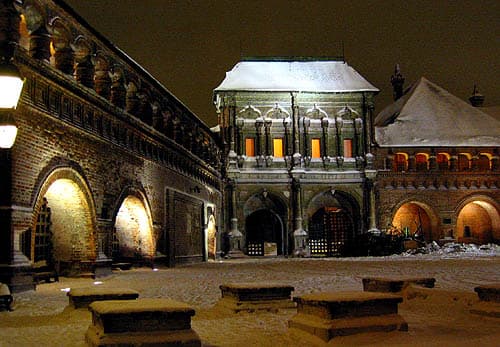
Krutitsy Metochion is an active ecclesiastical estate of the Russian Orthodox Church located in Moscow, Russia, established in the late 13th century. It features historical buildings from the late 17th century, erected on earlier foundations, and experienced a period of prosperity before being shut down by imperial authorities in the 1780s. After serving as a military warehouse for nearly two centuries, it was restored by Petr Baranovsky and gradually reopened to the public, eventually being returned to the Church in the 1990s.

Kamenny Monastery
Spas-Kamenny Monastery, the first stone monastery of the Russian North, was established on a small island in Kubensky Lake. Founded in 1269, it became a significant spiritual center, known for adopting the coenobitic rule of Mount Athos and for its historical struggle against paganism. Despite periods of decline and destruction, including fires and Soviet closure, the monastery has seen a recent revival with plans for restoration.

Antonievo-Siysky Monastery
The Antonievo-Siysky Monastery is a historic Russian Orthodox monastery located in the Arkhangelsk Oblast of Russia. Founded in 1520 by Saint Antonius of Siya, it grew significantly, becoming a prominent spiritual and economic center in the Russian North, particularly known for its salt trade and rich library. The monastery played a role in Russian history, notably as a place of exile for Feodor Romanov, who later became Patriarch of Moscow and whose son founded the Romanov dynasty.