
Krutitsy
Krutitsy Metochion is an active ecclesiastical estate of the Russian Orthodox Church located in Moscow, Russia, established in the late 13th century. It features historical buildings from the late 17th century, erected on earlier foundations, and experienced a period of prosperity before being shut down by imperial authorities in the 1780s. After serving as a military warehouse for nearly two centuries, it was restored by Petr Baranovsky and gradually reopened to the public, eventually being returned to the Church in the 1990s.
Key Facts
- ›Originally established in the late 13th century, with significant buildings dating from the late 17th century.
- ›Served as a military warehouse for nearly two centuries after being shut down by imperial authorities.
- ›Restored by Petr Baranovsky and reopened to the public after World War II.
- ›Returned to the Russian Orthodox Church between 1991 and 1996.
- ›Contains the Dormition Cathedral, which features both a lower winter church and an upper summer church.
- ›The Metropolitan's Gallery and Teremok tower, designed by Osip Startsev and Illarion Kovalyov, are notable architectural elements.
Baroque
Dormition Cathedral, Metropolitan's Chamber, Metropolitan's Gallery, Teremok Tower, Moscow's First Fountain
Krutitsy Patriarchal Metochion
Prince Daniel of Moscow, Bishop Vassian, Metropolitans of Krutitsy, Patriarch Nikon, Metropolitan Paul Ii, Metropolitan Ignat Smola, Grand Duke Alexander, Petr Baranovsky, Osip Startsev, Illarion Kovalyov, Stepan Ivanov
- Establishment of the Diocese of Sarai In 1261
- Relocation of the Diocese To Moscow In 1454
- Krutitsy Serving As the Main Cathedral of Muscovy During the Time of Troubles
- Disputes Between Patriarch Nikon and Old Believers In the 1650s
- Imperial Authorities Shutting Down the Abbey In 1785
- Fire of Moscow Damaging the Dormition Cathedral
- Restoration Efforts Lasting Over Thirty Years From 1833 To 1868
- Dormition Cathedral Closing In 1924 and Being Looted
- Petr Baranovsky Making Krutitsy His Restoration Workshop Headquarters In 1947
- Return of Buildings To the Church Between 1991 and 1996
About Krutitsy
Krutitsy Metochion
Krutitsy Metochion is an active ecclesiastical estate belonging to the Russian Orthodox Church, situated in the Tagansky District of Moscow, Russia, approximately three kilometers southeast of the Kremlin. The name "Krutitsy" refers to the steep river banks of the Yauza River, in an area that historically held strategic importance. The metochion's origins trace back to the late 13th century, with its most prominent historical buildings erected in the late 17th century on the foundations of earlier structures from the 16th century.
History and Significance
The establishment of Krutitsy is closely linked to the Russian Orthodox Church's efforts to serve the Slavic population within the Golden Horde. Following the Mongol invasion, the Diocese of Sarai was established, and Prince Daniel of Moscow donated lands on the Moscow River banks for its development. By the 15th century, as the Golden Horde fragmented, the diocese relocated to Moscow, with its bishop becoming known as the Bishop of Krutitsy. The metochion later gained further prominence, with its bishops styled as Metropolitans of Krutitsy.
Krutitsy experienced a period of significant prosperity, particularly in the 17th century, coinciding with the rule of Metropolitan Paul II, who initiated an ambitious construction program. During the Time of Troubles, the Dormition Cathedral of Krutitsy temporarily served as the main cathedral of Muscovy. The 1650s also saw Krutitsy as a site of theological disputes, including those involving Patriarch Nikon and the Old Believers.
Demise and Restoration
The metochion's fortunes declined significantly after imperial reforms in the early 18th century. By the late 1780s, the Diocese of Krutitsy was abolished, and the abbey was shut down, with its property passing to the Imperial Military. The site was repurposed as a military base, and the Dormition Cathedral suffered damage, particularly during the Fire of Moscow in 1812, leading to orders for its demolition that were eventually rescinded. Despite continued military occupation and the construction of warehouses and barracks, restoration efforts began in the mid-19th century under the patronage of Grand Duke Alexander.
Following the Russian Revolution, the site continued to be used by the military, with churches closed and repurposed. A pivotal moment in Krutitsy's revival came in 1947 when Petr Baranovsky, a notable Russian restorer, established his workshop there. Extensive renovation work was carried out in the latter half of the 20th century. Since the 1990s, Krutitsy has been returned to the Russian Orthodox Church and functions as the Patriarchal Metochion, with ongoing restoration efforts at certain structures.
Architectural and Visitor Information
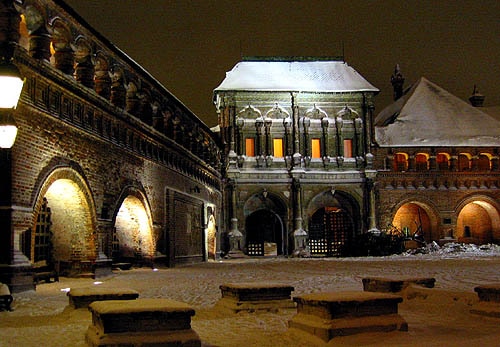
The memorial buildings at Krutitsy Metochion represent significant examples of 17th-century Russian ecclesiastical architecture. These include the five-domed Dormition Cathedral, the Resurrection Church, the Metropolitan's Chamber, and the striking Metropolitan's Gallery with its Teremok tower, designed by architects Osip Startsev and Illarion Kovalyov. The metochion is accessible to the public, managed by clergy, and visitors are expected to adhere to specific rules, such as respecting photography policies and leaving at the end of evening services. Restoration work continues on some of its structures, preserving its historical and spiritual significance.
Source: Wikipedia ↗
Frequently Asked Questions
When was Krutitsy Metochion founded?
Krutitsy Metochion was established in the late 13th century. The first church on the new site was completed in 1272, following a donation of land by Prince Daniel of Moscow.
What happened to Krutitsy Metochion after the 18th century?
After being abolished as a diocese and shut down as an abbey in 1785, Krutitsy became a military base. It suffered damage from fires and was used for military storage and barracks, with some parts rebuilt or repurposed.
Who was responsible for the restoration of Krutitsy Metochion?
The restoration of Krutitsy Metochion was significantly undertaken by Petr Baranovsky, a renowned Russian restorer, who made it the headquarters of his workshop in 1947. Restoration efforts continued through the 1960s, 1970s, and 1980s.
Is Krutitsy Metochion currently active?
Yes, Krutitsy Metochion is an operating ecclesiastical estate of the Russian Orthodox Church. It was returned to the Church and re-established as the personal metochion of the Patriarch of Moscow and all Russia in the 1990s.
Can the public visit Krutitsy Metochion?
Yes, Krutitsy Metochion is accessible to the public, though certain rules are enforced. Visitors should be aware of photography restrictions and are expected to leave at the end of evening mass.
What are some of the key historical buildings at Krutitsy Metochion?
Key memorial buildings include the Dormition Cathedral with its lower and upper churches, the Resurrection Church, the Metropolitan's Chamber, and the Metropolitan's Gallery with the Teremok tower. The Riverside Dormitory is also a significant structure.
Related Monasteries

Danilov Monastery
Danilov Monastery, also known as Svyato-Danilov Monastery, is a historic Russian Orthodox monastery located in Moscow. Traditionally founded in the late 13th century by Prince Daniel of Moscow, it has a complex history involving periods of decline, rebuilding, and significant damage. Since 1983, it has served as the spiritual and administrative headquarters of the Russian Orthodox Church and the official residence of the Patriarch of Moscow and all Rus'.

Kamenny Monastery
Spas-Kamenny Monastery, the first stone monastery of the Russian North, was established on a small island in Kubensky Lake. Founded in 1269, it became a significant spiritual center, known for adopting the coenobitic rule of Mount Athos and for its historical struggle against paganism. Despite periods of decline and destruction, including fires and Soviet closure, the monastery has seen a recent revival with plans for restoration.

Antonievo-Siysky Monastery
The Antonievo-Siysky Monastery is a historic Russian Orthodox monastery located in the Arkhangelsk Oblast of Russia. Founded in 1520 by Saint Antonius of Siya, it grew significantly, becoming a prominent spiritual and economic center in the Russian North, particularly known for its salt trade and rich library. The monastery played a role in Russian history, notably as a place of exile for Feodor Romanov, who later became Patriarch of Moscow and whose son founded the Romanov dynasty.