
Antonievo-Siysky Monastery
The Antonievo-Siysky Monastery is a historic Russian Orthodox monastery located in the Arkhangelsk Oblast of Russia. Founded in 1520 by Saint Antonius of Siya, it grew significantly, becoming a prominent spiritual and economic center in the Russian North, particularly known for its salt trade and rich library. The monastery played a role in Russian history, notably as a place of exile for Feodor Romanov, who later became Patriarch of Moscow and whose son founded the Romanov dynasty.
Key Facts
- ›Founded in 1520 by Saint Antonius of Siya.
- ›Located in Kholmogorsky District of Arkhangelsk Oblast, Russia.
- ›Benefited from trade routes connecting Archangel with Moscow.
- ›Exiled Feodor Romanov (later Patriarch Philaret) in 1599.
- ›Experienced a period of closure from 1923 to 1992.
- ›Its library contained significant historical texts, including the Siysky Gospel from 1339.

16th-Century Russian, 17th-Century Russian
Siya Zakaznik Nature Protected Area, Monastic Library, Treasury With Medieval Jewelry, Siysky Gospel, Album of 500 Western Religious Etchings
Siya Monastery of St. Antonius
Saint Antonius of Siya, Feodor Romanov, Mikhail Romanov, Ivan the Terrible, Feodor
Founded By Saint Antonius of Siya, Exile of Feodor Romanov, Construction of the Katholikon, Disbandment and Subsequent Reopening
About Antonievo-Siysky Monastery
The Antonievo-Siysky Monastery, also known as the Siya Monastery of St. Antonius, is a historically significant Russian Orthodox monastery nestled deep within the woods of Arkhangelsk Oblast, Russia. Founded in 1520 by Saint Antonius of Siya, its remote location, approximately 90 km south of Kholmogory, did not hinder its growth into one of the foremost centers of Christianity in the Russian North.
Early Growth and Royal Patronage
Following Saint Antonius's death in 1556, the monastery flourished, partly due to its involvement in the salt trade with Western Europe. Its strategic position on a river route connecting to the Northern Dvina, and a station on the trade route between Archangel and Moscow, facilitated its economic development. Ivan the Terrible and his son Feodor recognized its importance, granting the monastery significant privileges and land. By 1579, it possessed extensive ploughlands stretching towards Kargopol, demonstrating its considerable territorial holdings.
A Place of Exile and Royal Succession
The Antonievo-Siysky Monastery gained historical prominence in 1599 when Boris Godunov exiled his political rival, Feodor Romanov, to its secluded grounds. While many of his relatives faced harsher fates, Feodor took monastic vows as Philaret and eventually rose to become the hegumen (abbot) of the monastery. His son, Mikhail, would later establish the Romanov dynasty of Russian tsars, making the monastery indirectly instrumental in a pivotal moment of Russian history.
Architectural Development and Cultural Treasures
The 17th century saw continued prosperity and architectural expansion. The large katholikon was constructed between 1587 and 1608, followed by the tent-like church and refectory completed by 1644, and a belfry added in 1652. The monastery's library was renowned as one of the richest in Russia, housing invaluable texts such as the Siysky Gospel from 1339 and a rare 16th-century album of Western religious etchings adapted for Orthodox use. Its treasury was also noted for its collection of medieval jewelry.
Disbandment and Revival
In 1923, during the Soviet era, the monastery was disbanded. Its precious library and treasury were dispersed to Moscow and Arkhangelsk, while the monastery's medieval buildings were utilized for secular purposes, including a sanatorium and a kolkhoz. The monastic community was readmitted to the site in 1992, and efforts immediately began to undertake emergency repairs and restore the historic complex. Today, the Antonievo-Siysky Monastery stands as an active religious site undergoing a significant revival.
Source: Wikipedia ↗
Frequently Asked Questions
When was the Antonievo-Siysky Monastery founded?
The Antonievo-Siysky Monastery was founded in 1520 by Saint Antonius of Siya. This marked the beginning of its long history as a significant spiritual center in the Russian North.
What is the significance of the Antonievo-Siysky Monastery?
The monastery became a prominent center of Christianity in the Russian North, growing on the salt trade and receiving privileges from Ivan the Terrible. It also served as a place of exile for notable figures, including Feodor Romanov, whose son later established the Romanov dynasty.
What happened to the monastery after 1923?
The monastery was disbanded in 1923. Its valuable library and treasury were relocated, and the medieval buildings were repurposed for secular uses such as a sanatorium and a kolkhoz.
Is the Antonievo-Siysky Monastery currently active?
Yes, monks were readmitted to the grounds in 1992, and they immediately began emergency repairs. The monastery is now active and undergoing restoration.
What architectural styles are present at the monastery?
Key structures like the katholikon were built between 1587 and 1608. The tent-like church and refectory were completed by 1644, and a belfry was added in 1652, reflecting 16th and 17th-century Russian ecclesiastical architecture.
Related Monasteries

Goritsky Monastery (Goritsy)
The Goritsky Monastery of Resurrection is a Russian Orthodox convent located in the village of Goritsy, Vologda Oblast. Founded in 1544 by Yefrosinya Staritskaya, it has a complex history involving royal figures, forced monasticism, and periods of closure and revival. Since the 1990s, a small community of nuns has resided there, and parts of the complex are managed by a historical museum.

Nikolo-Perervinsky Monastery
Nikolo-Perervinsky Monastery is a historical Orthodox monastery in Moscow, Russia, dedicated to Saint Nicholas the Miracle-Worker. First mentioned in 1623, its name is linked to the Moskva River's changing course. The monastery experienced significant expansion in the late 17th century and housed a theological seminary from 1775. It was closed in 1928 but reopened for services in 1991.
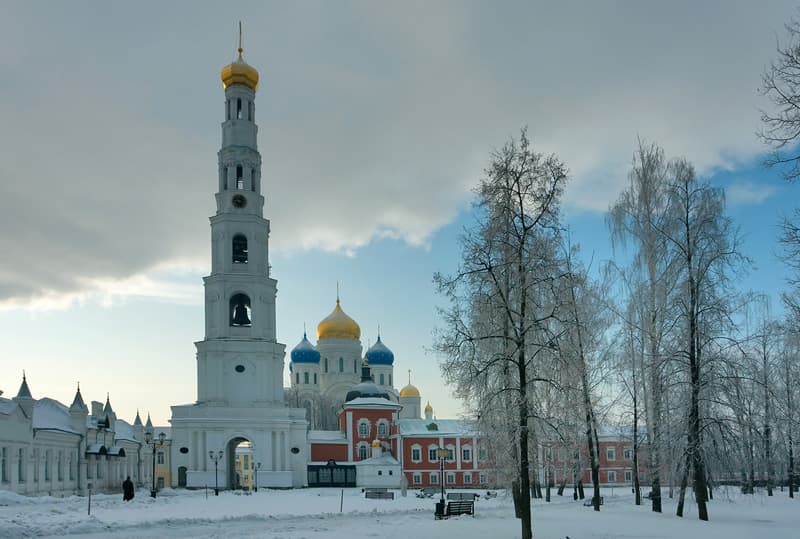
Nikolo-Ugresh monastery
The Nikolo-Ugreshsky Monastery is a historic Russian Orthodox monastery located in Dzerzhinsky, a suburb of Moscow. First documented in 1521, it played a role in defending the Russian capital and was significantly expanded in the 17th century. After being closed and repurposed following the Russian Revolution, it was returned to the Russian Orthodox Church in 1991 and has since undergone restoration, now housing a seminary, museums, and serving as a metropolitan residence.