
Priory of Le Plessis-Grimoult
The Priory of Le Plessis-Grimoult was an Augustinian monastery established in the 12th century in Normandy, France. While the church and priory buildings were constructed in the late 13th century, only the priory's gate and remnants of the cloister and other structures now remain. It gained historical note when Louis XIV appointed Jacques-Bénigne Bossuet as its prior in the late 17th century, providing him with income during his tenure as tutor to the Grand Dauphin.
Key Facts
- ›Established in the 12th century in Le Plessis-Grimoult, Calvados, Normandy.
- ›Ruins were listed as a monument historique in 1928.
- ›The church building and priory were constructed in the late 13th century.
- ›Jacques-Bénigne Bossuet served as prior from 1671.
- ›The priory had 35 priors before its nationalization during the French Revolution.

Gothic
Priory Gate, Remnants of Cloister, Fortified Garden Archaeological Site
Prieuré Du Plessis-Grimoult
Grimoult Du Plessis, William the Bastard, Odo, Bishop of Bayeux, Richard Samson, Guillaume Causson, Jacques-BéNigne Bossuet, Julian De Saint-Germain
- Grimoult Du Plessis Executed For Coup Attempt
- Church Dedicated To Saint Stephen
- Community of Canons Regular Brought To Le Plessis-Grimoult
- Canons Moved To Champ Osburt
- Canons Moved To ChâTeau De Vire
- Church Building and Priory Constructed
- Bossuet Appointed Prior
- Dispute With Julian De Saint-Germain Over Tithes
- Nationalization of Church Property During the French Revolution
About Priory of Le Plessis-Grimoult
The Priory of Le Plessis-Grimoult, located in Le Plessis-Grimoult in the Calvados department of Normandy, France, was an Augustinian monastery founded in the 12th century. The site holds historical significance, with its ruins designated as a monument historique in 1928, and its nearby archaeological site and fortified garden remains recognized in 1996. While the original establishment dates to the 12th century, the primary church building and priory structure were erected in the late 13th century.
History and Establishment
The origins of the priory are intertwined with local baronial history. In 1047, Grimoult du Plessis was executed for an attempted coup against William the Bastard, Duke of Normandy, and his lands were subsequently granted to Odo, the Bishop of Bayeux. The local church was dedicated to Saint Stephen in 1131. Around 1135, Richard Samson, also known as Richard of Dover, a former chaplain to William, established a community of canons regular at Le Plessis-Grimoult, becoming its first prior.
Subsequent moves of the canons occurred, with the church and priory in their current location being built under Prior Guillaume Causson in the late 13th century. However, only the priory's gate remains standing today.
Notable Priorship and Later History
In 1671, Jacques-Bénigne Bossuet, a prominent theologian and bishop, was appointed as the prior of Le Plessis-Grimoult by Louis XIV. This position provided Bossuet with a necessary income while he served as tutor to the Grand Dauphin, without demanding excessive time commitment. During his tenure, Bossuet was involved in a dispute over tithes with Julian de Saint-Germain, the priest of Maisoncelles-la-Jourdan, which was settled by a trial in 1677. The priory had a succession of 35 priors from its foundation until the nationalization of church property during the French Revolution.
Architectural Remains
By 1830, the priory's structures were largely in disrepair. Descriptions from that era note a transept with an apse, 13th-century columns with capitals, and a choir older than the tower. The roof was absent, and the western wall of the cloister, along with two doors opening onto its gallery, were still standing. Capitals of columns in other ground-floor rooms were estimated to be from the 14th century, and a fireplace in a room believed to be the kitchen was noted. The priory also served a significant number of surrounding parishes.
Source: Wikipedia ↗
Frequently Asked Questions
When was the Priory of Le Plessis-Grimoult founded?
The Priory of Le Plessis-Grimoult was established in the 12th century. The current church building and priory were constructed later, in the late 13th century.
What is the current state of the Priory of Le Plessis-Grimoult?
The Priory of Le Plessis-Grimoult is now a ruin. Its ruins were recognized as a national heritage site in 1928, with further archaeological sites and garden remains listed in 1996.
Who was Jacques-Bénigne Bossuet in relation to the priory?
Jacques-Bénigne Bossuet, a prominent French theologian and bishop, was appointed as the prior of Le Plessis-Grimoult in 1671 by Louis XIV. This appointment provided him with a steady income while he served as tutor to the Grand Dauphin.
What architectural features remain from the priory?
Today, only the priory's gate remains standing. Architectural descriptions from 1830 mention remnants of a transept, apse, columns with capitals from the 13th to 15th centuries, the western wall of the cloister, and a fireplace in a room believed to be the kitchen.
Related Monasteries

Abbaye Blanche
The Abbaye Blanche was a Benedictine nunnery founded in 1112 in Mortain, France, by Saint Vitalis. It was established for women with his sister, Adelina, as its first abbess. The community followed a strict interpretation of the Rule of Saint Benedict and later joined the Cistercian order in 1147. Though much has been lost to time, remnants of its Romanesque and Early Gothic architecture endure.
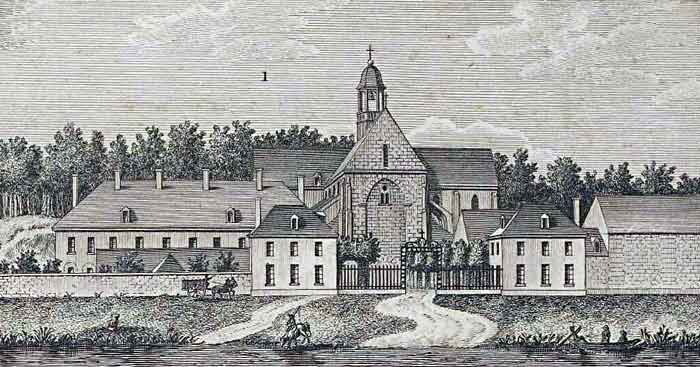
Barbeau Abbey
Barbeau Abbey was a Cistercian monastery founded in 1147 by King Louis VII of France. Located in Fontaine-le-Port, Seine-et-Marne, it was a site of royal burial and experienced periods of prosperity and destruction throughout its history, including the Hundred Years' War and the French Revolution. Today, few original structures remain, with a riding school occupying the former site.

Bellevaux Abbey
Bellevaux Abbey was a Cistercian monastery established in 1120 in Franche-Comté, France, by Pons de Morimond. It was a significant religious house, connected to local nobility and notable figures like Burchard of Bellevaux and Peter of Tarentaise. Though suppressed in 1790 and largely demolished shortly after, its history includes periods of destruction and rebuilding, with the final structures erected by Abbot Louis Albert de Lezay-Marnésia. The site later housed a Trappist community before being sold to private owners.