
Pittenweem Priory
Pittenweem Priory was an Augustinian priory established in the village of Pittenweem, Fife, Scotland. Initially linked to Benedictines from Reading Abbey, it later became the primary seat for canons of St. Andrews Cathedral Priory. The priory is notable for its association with the sacred cave of Saint Fillan and the survival of significant medieval structures like its east gatehouse and the 'Great House'.
Key Facts
- ›Founded as a Benedictine priory by monks from Reading Abbey around 1145.
- ›Became the chief seat for canons of St. Andrews Cathedral Priory after 1288.
- ›Associated with the sacred cave of Saint Fillan, which was rededicated as a chapel in 1935.
- ›The 15th-century fortified east gatehouse of the priory survives.
- ›The 'Great House', a well-preserved late medieval structure, likely served as living quarters for the prior and monks.

Medieval
Sacred Cave Associated With Saint Fillan, Fortified East Gatehouse, the 'Great House'
St Monan, Saint Fillan
- Benedictines From Reading Abbey Founded the Priory of St. Mary the Virgin On the Isle of May Around 1145.
- David I of Scotland Granted the Monks the Manor of Pittenweem.
- In 1288, the Isle of May Priory Was Sold To the Bishop of St. Andrews.
- In 1318, Canons Relocated From the Isle of May To Pittenweem.
- the Cave Was Rededicated As A Place of Worship In 1935.
About Pittenweem Priory
Pittenweem Priory was an Augustinian priory situated in the coastal village of Pittenweem in Fife, Scotland. Its history is intertwined with earlier religious activity, with traditions suggesting St. Monan lived at a monastery on the site in the 6th century. The priory as it became known was established around 1145 by Benedictine monks from Reading Abbey, who were granted the manor of Pittenweem by David I of Scotland and erected their priory over an ancient sacred cave associated with Saint Fillan.
History and Significance
The priory served as a stopping point for pilgrims journeying to St. Andrews or the shrine of St. Ethernan on the Isle of May. However, due to challenges such as raiding parties from Orkney and the isolation of the Isle of May, the monks sold the site to the Bishop of St. Andrews in 1288. This led to Pittenweem becoming the primary seat for the canons of St. Andrews Cathedral Priory. The canons eventually relocated from the Isle of May to Pittenweem in 1318, finding it less exposed to sea passage dangers and closer to their superior house. The sacred cave associated with Saint Fillan, a key feature of the priory, was rededicated as a place of worship by the Bishop of St. Andrews in 1935.
Surviving Structures
While the priory church no longer stands, with the present Church of Scotland parish kirk occupying its site, significant remnants of the priory complex endure. The fortified east gatehouse, dating from the 15th century, remains a notable feature. Additionally, the 'Great House' survives and is recognized as one of Scotland's best-preserved late medieval houses, likely having functioned as accommodation for the prior and monks. This structure was designated a Category A listed building in 1972.
Source: Wikipedia ↗
Frequently Asked Questions
When was Pittenweem Priory founded?
The priory was founded by Benedictines from Reading Abbey around 1145. Before this, there is a belief that the 6th-century recluse St Monan lived at a monastery on the site. Historical accounts suggest Edgar, King of Scotland, granted Pittenweem to the Culdees in 1100.
What religious order was Pittenweem Priory associated with?
Initially, it was founded by Benedictines from Reading Abbey. Later, after severing ties with Reading, it became the chief seat for the canons of St. Andrews Cathedral Priory, who were Augustinians. The community on the Isle of May relocated to Pittenweem in 1318.
What remains of Pittenweem Priory today?
Much of the fortified east gatehouse, dating from the 15th century, is still standing. Additionally, the 'Great House', considered one of Scotland's best-preserved late medieval houses, survives and may have been used as living quarters for the prior and monks. The present Church of Scotland parish kirk is on the site of the priory church.
Is Pittenweem Priory associated with any saints?
Yes, the priory is associated with Saint Fillan, after whom the priory's sacred cave was rededicated as a chapel in 1935. There is also a belief that the 6th-century religious recluse St Monan lived at a monastery on the site before relocating.
Related Monasteries
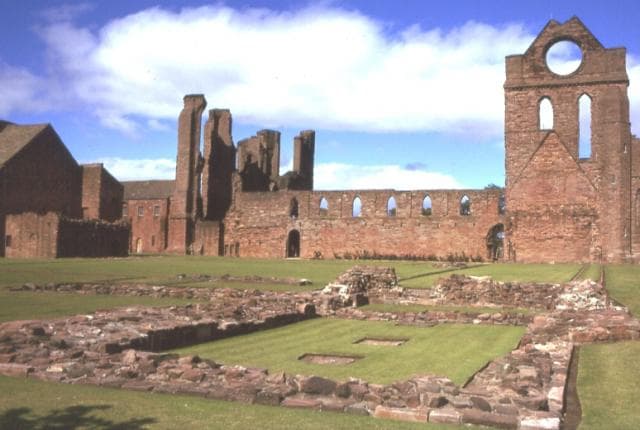
Arbroath Abbey
Arbroath Abbey, a ruined Cistercian monastery located in Arbroath, Scotland, was founded in 1178 by King William the Lion. It is renowned as the site where the Declaration of Scottish Independence was likely drafted in 1320. The Abbey, once the wealthiest in Scotland, is now managed by Historic Environment Scotland and is a popular tourist attraction, notable for its distinctive red sandstone ruins.

Dundrennan Abbey
Dundrennan Abbey was a Cistercian monastery established in 1142 in Dundrennan, Scotland. Known for its Romanesque architecture, the abbey reflects the austere Cistercian ideal and is noted for the preservation of its original forms due to its hard-weathering grey sandstone construction. Although extensively ruined, it holds historical significance as the site where Mary, Queen of Scots, spent her final night in Scotland in 1568 before fleeing.

Eynhallow Monastery
Eynhallow Church, a ruined medieval structure on the uninhabited Orkney island of Eynhallow, is believed to have originated as a monastery, possibly Benedictine, dating back to the 12th century. Its name, derived from Old Norse for "Holy Isle," suggests its former religious significance. The site, which also includes remains of a post-medieval settlement, is a scheduled monument and holds a place in Norse folklore.