
Mozac Abbey
Mozac Abbey, located in Auvergne, France, was founded in the 6th or 7th century and later became affiliated with the Cluniac Order in 1095. Despite significant damage from earthquakes in the late 15th century, the abbey church, which now serves as the local parish church, retains notable Romanesque architectural elements, particularly its sculpted capitals. The abbey was dissolved during the French Revolution in 1790, and its collection of relics, including those of Saint Austremonius, are still preserved.
Key Facts
- ›Founded between 533 and 680 by Saint Calminius and Saint Namadia.
- ›Affiliated with the Cluniac Order in 1095.
- ›Suffered severe damage from earthquakes between 1477 and 1490.
- ›Rebuilt in the Gothic style after the earthquakes.
- ›The abbey church still houses relics of Saint Austremonius and Saint Calminius.
- ›Dissolved in 1790 during the French Revolution.

Romanesque, Gothic
Romanesque Capitals, Relics of Saint Austremonius, Chasse Reliquary Shrine of Saint Calminius
Mozat
Saint Calminius, Saint Namadia, Saint Austremonius, Pope Urban Ii, Prosper MéRiméE
Founded, Affiliated With the Cluniac Order, Damaged By Earthquakes, Dissolved During the French Revolution
About Mozac Abbey
Mozac Abbey is a former Cluniac monastery situated in the commune of Mozac, close to Riom in the Auvergne region of France. Its origins trace back to either 533 or 680 AD, with a founding attributed to Saint Calminius and his wife, Saint Namadia. The monastery was initially dedicated to Saint Peter, and early traditions claim it received relics of the saint, along with those of Saint Caprasius of Agen. Later, a significant endowment of relics of Saint Austremonius, the first bishop of Clermont and a key figure in the evangelization of Auvergne, was bestowed upon the abbey by either Pepin the Short or Pepin II of Aquitaine, placing the foundation under royal protection.
History and Affiliation
A pivotal moment in the abbey's history occurred in 1095 when Pope Urban II, during the Council of Clermont, affiliated Mozac with the influential Cluniac Order. While most affiliated houses became dependent priories, Mozac managed to retain its status as an abbey, preserving a degree of autonomy. The early twelfth century saw the abbey undergo rebuilding. However, its structures suffered considerably from a series of severe earthquakes between 1477 and 1490.
Architectural Legacy and Dissolution
Despite the destruction, significant Romanesque architectural elements have survived, particularly its sculpted capitals, which were notably admired by Prosper Mérimée for their artistic merit. The subsequent rebuilding was executed in the Gothic style, utilizing the durable Volvic stone. From 1516, Mozac was administered by commendatory abbots who were not permanently in residence. The abbey's monastic life came to an end with its dissolution in 1790 during the French Revolution. The former abbey church endures today as the functioning parish church of Mozac.
Notable Contents
The church at Mozac remains a repository for important relics. The relics of Saint Austremonius are still preserved, alongside those of the founder, Saint Calminius. The reliquary housing Saint Calminius's relics is a celebrated piece of medieval Limoges enamel, recognized as the largest extant reliquary of its kind from the medieval period.
Source: Wikipedia ↗
Frequently Asked Questions
When was Mozac Abbey founded?
Mozac Abbey was founded in either 533 or 680 by Saint Calminius and his wife, Saint Namadia.
What religious order was Mozac Abbey affiliated with?
Mozac Abbey was affiliated with the Cluniac Order in 1095. Despite this affiliation, it maintained a degree of independence as an abbey rather than a dependent priory.
What happened to Mozac Abbey during the French Revolution?
During the French Revolution in 1790, Mozac Abbey was dissolved. Its church, however, survived and continues to function as the parish church of Mozac.
What are the notable architectural features of Mozac Abbey?
The abbey church retains elements of Romanesque architecture, most notably its carved Romanesque capitals, which were highly praised for their quality. Following earthquake damage, it was rebuilt in the Gothic style using Volvic stone.
What relics are preserved at Mozac Abbey?
Mozac Abbey preserves the relics of Saint Austremonius, the first bishop of Clermont, and those of its founder, Saint Calminius. The latter are housed in a significant Limoges enamel reliquary.
Related Monasteries
Dunkeld Monastery
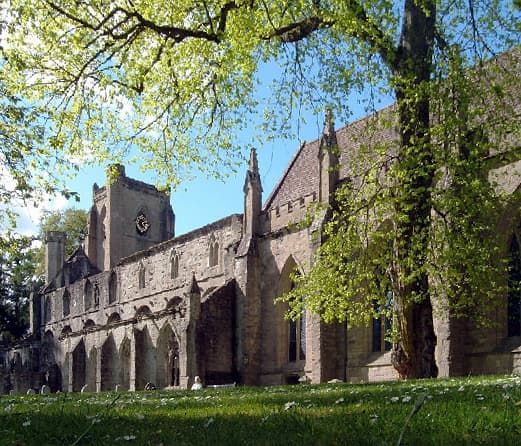
Dunkeld Monastery, originally a Culdee monastery, evolved into Dunkeld Cathedral, a significant religious site on the north bank of the River Tay in Scotland. Its construction began in 1260 and concluded in 1501, showcasing a blend of Gothic and Norman architectural styles. Although partly in ruins, the cathedral remains an active Church of Scotland parish church and is open to the public, housing relics and notable burials.

Holy Virgin Mary Coptic Orthodox Monastery
The Holy Virgin Mary Coptic Orthodox Monastery, also known as Deir el-Muharraq or the Muharraq Monastery, is a significant monastic complex of the Coptic Orthodox Church located in Asyut Governorate, Upper Egypt. Its history is deeply intertwined with early Christian traditions in Egypt, featuring ancient structures like a 6th or 7th-century fortress and the Church of al-Adhra, which is believed to be built over a cave where Mary and Jesus may have stayed. The monastery houses an active community of monks and preserves important manuscript collections.

Bellecelle Abbey
Castres Cathedral, originally the church of Bellecelle Abbey, served as the episcopal seat for the Diocese of Castres from its creation in 1317 until its suppression after the French Revolution. The original Benedictine abbey church was destroyed by Huguenots in the 1570s, with only the bell tower surviving. Following incomplete reconstructions, the present building was begun in 1678 and consecrated in the early 18th century, though it remains unfinished.