
Holy Virgin Mary Coptic Orthodox Monastery
The Holy Virgin Mary Coptic Orthodox Monastery, also known as Deir el-Muharraq or the Muharraq Monastery, is a significant monastic complex of the Coptic Orthodox Church located in Asyut Governorate, Upper Egypt. Its history is deeply intertwined with early Christian traditions in Egypt, featuring ancient structures like a 6th or 7th-century fortress and the Church of al-Adhra, which is believed to be built over a cave where Mary and Jesus may have stayed. The monastery houses an active community of monks and preserves important manuscript collections.
Key Facts
- ›The monastic complex is located on Mount Koskam, south of Cusae (modern-day Al-Qusiyyah) in Upper Egypt.
- ›The stone fortress on Mount Koskam dates to the 6th or 7th century, with a chapel containing a 12th-century lectern.
- ›The monastery features three churches: the 12th-century Virgin Mary's Ancient Church, the 19th-century St. George Church, and the MID-20th-century Holy Virgin Mary's Recent Church.
- ›The Church of al-Adhra is believed by many Copts to be one of the first Christian churches in Egypt and is associated with claims of Mary and Jesus's stay during their flight to Egypt.
- ›The monastery's libraries historically held ancient Coptic manuscripts and a collection of modern books, though their fate after a 2013 arson is uncertain.
- ›It houses an active community of approximately 100 monks practicing Koinonia (community) monasticism.

Neoclassical, Ancient Coptic
Stone Fortress, Ancient Coptic Manuscripts Library, Contemporary Research and Reading Library, Church of Al-Adhra, 12th-Century Lectern
Deir El-Muharraq, Muharraq Monastery, Virgin Mary Monastery, Mount Koskam Monastery
Mary, Jesus
Arson In August 2013, Host For Ethiopian Monks In the 17th Century
About Holy Virgin Mary Coptic Orthodox Monastery
The Holy Virgin Mary Coptic Orthodox Monastery, also known by its Arabic name Deir el-Muharraq and various other designations including Muharraq Monastery, Virgin Mary Monastery, and Mount Koskam Monastery, stands as a significant monastic complex within the Coptic Orthodox Church of Alexandria. Situated in Upper Egypt's Asyut Governorate, on Mount Koskam just south of Cusae (modern Al-Qusiyyah), it is one of the most venerated sites for Coptic Christians.
History and Features
The monastery's origins are ancient, with its stone fortress dating back to the 6th or 7th century. Within this fortress lies a chapel containing a 12th-century lectern, indicating repairs and continued use during the medieval period. The complex boasts three primary churches: the ancient Church of the Virgin Mary, with additions from the 16th and 19th centuries; the Neoclassical St. George Church, constructed between 1878 and 1880; and the Holy Virgin Mary's Recent Church, built from 1940 to 1964. A central feature is the Church of al-Adhra, built over a cave traditionally believed to be a resting place for Mary and Jesus during their flight into Egypt. The altar stone here is dated to 747 CE.
The monastery has historically been a center of monastic life, currently housing an active community of approximately 100 monks practicing Koinonia, or community monasticism. Its libraries, one dedicated to ancient Coptic manuscripts and another to contemporary research, have preserved invaluable historical and religious texts, though their condition and completeness are uncertain following an arson incident.
Significant Events
In August 2013, the Muharraq Monastery was subjected to arson by rioters, resulting in substantial damage, including the destruction of surrounding Coptic homes. The fate of the ancient manuscripts and the monastery's extensive library collections remains a point of concern and investigation following this destructive event. The monastery also served as a host for Ethiopian monks in the 17th century. Many Coptics hold this church in high veneration, believing it to be one of the first Christian churches in ancient Egypt and associating it with a Marian visionary event claimed in the early 2000s.
Source: Wikipedia ↗
Frequently Asked Questions
What is the significance of the Deir el-Muharraq monastery?
Deir el-Muharraq is highly venerated by many Copts, believed to be one of the earliest Christian churches in Egypt. It is also associated with traditions of the Holy Family's flight to Egypt and a Marian visionary event.
What are the main architectural features of the monastery?
The monastery complex includes a stone fortress from the 6th or 7th century, a 12th-century Virgin Mary's Ancient Church with later additions, a 19th-century Neoclassical St. George Church, and a mid-20th-century Holy Virgin Mary's Recent Church.
What happened to the monastery in 2013?
In August 2013, rioters set fire to the Muharraq Monastery, causing significant damage. The extent of the damage to the ancient Coptic manuscripts and the monastery's libraries remains unknown.
What is the religious tradition of the Holy Virgin Mary Coptic Orthodox Monastery?
The monastery belongs to the Coptic Orthodox Church of Alexandria, a distinct Oriental Orthodox Christian tradition.
Does the monastery have an active monastic community?
Yes, the monastery houses an active community of approximately 100 monks who practice Koinonia, or community monasticism.
Related Monasteries
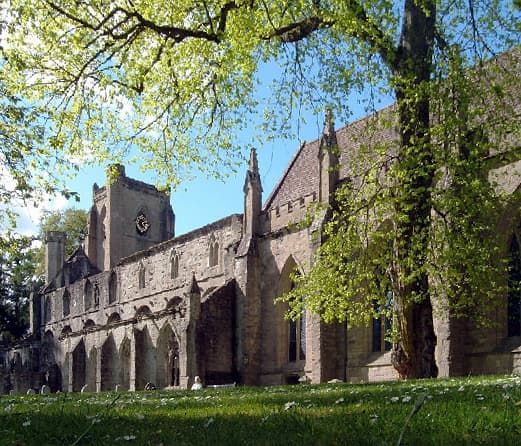
Dunkeld Monastery
Dunkeld Monastery, originally a Culdee monastery, evolved into Dunkeld Cathedral, a significant religious site on the north bank of the River Tay in Scotland. Its construction began in 1260 and concluded in 1501, showcasing a blend of Gothic and Norman architectural styles. Although partly in ruins, the cathedral remains an active Church of Scotland parish church and is open to the public, housing relics and notable burials.

Mozac Abbey
Mozac Abbey, located in Auvergne, France, was founded in the 6th or 7th century and later became affiliated with the Cluniac Order in 1095. Despite significant damage from earthquakes in the late 15th century, the abbey church, which now serves as the local parish church, retains notable Romanesque architectural elements, particularly its sculpted capitals. The abbey was dissolved during the French Revolution in 1790, and its collection of relics, including those of Saint Austremonius, are still preserved.

Archangel Gabriel Coptic Orthodox Monastery
The Archangel Gabriel Coptic Orthodox Monastery, also known as Naqlun, is an ancient Coptic monastery situated in the Faiyum Oasis of Egypt. Its history stretches from the 5th century to the present day, with significant archaeological discoveries shedding light on its past. The monastery is notable for its preserved structures, including a church with multiple sanctuaries, numerous hermitages, and Christian necropolises, as well as a rich collection of ancient texts.