
Mount Athos
Mount Athos is a mountain and peninsula in Greece renowned as a major center of Eastern Orthodox monasticism. Its history stretches back to at least the 9th century, evolving from scattered hermitages to organized monastic communities supported by Byzantine emperors and later Orthodox rulers. The area is governed by the monastic community of Mount Athos, ecclesiastically under the Patriarch of Constantinople, and is notable for its prohibition of women and its designation as a UNESCO World Heritage Site due to its well-preserved architecture and natural environment.
Key Facts
- ›An autonomous monastic state within Greece, governed by the monastic community of Mount Athos.
- ›Ecclesiastically under the direct jurisdiction of the Ecumenical Patriarch of Constantinople.
- ›Women are prohibited from entering the area governed by the monastic community.
- ›Inhabited since ancient times with a continuous Christian monastic tradition dating back to at least the 9th century.
- ›Inscribed on the UNESCO World Heritage List in 1988 for its historical, architectural, and environmental significance.
- ›Access is restricted and requires a special permit (diamonitirion), limited to male visitors.

- Unesco World Heritage Site
- Autonomous Monastic Republic
- Strict Prohibition of Women
- Extensive Network of Footpaths
- Diverse Flora and Fauna, Including Endemic Plant Species
Agio Oros, Holy Mountain, Sveta Gora, Afon
Saint Athanasius the Athonite, Blessed Virgin Mary, John the Evangelist, Darius, Mardonius, Herodotus, Xerxes I, Dinocrates, Pliny the Elder, Julian, Theodosius I, Hesychius of Alexandria, Nikephoros Ii Phokas
- Persian Fleet Disaster Near Mount Athos
- Spartan Fleet Disaster Near Mount Athos
- Xerxes I Excavates the Xerxes Canal
- Foundation of Great Lavra Monastery By Saint Athanasius the Athonite
- Fall of Constantinople and Expansion of the Ottoman Empire, Impacting Monasteries.
- Incorporation Into the Modern Greek State While Maintaining Autonomous Status.
About Mount Athos
Mount Athos: The Holy Mountain
Mount Athos is a mountain and peninsula in northeastern Greece, directly bordering the Aegean Sea. It is globally recognized as a paramount center of Eastern Orthodox monasticism, a spiritual and administrative entity known as the 'Monastic Community of Mount Athos'. This autonomous region is ecclesiastically under the direct authority of the Ecumenical Patriarch of Constantinople. Its history is deeply rooted, with monastic traditions dating back at least to the 9th century during the Byzantine era, evolving from scattered hermitages to large, organized cenobitic monasteries.
Name and Geography
Historically known as Athos and the peninsula as Acté, in modern Greek it is referred to as Oros Athos (Mount Athos) and Hersonisos tou Atho (Athos Peninsula). The designation 'Agio Oros', meaning 'Holy Mountain', is also widely used, a translation mirrored in various Orthodox languages such as 'Sveta Gora' in Bulgarian, Macedonian, and Serbian. The peninsula itself is the easternmost projection of the larger Chalkidiki peninsula, characterized by steep, densely forested slopes that rise to the summit of Mount Athos, reaching 2,033 meters. The surrounding seas have historically been treacherous, with ancient accounts detailing significant naval disasters.
Flora and Fauna
The natural environment of Mount Athos is a significant aspect of its heritage. The region is largely covered by mixed broadleaf deciduous and evergreen forests, with black pine forests at higher elevations. A rich array of plant life, including various oaks, pines, chestnuts, and cypress, thrives across the peninsula. Notably, at least 35 plant species are endemic to Mount Athos, with some, like Isatis tinctoria ssp. athoa and Viola athois, bearing its name. The area also supports a diverse fauna, including mammals such as gray wolves and wild boar, and a variety of bird species including eagles and owls. Over 350 species of mushrooms have also been recorded.
Historical and Religious Significance
According to Athonite tradition, the Blessed Virgin Mary blessed the mountain, declaring it her garden, and from that moment, it was consecrated and set apart. While historical documentation from antiquity is sparse, monks are believed to have inhabited the area from the 3rd or 4th century AD. The Byzantine era saw significant expansion and institutionalization, notably with the founding of the Great Lavra monastery by Saint Athanasius the Athonite in 963 AD, which became a model for subsequent monastic foundations. Despite falling under Ottoman rule after 1453, the monasteries maintained a degree of autonomy. The 19th century witnessed a revival and increase in monastic population, supported by donations from Orthodox nations. In the 20th century, Mount Athos was incorporated into Greece while retaining its unique autonomous status.
Access and Status
Access to Mount Athos is strictly regulated, requiring a special permit known as a diamonitirion, and is limited to male visitors. This restriction is a fundamental aspect of its religious tradition. The well-preserved architecture of its numerous monasteries, combined with the preservation of its natural environment, led to its inscription on the UNESCO World Heritage List in 1988. Mount Athos continues to be a vibrant and active center of Eastern Orthodox monastic life.
Source: Wikipedia ↗
Frequently Asked Questions
What is Mount Athos?
Mount Athos is a mountain and peninsula in northeastern Greece that serves as a significant center for Eastern Orthodox monasticism. It is an autonomous monastic state governed by its monastic community and is recognized as a UNESCO World Heritage Site.
What is the religious tradition of Mount Athos?
Mount Athos is a center of Eastern Orthodox monasticism. Its monastic community operates under the ecclesiastical jurisdiction of the Ecumenical Patriarch of Constantinople.
When was Mount Athos founded?
Monastic presence on Mount Athos can be traced back to at least the 9th century, with organized monastic communities developing by the 10th century. The foundation of the Great Lavra monastery in 963 by Saint Athanasius the Athonite is considered a major milestone in its institutional organization.
Where is Mount Athos located?
Mount Athos is located on the Athos peninsula, the easternmost 'leg' of the larger Chalkidiki peninsula in central Macedonia, Greece, protruding into the Aegean Sea.
Are women allowed to visit Mount Athos?
No, by Greek law and religious tradition, women are prohibited from entering the area governed by the monastic community of Mount Athos. Access is restricted to male visitors.
What is the significance of Mount Athos?
Mount Athos is significant as a major spiritual and monastic center of Eastern Orthodoxy, preserving ancient traditions, well-preserved architecture, and a unique autonomous governance. Its natural environment is also highly valued, leading to its UNESCO World Heritage status.
Related Monasteries

Meteora
Meteora is a rock formation in northwestern Greece famous for its complex of Eastern Orthodox monasteries built atop towering natural pillars. Established primarily from the 14th century onwards, these monasteries offered refuge and spiritual centers, with 24 originally built and six still extant today. Recognized for their unique architecture, beauty, and religious significance, Meteora is a UNESCO World Heritage site visited by many for its history, culture, and natural splendor.
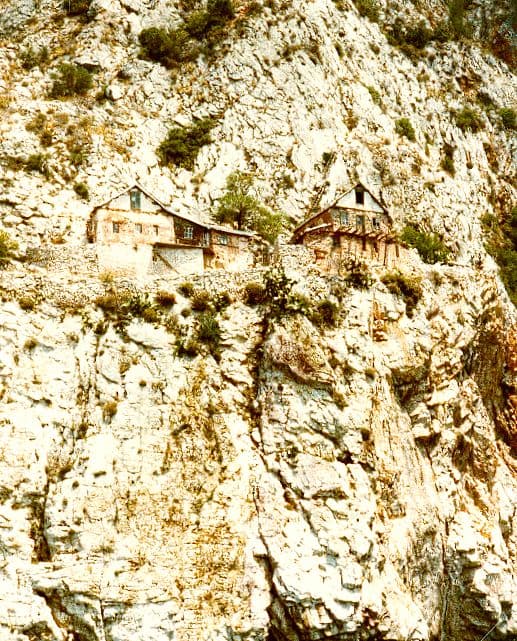
Karoulia
Karoulia is an Eastern Orthodox skete on Mount Athos, subordinate to the Great Lavra. Situated on the southernmost shore, it is known for its 12 hermitages built in the 17th century, where approximately 10 monks practice hesychasm and asceticism in challenging cliffside dwellings. Access to these remote huts is primarily by ladder or rope, reflecting a life of deep contemplation and austerity.
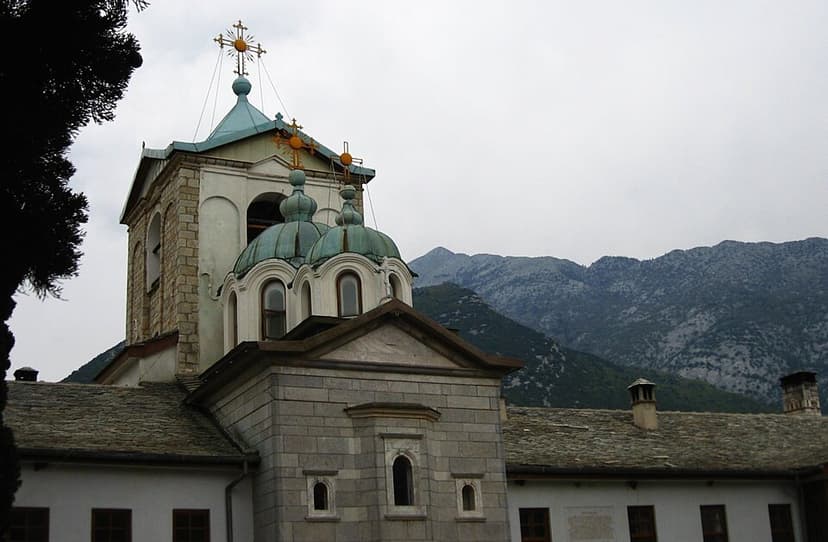
Prodromos (Mount Athos)
The Skete of Prodromos, also known as Romanian Skete Prodromos, is a Romanian cenobitic skete on Mount Athos, Greece, affiliated with the Great Lavra Monastery. Founded by Romanian monks, it became a significant center for Romanian Orthodox monasticism on the Holy Mountain, eventually receiving official recognition and support from both ecclesiastical and state authorities.