
Lyminge Abbey
Lyminge Abbey was one of the earliest religious houses established in England, founded by Æthelburh of Kent, daughter of King Æthelberht, in the 7th century. After returning to Kent following the death of her husband, King Edwin of Northumbria, Æthelburh became the abbess of this nunnery and convent. The abbey faced significant challenges due to Viking raids, leading its inhabitants to seek refuge in Canterbury by 804.
Key Facts
- ›Founded by Æthelburh of Kent, a royal figure and later venerated as a saint.
- ›Considered one of the first religious houses established in England.
- ›Suffered from numerous Viking raids, impacting its security and inhabitants.
- ›Its people sought refuge in Canterbury by 804 due to raids.
- ›The precise location of the abbey remains unknown.

æThelburh of Kent
- æThelburh's Return To Kent and Establishment of the Nunnery C. 633
- Viking Raids Leading To Inhabitants Seeking Refuge In Canterbury By 804
About Lyminge Abbey
Lyminge Abbey was a significant early religious institution in England, founded in the 7th century by Æthelburh of Kent. Situated about four miles northwest of Folkestone on the south coast of Kent, it stands as one of the first monastic foundations in the country. Æthelburh, daughter of King Æthelberht of Kent, established the nunnery and convent following her return from Northumbria after the death of her husband, King Edwin, in 633. She herself was later venerated as a saint.
History and Challenges
The early history of Lyminge Abbey was marked by its strategic location, which also made it a target for Viking raids. These incursions posed a severe threat to the community, leading to its inhabitants seeking refuge in the city of Canterbury by 804. The abbey suffered from these repeated attacks, which likely contributed to its eventual decline and the loss of its precise historical location.
Location and Legacy
While the exact site of Lyminge Abbey is no longer known, historical belief places it in the vicinity of the present-day Lyminge church. This church is dedicated to St. Mary and St. Ethelburga, further linking it to the abbey's founder and its early religious significance. Despite its eventual fate, Lyminge Abbey represents a crucial chapter in the spread of Christianity and the establishment of monasticism in Anglo-Saxon England.
Source: Wikipedia ↗
Frequently Asked Questions
When was Lyminge Abbey founded?
Lyminge Abbey was founded in the 7th century by Æthelburh of Kent. She established the nunnery and convent after returning to Kent.
Who founded Lyminge Abbey?
The abbey was founded by Æthelburh of Kent, who was the daughter of King Æthelberht of Kent. She became the abbess after her husband's death.
What happened to Lyminge Abbey during the Viking Age?
Lyminge Abbey was vulnerable to Viking raids. Due to these attacks, the people of the abbey were taken to seek protection in Canterbury by 804.
Where was Lyminge Abbey located?
The exact location of Lyminge Abbey is not precisely known. However, it is believed to have been situated around the area of Lyminge church, which is dedicated to St Mary and St Ethelburga.
Related Monasteries

Hartlepool — St Hilda's Monastery
Hartlepool Abbey, also known as Heretu Abbey, was a Northumbrian monastery founded in 640 CE by Hieu and Aidan of Lindisfarne. It was a significant double monastery, housing both monks and nuns, and was notable for its early female leadership, with Hieu serving as the first abbess. The monastery played a role in early Christianity in Northumbria and marks the earliest beginnings of the modern town of Hartlepool.
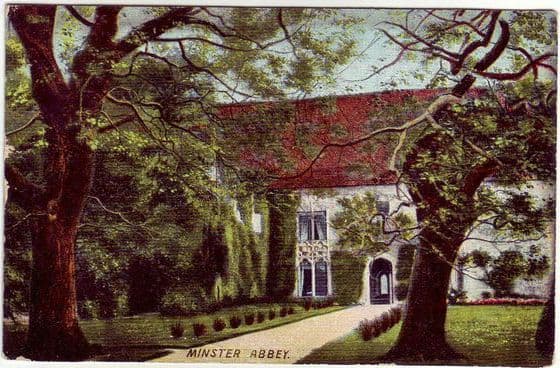
Minster in Thanet Priory
Minster Abbey in Minster-in-Thanet, Kent, England, originally comprised two abbeys: a 7th-century foundation that endured until the Dissolution of the Monasteries, and a modern Benedictine priory established in 1937 beside its ruins. The ancient abbey was famously founded by Domne Eafe, who received land as compensation for her brothers' deaths, with its boundaries legendarily defined by a deer. The current site hosts a Benedictine community of women.

Wearmouth Abbey
Wearmouth-Jarrow Abbey was a significant Benedictine double monastery in Anglo-Saxon Northumbria, founded by Benedict Biscop in 674. It became a renowned center of learning and book production, notably associated with the scholar Bede. Though sacked by Vikings and later refounded as cells of Durham Priory, its monastic buildings largely fell into ruin after the Dissolution of the Monasteries in 1536, with the abbey churches surviving as parish churches.