
Wearmouth Abbey
Christian·England·Ruins and Parish Churches·7th century
Wearmouth-Jarrow Abbey was a significant Benedictine double monastery in Anglo-Saxon Northumbria, founded by Benedict Biscop in 674. It became a renowned center of learning and book production, notably associated with the scholar Bede. Though sacked by Vikings and later refounded as cells of Durham Priory, its monastic buildings largely fell into ruin after the Dissolution of the Monasteries in 1536, with the abbey churches surviving as parish churches.
Key Facts
- ›Founded in 674 at Monkwearmouth and expanded to Jarrow in 685, forming a double monastery.
- ›A center of learning, producing the scholar Bede.
- ›Introduced Roman architectural and glassmaking traditions to England.
- ›Sacked by Viking raiders in the late 8th and 9th centuries, leading to abandonment.
- ›Refounded in the 14th century as cells of Durham Priory before dissolution in 1536.
- ›The abbey churches survive today as parish churches in Monkwearmouth and Jarrow.

Romanesque, Anglo-Saxon
- St Peter's Church, Monkwearmouth
- St Paul's Church, Jarrow
- Oldest Stained Glass Window In the World
- Surviving Ruins of Monastic Buildings At Jarrow
- Jarrow Hall
Monkwearmouth-Jarrow Abbey, Monasterii Wirimutham-Gyruum
Benedict Biscop, Bede, Ceolfrith, Eosterwine, Aldwin
Foundation of St Peter's, Monkwearmouth, Foundation of St Paul's, Jarrow, Viking Raids and Abandonment, Refoundation As Cells of Durham Priory, Dissolution of the Monasteries
About Wearmouth Abbey
Wearmouth-Jarrow Abbey
Wearmouth-Jarrow Abbey, officially the Abbey Church of Saint Peter and Saint Paul, Monkwearmouth–Jarrow, was a pivotal Benedictine double monastery in the Anglo-Saxon Kingdom of Northumbria. Its foundation was initiated by Benedict Biscop, who established the first house, St Peter's at Monkwearmouth, on the River Wear, around 674 AD. This was followed by the establishment of St Paul's at Jarrow on the River Tyne in 685 AD, creating a unified monastic community spread across two locations.
Foundation and Early Significance
Benedict Biscop's vision was to create a model monastery for England, drawing inspiration from Roman traditions and introducing advanced architectural and artistic techniques. He brought skilled masons and glassmakers from Francia to construct the monastery's buildings, which were among the first stone structures in England. The abbey also benefited from Biscop's extensive travels, as he imported books and religious artifacts from Rome and Lérins Abbey.
The monastery quickly became a renowned center of learning and scholarship. John, the arch-cantor of St Peter's Basilica in Rome, was persuaded to come and teach plainsong, further enhancing the abbey's musical and liturgical life. Under the leadership of Benedict Biscop and his successors, such as Ceolfrith and Eosterwine, the double monastery flourished for approximately two centuries.
A Hub of Scholarship and Manuscript Production
Wearmouth-Jarrow is most famously associated with the Venerable Bede, one of the greatest scholars of the Anglo-Saxon period. Educated under Ceolfrith's patronage, Bede spent his life at Jarrow, where he produced his seminal works, including the Ecclesiastical History of the English People. The abbey's extensive library, amassed by Benedict Biscop, provided the resources for Bede and other monks to engage in deep study and intellectual pursuits. The scriptorium was highly productive, developing a distinctive insular minuscule script for faster book production. A significant achievement was the creation of three great "pandect" Bibles, one of which, the Codex Amiatinus, survives today as the oldest complete Vulgate Bible.
Decline and Legacy
The prosperity of Wearmouth-Jarrow was shattered by Viking raids, with the first recorded raid occurring in 794 AD, followed by further destruction around 860 AD. The abbey was eventually abandoned in the late 9th century. While there was a brief attempt to revive it in the Norman period by Aldwin, prior of Winchcombe Abbey, the two houses were re-established in the early 14th century as cells of Durham Priory.
Following the Dissolution of the Monasteries under King Henry VIII in 1536, the conventual buildings fell into ruin. The abbey churches, however, survived and continue to serve as parish churches in Monkwearmouth and Jarrow. Substantial ruins of the monastic complex at Jarrow can still be seen today, and the sites are recognized for their historical and archaeological importance. Excavations have revealed early Anglo-Saxon buildings and artifacts, shedding light on the monastic life and the abbey's contribution to European culture.
Source: Wikipedia ↗
Frequently Asked Questions
When was Wearmouth-Jarrow Abbey founded?
The first house, St Peter's at Monkwearmouth, was founded in 674 AD. The second house, St Paul's at Jarrow, was established in 685 AD.
Who was the most famous scholar associated with Wearmouth-Jarrow Abbey?
The most famous scholar associated with the abbey was Bede, an Anglo-Saxon monk, historian, and theologian. He lived, wrote, and died as a monk at Jarrow.
What happened to Wearmouth-Jarrow Abbey after its Viking raids?
The abbey was sacked by Vikings in the late 8th and 9th centuries and was largely abandoned. There was a brief attempt at revival after the Norman Conquest, and it was refounded in the 14th century as cells of Durham Priory.
What remains of Wearmouth-Jarrow Abbey today?
The abbey churches of St Peter's at Monkwearmouth and St Paul's at Jarrow survive as parish churches. Substantial ruins of the monastic buildings at Jarrow still exist next to St Paul's Church.
What was the significance of Wearmouth-Jarrow Abbey's library?
The library, built by Benedict Biscop through his travels to Rome, was a crucial resource that made the abbey a cradle of English literature and learning. It housed important texts that facilitated scholarship and the production of influential manuscripts.
Was Wearmouth-Jarrow Abbey ever a UNESCO World Heritage Site?
The United Kingdom nominated the entire Monkwearmouth-Jarrow Abbey site for UNESCO World Heritage designation in 2011, but the bid was subsequently withdrawn.
Related Monasteries

Hartlepool — St Hilda's Monastery
Hartlepool Abbey, also known as Heretu Abbey, was a Northumbrian monastery founded in 640 CE by Hieu and Aidan of Lindisfarne. It was a significant double monastery, housing both monks and nuns, and was notable for its early female leadership, with Hieu serving as the first abbess. The monastery played a role in early Christianity in Northumbria and marks the earliest beginnings of the modern town of Hartlepool.

Lyminge Abbey
Lyminge Abbey was one of the earliest religious houses established in England, founded by Æthelburh of Kent, daughter of King Æthelberht, in the 7th century. After returning to Kent following the death of her husband, King Edwin of Northumbria, Æthelburh became the abbess of this nunnery and convent. The abbey faced significant challenges due to Viking raids, leading its inhabitants to seek refuge in Canterbury by 804.
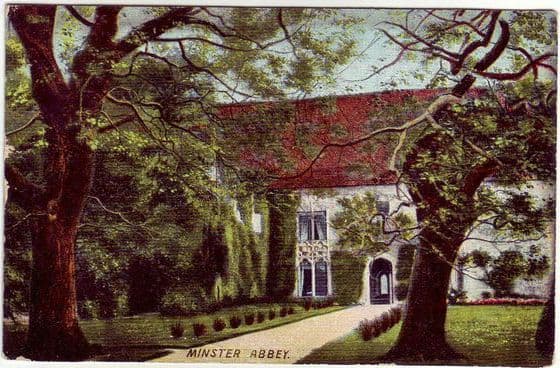
Minster in Thanet Priory
Minster Abbey in Minster-in-Thanet, Kent, England, originally comprised two abbeys: a 7th-century foundation that endured until the Dissolution of the Monasteries, and a modern Benedictine priory established in 1937 beside its ruins. The ancient abbey was famously founded by Domne Eafe, who received land as compensation for her brothers' deaths, with its boundaries legendarily defined by a deer. The current site hosts a Benedictine community of women.