
Hartlepool — St Hilda's Monastery
Hartlepool Abbey, also known as Heretu Abbey, was a Northumbrian monastery founded in 640 CE by Hieu and Aidan of Lindisfarne. It was a significant double monastery, housing both monks and nuns, and was notable for its early female leadership, with Hieu serving as the first abbess. The monastery played a role in early Christianity in Northumbria and marks the earliest beginnings of the modern town of Hartlepool.
Key Facts
- ›Founded in 640 CE by Hieu and Aidan of Lindisfarne.
- ›Was a double monastery, accommodating both monks and nuns.
- ›Hieu, the first abbess, led the institution from 640 to 649 CE.
- ›Hilda of Whitby served as the second abbess before founding Whitby Abbey.
- ›The monastery's cemetery has been extensively excavated, yielding significant Anglo-Saxon artifacts.
- ›It marks the earliest beginnings of the modern town of Hartlepool.

Anglo-Saxon
Monastic Cemetery, Anglo-Saxon Artifacts
Heretu Abbey, Hereteu Abbey, Heorthu Abbey, Herutey Abbey
Hieu, Aidan of Lindisfarne, Hilda of Whitby, Heresuid, Bregesuid, Frigyd, Hildilid, Eadgyd, Torchtgyd
- Founded In 640 Ce.
- Hilda Appointed Second Abbess Around 649 Ce.
- King Oswiu Sent His Daughter æLfflæD To the Monastery In 655 Ce.
- Hilda Left For Whitby Abbey In 657 Or 658 Ce.
- Possible Destruction By Danish Vikings Around 800 Ce.
About Hartlepool — St Hilda's Monastery
Hartlepool Abbey: A Double Monastery of Early Northumbria
Hartlepool Abbey, also known by various names including Heretu Abbey, Hereteu Abbey, Heorthu Abbey, and Herutey Abbey, was a significant Northumbrian monastery established in 640 CE. Founded by Hieu and Aidan of Lindisfarne on what is now known as the Heugh or Old Hartlepool in County Durham, England, it was built in the early Anglo-Saxon style, likely consisting of simple wooden huts surrounding a church within a walled enclosure.
A Double Monastery with Female Leadership
A defining characteristic of Hartlepool Abbey was its status as a double monastery, accommodating both monks and nuns. From its founding in 640 CE until 649 CE, it was presided over by Hieu, who holds the distinction of being the first female abbess to lead such an institution. This tradition of female leadership continued, as Hilda (later Hilda of Whitby) was appointed the second abbess by Bishop Aidan. Bede's writings indicate that Hilda oversaw both male and female students, and archaeological findings of male interments in the cemetery further support the co-institutional nature of the abbey.
Historical Trajectory and Archaeological Significance
After Hieu departed for Tadcaster in 649 CE, Hilda took charge, organizing the community with a clear timetable for prayer, work, and rest. A significant event occurred in 655 CE when King Oswiu of Northumbria sent his infant daughter, Ælfflæd, to the abbey to be consecrated to God. Hilda remained at Hartlepool until 657 or 658 CE, when she was called upon by Aidan to become the founding abbess of Whitby Abbey, taking Ælfflæd and ten nuns with her. Following Hilda's departure, the monastery largely disappears from historical records. It is believed to have either ceased operations or evolved into the nucleus of Hilda's new foundation at Whitby. The area around the monastery saw the foundation of a village in the 7th century, representing the earliest beginnings of the modern town of Hartlepool. However, after the 7th century, the monastery and its surrounding village are not mentioned again until the 12th century, suggesting a decline in importance, possibly due to Danish Viking raids around 800 CE or simple abandonment.
Excavations and Discoveries
Modern archaeological efforts have shed light on the site. While no physical traces of the monastery's structures remain, its cemetery has been extensively explored, making it one of the most thoroughly investigated Northumbrian monasteries of the 7th and 8th centuries. Excavations, notably beginning in 1833 and revisited by the television program "Time Team" in 2000, have unearthed numerous human burials and Anglo-Saxon artifacts. These finds include multiple female skeletons aligned north to south, unusual for Christian burials, often with flat stones as pillows and larger inscribed stones above. Namestones identified several figures, including Heresuid and Bregesuid (Hilda's mother and sister), Frigyd (abbess of Hackness), and Hildilid, Eadgyd, and Torchtgyd (abbess and nuns of Barking Abbey), providing valuable insights into the community and its connections.
Source: Wikipedia ↗
Frequently Asked Questions
When was Hartlepool Abbey founded?
Hartlepool Abbey was founded in 640 CE by Hieu and Aidan of Lindisfarne. This marks its origin as a significant religious site in Northumbria.
What type of monastery was Hartlepool Abbey?
It was a double monastery, meaning it housed both monks and nuns. This was a notable characteristic, especially given its early female leadership.
Who were some of the notable abbesses of Hartlepool Abbey?
The first abbess was Hieu, who led the monastery from 640 to 649 CE. She was followed by Hilda of Whitby, who later became the founding abbess of Whitby Abbey.
What remains of Hartlepool Abbey today?
No trace of the monastery buildings remains today. However, the monastic cemetery has been found and extensively explored, yielding important archaeological finds.
What is the historical significance of Hartlepool Abbey?
The monastery was a center of early Christianity in Northumbria and a double monastery with female leadership. It also marks the earliest beginnings of the modern town of Hartlepool.
Related Monasteries

Lyminge Abbey
Lyminge Abbey was one of the earliest religious houses established in England, founded by Æthelburh of Kent, daughter of King Æthelberht, in the 7th century. After returning to Kent following the death of her husband, King Edwin of Northumbria, Æthelburh became the abbess of this nunnery and convent. The abbey faced significant challenges due to Viking raids, leading its inhabitants to seek refuge in Canterbury by 804.
Minster in Thanet Priory
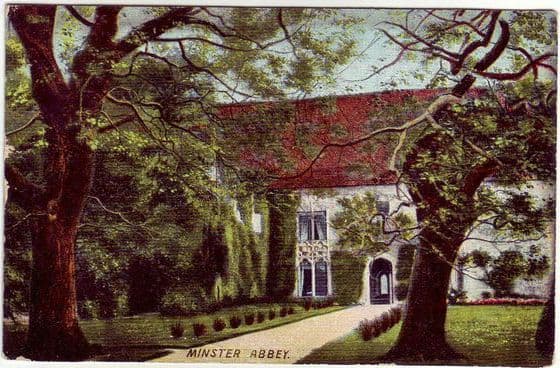
Minster Abbey in Minster-in-Thanet, Kent, England, originally comprised two abbeys: a 7th-century foundation that endured until the Dissolution of the Monasteries, and a modern Benedictine priory established in 1937 beside its ruins. The ancient abbey was famously founded by Domne Eafe, who received land as compensation for her brothers' deaths, with its boundaries legendarily defined by a deer. The current site hosts a Benedictine community of women.

Wearmouth Abbey
Wearmouth-Jarrow Abbey was a significant Benedictine double monastery in Anglo-Saxon Northumbria, founded by Benedict Biscop in 674. It became a renowned center of learning and book production, notably associated with the scholar Bede. Though sacked by Vikings and later refounded as cells of Durham Priory, its monastic buildings largely fell into ruin after the Dissolution of the Monasteries in 1536, with the abbey churches surviving as parish churches.