
Les Écharlis Abbey
Les Écharlis Abbey was a former Cistercian monastery in Villefranche, Yonne, France, founded in the 12th century. It grew rapidly, partly due to the fame of Saint Alpaïs, but experienced numerous destructions and hardships throughout its history, including during the Hundred Years' War and the French Wars of Religion. The abbey was dissolved in 1791 and sold during the French Revolution, with only the 12th-century entrance and a 13th-century chapel remaining of the original medieval structures.
Key Facts
- ›Founded in the 12th century by a secular priest and two companions, later joining the Cistercian order.
- ›Became the first dependency of Fontenay Abbey.
- ›Moved from an initial site to a more suitable location after the first site proved inadequate.
- ›Suffered significant destruction during the Hundred Years' War and the French Wars of Religion.
- ›Dissolved in 1791 and sold as national property during the French Revolution.
- ›Only the 12th-century entrance and a 13th-century chapel dedicated to Notre-Dame-de-Pitié survive from the medieval monastery.

Romanesque, Gothic
12th-Century Entrance Gate, 13th-Century Chapel of Notre-Dame-De-Pitié, Barrel-Vaulted Abbey and Cloister
Abbaye Des éCharlis
Saint AlpaïS, éTienne, ThéObald, Garnier, Guillaume, Henri I Sanglier, Hugues De Toucy, Pope Alexander Iii, Pope Benedict Xii, Jean De Langeac, Guillaume Pellissier, Denis De Buffevant, Gaspard De Coriolis D'Espinouse, Marie-Joseph MéSange, Dom Jean-Antoine Choppin, FrançOis GuéRiotand, Claude Viennot
- Foundation In the 12th Century
- Affiliation With Fontenay Abbey
- Move To A New Site In the 12th Century
- Destruction During the Hundred Years' War
- Destruction During the French Wars of Religion
- Dissolution In 1791
- Sale As A Bien National In 1792
- Pillage and Burning During the Fronde
About Les Écharlis Abbey
Les Écharlis Abbey (French: Abbaye des Écharlis) is a former Cistercian monastery located in Villefranche, Yonne, France. Its history is marked by both periods of growth and significant destruction.
Foundation and Early Growth
The monastery was founded in the 12th century by a secular priest named Étienne, along with two companions, Théobald and Garnier. They were granted land by Vivien, lord of La Ferté-Loupière, and soon after, the nascent community joined the Cistercian order as a dependency of Fontenay Abbey. An initial site was quickly deemed too small, leading the monks to relocate a few kilometers away. This second site, established after disputes with the original landowner's son were resolved by the Archbishop of Sens, became the more permanent location. The abbey experienced rapid growth, partly attributed to the fame of Saint Alpaïs, a hermit who lived nearby and whose sanctity attracted pilgrims. The monks wrote several lives of Saint Alpaïs, contributing to her veneration.
Hardships and Decline
Despite its early success, Les Écharlis Abbey faced numerous challenges throughout its existence. The Hundred Years' War and the French Wars of Religion brought repeated destruction, forcing the monks to seek refuge elsewhere and leaving the abbey unoccupied and vulnerable to pillage at various times. The introduction of abbots in commendam, where an abbot from outside the order managed the abbey's revenues, also contributed to its decline. These commendatory abbots, often from noble families, did not always ensure the necessary upkeep of the monastery, leading to further dilapidation. The abbey suffered further damage during the Fronde in the 17th century.
Dissolution and Legacy
By the 18th century, efforts were made to restore the monastery, but the monastic community remained very small. In 1791, during the French Revolution, the monks were forced to leave, and the monastery was sold as national property in 1792. The buyer dismantled the abbey, and today, only the 12th-century entrance gate and a 13th-century chapel dedicated to Notre-Dame-de-Pitié, which served as a site of local pilgrimage, remain as testaments to its past.
Source: Wikipedia ↗
Frequently Asked Questions
When was Les Écharlis Abbey founded?
The monastery at Les Écharlis likely existed before its affiliation with the Cistercian Order. Historical records suggest a possible foundation date between 1108 and 1125, with a papal bull confirming its foundation dating to November 20, 1163.
What is the origin of the name Les Écharlis?
The text does not explicitly state the origin of the name 'Les Écharlis'.
What caused the frequent destruction of Les Écharlis Abbey?
The abbey suffered repeated destruction due to various conflicts, including the Hundred Years' War, the French Wars of Religion, and the Fronde. It was also targeted by armed bands sponsored by local lords.
Who was Saint Alpaïs and how is she connected to Les Écharlis Abbey?
Saint Alpaïs was a peasant saint who lived as a hermit nearby. The monks of Les Écharlis befriended her, and her growing sanctity attracted large crowds, contributing to the abbey's growth and fame. Numerous lives of Saint Alpaïs were written by monks from the abbey.
What remains of Les Écharlis Abbey today?
Today, only the 12th-century entrance gate to the property remains from the medieval monastery. Additionally, a 13th-century chapel dedicated to Notre-Dame-de-Pitié, which served as a place of local pilgrimage, also survives.
Why did the monks move the abbey to a new location?
The initial site was deemed too small for the growing number of monks. Furthermore, as it was not located in a valley, it lacked running water, which was a common Cistercian custom. The move was approved by the Archbishop of Sens despite initial opposition and an act of arson by a local lord.
Related Monasteries

Abbaye Blanche
The Abbaye Blanche was a Benedictine nunnery founded in 1112 in Mortain, France, by Saint Vitalis. It was established for women with his sister, Adelina, as its first abbess. The community followed a strict interpretation of the Rule of Saint Benedict and later joined the Cistercian order in 1147. Though much has been lost to time, remnants of its Romanesque and Early Gothic architecture endure.
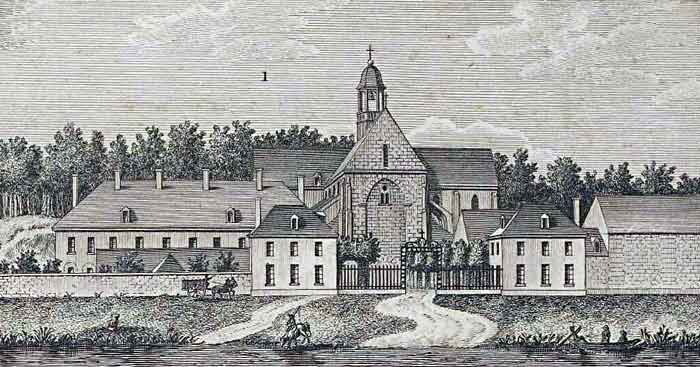
Barbeau Abbey
Barbeau Abbey was a Cistercian monastery founded in 1147 by King Louis VII of France. Located in Fontaine-le-Port, Seine-et-Marne, it was a site of royal burial and experienced periods of prosperity and destruction throughout its history, including the Hundred Years' War and the French Revolution. Today, few original structures remain, with a riding school occupying the former site.

Bellevaux Abbey
Bellevaux Abbey was a Cistercian monastery established in 1120 in Franche-Comté, France, by Pons de Morimond. It was a significant religious house, connected to local nobility and notable figures like Burchard of Bellevaux and Peter of Tarentaise. Though suppressed in 1790 and largely demolished shortly after, its history includes periods of destruction and rebuilding, with the final structures erected by Abbot Louis Albert de Lezay-Marnésia. The site later housed a Trappist community before being sold to private owners.