
Holyrood Abbey
Canons Regular (Augustinian)·Scotland·Ruins·12th century
Holyrood Abbey is a ruined Augustinian monastery in Edinburgh, Scotland, founded in 1128 by King David I. Initially a significant religious center, it also served as a royal residence and a site for parliamentary meetings. Although damaged during conflicts and the Reformation, its nave continued as a parish church until the 18th century when structural failures led to its ruin.
Key Facts
- ›Founded in 1128 by King David I of Scotland, legend attributes its founding to his miraculous escape from a stag.
- ›Originally served by Augustinian Canons Regular from Merton Priory.
- ›Served as a royal residence and hosted parliamentary meetings throughout its history.
- ›Suffered significant damage during the War of the Rough Wooing and the Scottish Reformation.
- ›The nave functioned as the parish church of Canongate until the 18th century.
- ›A 1760 attempt to replace the roof with stone vaults led to a collapse in 1768, leaving it a roofless ruin.

Romanesque, Gothic
Ruined Abbey Church, Adjacent To the Palace of Holyroodhouse, Site of Royal Burials, Sanctuary Stones Marking Former Boundary
David I of Scotland, St. Margaret of Scotland, Robert the Bruce, James Ii of Scotland, Mary Queen of Scots, Charles I of England
Founding of the Abbey, Parliamentary Meetings Held Here, Treaty of Edinburgh–Northampton Signed Nearby, Damage During the War of the Rough Wooing, Damage During the Scottish Reformation, Roof Collapse
About Holyrood Abbey
Holyrood Abbey is a significant ruined monastery located in Edinburgh, Scotland, situated at the eastern end of the Royal Mile and adjacent to the Palace of Holyroodhouse. Founded in 1128 by King David I of Scotland, the abbey's origins are intertwined with legend, which attributes its establishment to the king's miraculous escape from a stag during a hunt. The abbey was originally served by Augustinian Canons Regular, likely following the architectural model of Merton Priory.
History and Royal Connections
Throughout its existence as an active religious house, Holyrood Abbey played a multifaceted role in Scottish history. It was not solely a place of worship and monastic life but also became a significant royal center. The abbey guesthouse was developed into a royal residence, and following the Scottish Reformation, the adjacent Palace of Holyroodhouse was further expanded. The abbey church itself served various functions, being used as a parish church until the 17th century. It also hosted numerous parliamentary meetings and was the site of several royal coronations and weddings, including those of James II and James III.
Decline and Ruin
The abbey church suffered damage during periods of conflict, notably during the War of the Rough Wooing in the 16th century and further vandalism during the Scottish Reformation. By the late 17th century, it was converted into a Chapel Royal and chapel of the Order of the Thistle. However, a drastic structural intervention in the late 18th century proved disastrous. An attempt to replace the aging timber roof trusses with stone vaults in 1758-1760 proved too heavy for the decaying walls. This led to severe deformation, and the roof ultimately collapsed in two stages in 1768, leaving Holyrood Abbey as the roofless ruin that exists today. Despite proposals for restoration, the abbey has remained in its ruined state, a poignant historical monument.
Source: Wikipedia ↗
Frequently Asked Questions
What is the origin of the name Holyrood Abbey?
The name 'Holyrood' is derived from 'Rood,' an old word for the cross on which Jesus Christ was crucified. Therefore, Holyrood Abbey signifies 'Holy Cross'.
What was the legend behind the founding of Holyrood Abbey?
Legend states that King David I, while hunting, was saved from a charging stag by the miraculous appearance of a holy cross. As a thanksgiving, he founded the abbey on the site in 1128.
What role did Holyrood Abbey play in Scottish royal history?
The abbey guesthouse was developed into a royal residence, and the Palace of Holyroodhouse was expanded nearby. It was also the site of coronations, royal weddings, and births.
When did Holyrood Abbey become a ruin?
After extensive remodelling and use as a Chapel Royal, a disastrous attempt in 1758-1760 to replace the timber roof with stone vaults proved too heavy for the walls. The roof finally collapsed in 1768, leaving the abbey in its current ruined state.
Was Holyrood Abbey always a religious institution?
While founded as a monastery for Canons Regular, its proximity to the royal court led to its increasing use as a secular royal residence and the development of the adjacent Palace of Holyroodhouse. Parts of it also served as a parish church.
Related Monasteries
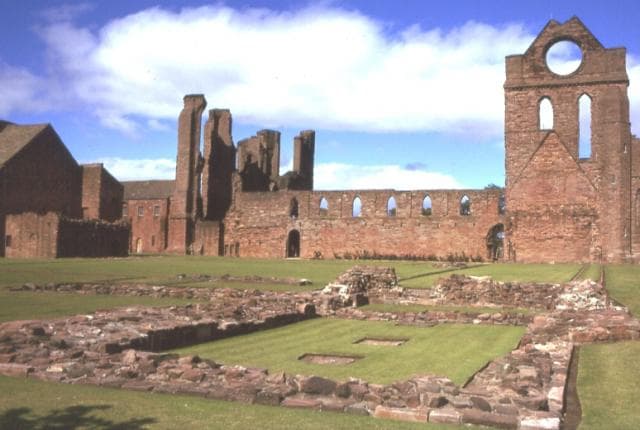
Arbroath Abbey
Arbroath Abbey, a ruined Cistercian monastery located in Arbroath, Scotland, was founded in 1178 by King William the Lion. It is renowned as the site where the Declaration of Scottish Independence was likely drafted in 1320. The Abbey, once the wealthiest in Scotland, is now managed by Historic Environment Scotland and is a popular tourist attraction, notable for its distinctive red sandstone ruins.
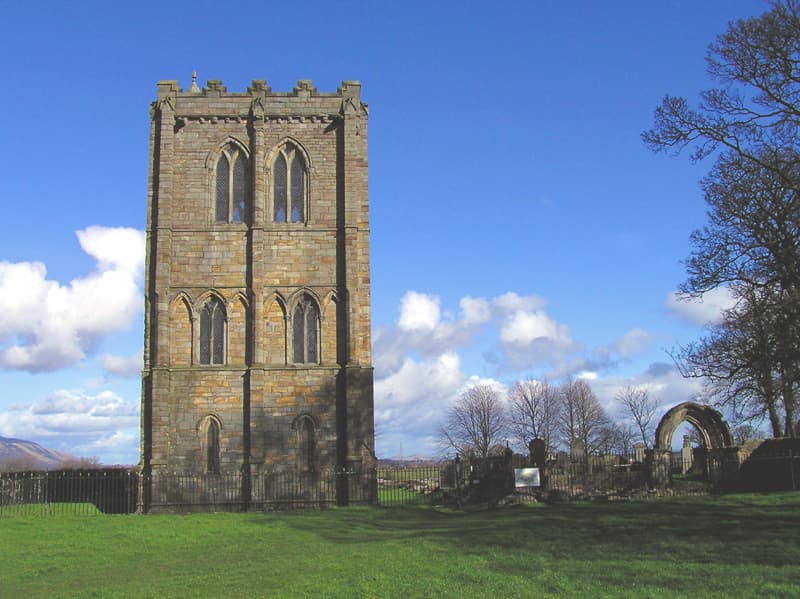
Cambuskenneth Abbey
Cambuskenneth Abbey, established around 1140 by King David I of Scotland, was a significant provostry of Canons Regular and the only Scottish house of the French Arrouaise Order. Situated by a meander of the River Forth near Stirling, it played a crucial role in Scottish public life, hosting parliaments and royal events, and was the burial site for King James III and Queen Margaret of Denmark. Although largely reduced to its foundations today, its 13th-century bell tower remains intact, and the site is managed by Historic Scotland and open to visitors.
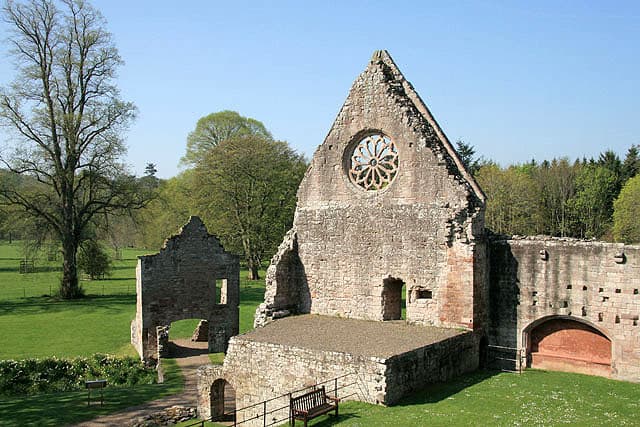
Dryburgh Abbey
Dryburgh Abbey, situated near the River Tweed in the Scottish Borders, was founded in 1150 by Premonstratensian canons. Despite significant destruction from English raids in the 14th and 16th centuries, the abbey experienced periods of restoration and flourished in the 15th century. Today, it stands as a designated scheduled monument, with its grounds serving as the final resting place for notable figures like Sir Walter Scott and Douglas Haig.