
Merton Priory
Merton Priory was an influential Augustinian priory founded in 1114 by Gilbert Norman, Sheriff of Surrey. Situated in what is now Colliers Wood, London, it became a significant center for learning and diplomacy, associated with figures like Thomas Becket and the establishment of Merton College, Oxford. The priory was demolished in 1538 during the Dissolution of the Monasteries, with its site now occupied by a supermarket and its remaining chapter house ruins serving as a museum.
Key Facts
- ›Founded in 1114 by Gilbert Norman, Sheriff of Surrey.
- ›Established as an Augustinian priory, initially colonized from Huntingdon.
- ›Served as a notable center for learning and diplomacy.
- ›Associated with the early studies of Thomas Becket and the eventual founding of Merton College, Oxford.
- ›Hosted a Parliament in 1236 where the Statute of Merton was passed.
- ›Demolished in 1538 during the Dissolution of the Monasteries.

Chapter House Ruins, Site of the Statute of Merton
Gilbert Norman, Thomas Becket, Hubert Walter, Walter De Merton, Edmund of Abingdon, King John, Prince Louis of France, King Henry Iii, King Henry Vi
- Colonization By Canons Regular From Huntingdon
- Thomas Becket's Studies
- Walter De Merton's Scholars Established A House
- King John Sent A Canon As Ambassador To Normandy
- Prince Louis of France Did Penance After Treaty of Lambeth
- King Henry Iii Held A Parliament and Passed the Statute of Merton
- Henry Vi's Crowning Ceremony
- Dissolution of the Monasteries
About Merton Priory
Merton Priory was a significant English Augustinian priory founded in 1114 by Gilbert Norman, Sheriff of Surrey under King Henry I. Located in the manor of Merton, in what is now the Colliers Wood area of the London Borough of Merton, the priory played a notable role in the religious, intellectual, and political life of medieval England.
History and Significance
The foundation was re-sited and colonized by Canons Regular from the Augustinian priory at Huntingdon by 1117. Merton Priory grew to become an important center for learning and diplomacy. Figures such as Thomas Becket are recorded to have briefly studied there, and later wore the habit of a Merton canon. It is also believed that Walter de Merton, the founder of Merton College at Oxford, may have studied at the priory; his establishment of a house for scholars eventually led to the college's relocation to Oxford. Edmund of Abingdon, the Archbishop of Canterbury, wrote some of his Oxford lectures in the priory's peaceful setting.
The priory also served as a venue for important political events. In 1205, King John dispatched a canon from Merton as an ambassador to Normandy. Prince Louis of France performed penance at the priory following peace conferences that culminated in the Treaty of Lambeth in 1217. A more significant political event occurred in 1236 when King Henry III convened a Parliament at Merton Priory, during which the Statute of Merton was enacted. This statute, among other provisions, allowed lords of the manor to enclose common land if sufficient pasture remained for their tenants, marking it as the first recorded statute of the first recorded English parliament.
Destruction and Legacy
Merton Priory met its end in 1538 as part of King Henry VIII's Dissolution of the Monasteries. At the time of its surrender, it housed 14 canons and was valued at a considerable sum of £960 16 shillings 6 pence in the Valor Ecclesiasticus of 1535. Much of the priory's masonry was subsequently repurposed for use in the construction of King Henry VIII's Nonsuch Palace. Today, the site of Merton Priory is occupied by a Sainsbury's supermarket. However, remnants of the priory's Chapter House survive and are preserved as a museum located under Merantun Way, situated between the supermarket and Merton Abbey Mills, offering a tangible link to its historical importance.
Source: Wikipedia ↗
Frequently Asked Questions
When was Merton Priory founded?
Merton Priory was founded in 1114 by Gilbert Norman, Sheriff of Surrey under King Henry I. The foundation was later colonized by Canons Regular from the Augustinian priory at Huntingdon and re-sited in Merton by 1117.
What was Merton Priory known for historically?
The priory was an important center of learning and diplomacy. It is associated with figures like Thomas Becket and Hubert Walter, and the scholars who eventually established Merton College at Oxford studied there. King Henry III also held a Parliament at the priory in 1236.
What happened to Merton Priory?
Merton Priory was demolished in 1538, following King Henry VIII's Dissolution of the Monasteries. Much of its masonry was reused at Nonsuch Palace. The site is now occupied by a Sainsbury's supermarket, and remains of the Chapter House are preserved as a museum.
Are there any remains of Merton Priory today?
Yes, some remains of the Chapter House of Merton Priory still exist. These ruins are now a museum located under Merantun Way, between Sainsbury's and Merton Abbey Mills.
Who were some notable people associated with Merton Priory?
Thomas Becket briefly studied at Merton Priory around 1130 and later wore its habit. Hubert Walter also adopted the habit of a Merton canon. Walter de Merton, who established a house for Merton scholars that became Merton College, is thought to have studied there. King Henry III held a Parliament at the priory, and King Henry VI had a crowning ceremony there.
Related Monasteries

Ankerwycke Priory
Ankerwycke Priory was a small and relatively poor Benedictine nunnery established around 1160 in Buckinghamshire, England. Dedicated to St. Mary Magdalene, it held lands across several counties. Dissolved in 1536, its revenues were transferred to Bisham Abbey, and the priory site later saw the construction of a manor house. Today, only a small section of ruins remains, situated in Berkshire.
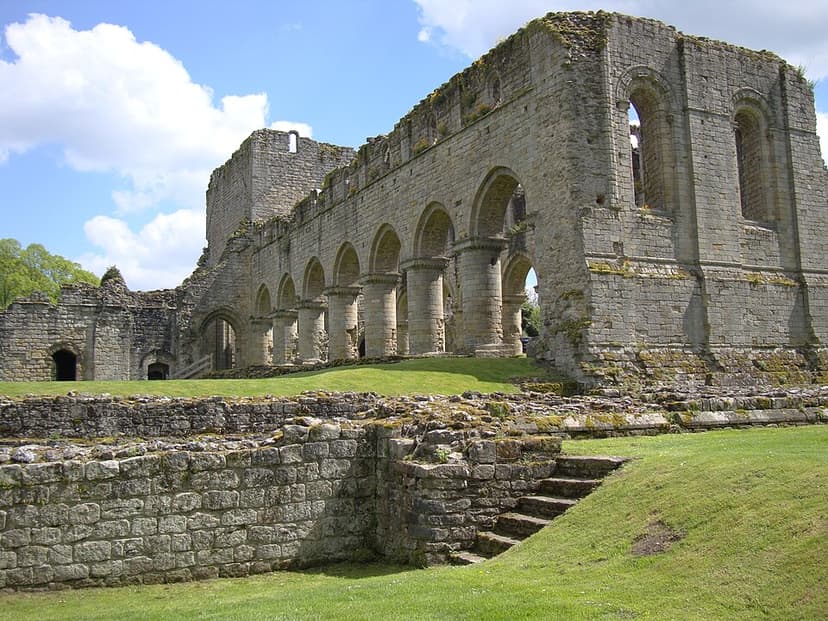
Buildwas Abbey
Buildwas Abbey was a significant Cistercian monastery in Shropshire, England, founded in 1135. It experienced periods of substantial growth and wealth, becoming a center of learning with a notable library. Despite facing challenges from economic crises and conflict, it played a role in royal administration, particularly concerning Ireland and Wales, before its suppression in 1536. Today, substantial remains of the abbey church and monastic buildings are maintained by English Heritage.

Byland Abbey
Byland Abbey was a Savigniac and later Cistercian monastic institution founded in 1135 in North Yorkshire, England. Despite an unstable early history with multiple relocations, it eventually settled at its final site near Coxwold. Once established, it became a significant religious and economic center, renowned for its sheep rearing and wool exports, and boasting a church described as one of the finest 12th-century structures in Europe. Though dissolved in 1538, extensive ruins remain, including the west front of the church with its notable rose window, and the site is maintained by English Heritage.