
Hautmont Abbey
Hautmont Abbey was a Benedictine monastery founded in the 640s by Madelgaire, the Count of Hainaut. Situated in Hautmont, France, it played a significant role in the region's religious history, enduring destructions by barbarians and later nationalization during the French Revolution. The abbey was known for its vast landholdings and the relics it housed.
Key Facts
- ›Founded in the 640s by Madelgaire, Count of Hainaut.
- ›Originally established as a religious community on a hill above the Sambre river.
- ›Endowed with extensive lands, including over 100 villages, by Halidulphe in 675 AD.
- ›Devastated by Normans and barbarians in 900 AD.
- ›Restored and the Benedictine rule re-established in the 11th century.
- ›Assets were nationalized during the French Revolution, leading to its abandonment and vandalism.

- Housed Relics of Saint Marcel and Saint George.
Abbey of Hautmont
Madelgaire, Saint Waltrude, Vincent Madegarius, Landry of Soignies, Halidulphe, Saint Ansbert, Herman, Count of Hainaut, Richilde of Hainaut, Arnould De Rumigny, Godefroi, Gerard of Florennes, Richard of Verdun, Emperor Folcuin, Gautier I, Count of Brienne, Gautier Ii
- Founded In the 640s.
- Devastated By Normans and Barbarians In 900 Ad.
- Restored and Benedictine Rule Re-Established In the 11th Century.
- Assets Nationalized During the French Revolution.
About Hautmont Abbey
Hautmont Abbey, also known as the Abbey of Hautmont, was a significant Benedictine monastery situated in Hautmont, in the Nord department of France. Its origins trace back to the 640s when Madelgaire, the Count of Hainaut, and his wife Saint Waltrude established a religious community on a hill above the Sambre river. Legend recounts a divine sign of a cross-shaped clearing in the snow marking the precise spot for its construction.
Foundation and Early History
Vincent Madegarius, who was Madelgaire himself, became the first Abbot. He endowed the abbey with substantial resources and acquired relics, including those of Saint Marcel. Around 660 AD, Landry of Soignies succeeded him as abbot, followed by Halidulphe in 675 AD. Halidulphe's charter in 691 granted the abbey over 100 villages and extensive lands, solidifying its considerable wealth and influence. The monastery later served as a place of banishment for Saint Ansbert by Pepin of Herstal. However, this early prosperity was shattered in 900 AD when the abbey was devastated and abandoned following attacks by Normans and other barbarians, which resulted in the massacre of several clergy members.
Restoration and Later Centuries
In the 11th century, Count Herman and his wife Richilde of Hainaut took control of Hautmont, initially granting it as a benefice. Despite a period of disruption where clerics were expelled and the abbey handed to Richard of Verdun, Emperor Folcuin intervened. With Gerard's support, he secured the return of the property, repaired the abbey, and crucially, restored the Benedictine rule. The House of Avesnes assumed control of the abbey in the 12th century, with Gautier I and later Gautier II representing the family as solicitors.
The French Revolution
The abbey's history took a dramatic turn during the French Revolution. Its assets were nationalized, and its movable goods were transferred to Avesnes. The religious inhabitants fled to escape persecution, leaving the abbey deserted. The period known as the Reign of Terror in 1793 led to widespread vandalism. The abbey's most valuable relics, including those of Saint Marcel and Saint George, were confiscated and sent to the Mint in Lille in February 1793, marking the end of its active monastic life.
Source: Wikipedia ↗
Frequently Asked Questions
When was Hautmont Abbey founded?
The origins of Hautmont Abbey lie in a religious community established in the 640s. Vincent Madegarius, later known as Madelgaire, Count of Hainaut, is credited with its founding.
Who was the first Abbot of Hautmont Abbey?
Vincent Madegarius, who was also the Count of Hainaut, served as the first Abbot of Hautmont Abbey. He endowed the abbey with significant resources and relics.
What happened to Hautmont Abbey during the French Revolution?
During the French Revolution, Hautmont Abbey's assets were nationalized. Its movable goods were sent to Avesnes, and the monks fled. The abbey experienced vandalism during the Reign of Terror.
What kind of monastic order was Hautmont Abbey?
Hautmont Abbey was a Benedictine monastery. The Benedictine rule was restored in the 11th century after a period of devastation.
Was Hautmont Abbey ever destroyed?
Yes, the monastery was devastated and abandoned in 900 AD after being attacked by Normans and other barbarians, who massacred several members of the clergy.
Related Monasteries

Chelles Abbey
Chelles Abbey was a significant Frankish monastery founded around 657/660, initially for women and later expanding into a double monastery due to its reputation for learning. It held strong royal connections throughout the Carolingian era and was renowned for its scriptorium. The abbey was dissolved during the French Revolution in 1790 and subsequently destroyed, with its remains incorporated into the modern town hall of Chelles.

Crespin Abbey
Crespin Abbey was a Benedictine monastery founded around 648 by Landelin of Crespin, a reformed brigand who became its first abbot. The abbey, dedicated to Saint Peter, flourished due to its reputation for miracles but was destroyed by Vikings in the 9th century. Although rebuilt, it housed secular priests before Benedictine monks returned in 1080, continuing until its dissolution in 1802.
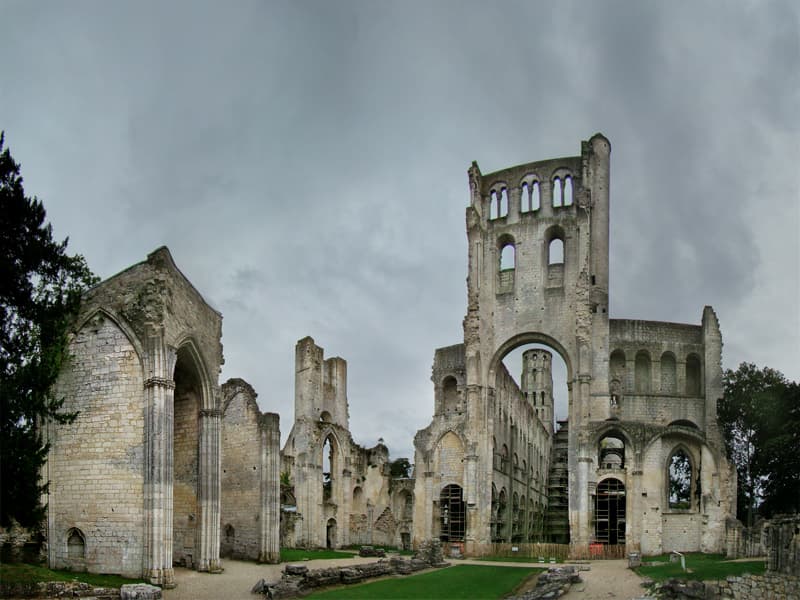
Jumièges Abbey
Jumièges Abbey, formally the Abbey of St Peter at Jumièges, was a significant Benedictine monastery founded in 654. Despite devastating raids by Vikings in 841, it was refounded and rebuilt under the patronage of the Dukes of Normandy, becoming a center of scholarship and a model for monastic life in the region. Today, its impressive ruins stand as a testament to its rich history, with notable surviving structures like its twin towers and western façade.