
Crespin Abbey
Crespin Abbey was a Benedictine monastery founded around 648 by Landelin of Crespin, a reformed brigand who became its first abbot. The abbey, dedicated to Saint Peter, flourished due to its reputation for miracles but was destroyed by Vikings in the 9th century. Although rebuilt, it housed secular priests before Benedictine monks returned in 1080, continuing until its dissolution in 1802.
Key Facts
- ›Founded around 648 by Landelin of Crespin.
- ›Originally a Benedictine monastery, later housed secular priests after Viking destruction.
- ›Reoccupied by Benedictines in 1080 and remained so until 1802.
- ›Destroyed by Vikings in the 9th century.
- ›Only a few ruins of the abbey church and the abbot's house remain today.

Abbot's House
Abbaye De Crespin
Landelin of Crespin
Founded Around 648, Destroyed By Vikings In the 9th Century, Re-Occupied By Benedictines In 1080, Dissolved In 1802
About Crespin Abbey
Crespin Abbey, known in French as Abbaye de Crespin, was a significant Benedictine monastery located in the commune of Crespin, in the Nord department of France. Its foundation is traditionally dated to around 648, established by Landelin of Crespin, a former brigand who became a missionary and the abbey's first abbot. The abbey was dedicated to Saint Peter and developed around a chapel built by Landelin.
Foundation and Early Years
The traditional account of Crespin's founding involves Landelin's conversion and withdrawal into the forest of Hainault. There, with two disciples, he built a hermitage on the bank of the Haine river. The spot was named "Crispinium" (Crespin) due to the curling waves of a spring that appeared after Landelin struck the ground with his staff. The growing reputation of Landelin and stories of miracles attracted a large number of disciples, leading to the construction of a chapel that became the nucleus of the Benedictine abbey.
History and Destruction
Initially, the monastery prospered, partly due to Landelin's reputation for performing miracles. However, in the 9th century, the abbey faced increasing threats from Viking raids. To protect Landelin's relics, they were moved to Boke, near Paderborn, in 836. Despite this, the abbey was destroyed by Vikings in 870. Although it was rebuilt, it did not immediately return to Benedictine occupation, instead housing a community of secular priests. The Benedictines did not re-occupy Crespin Abbey until 1080.
Later History and Dissolution
From 1080 until its dissolution in 1802, Crespin Abbey was led by 48 abbots. The abbey was dissolved during the Napoleonic period. Following its dissolution, the property was sold off and the structures were largely destroyed.
Present Day
Today, Crespin Abbey exists primarily as ruins. Few remnants of the original abbey church, first constructed in 673, remain. Of the other buildings, only the abbot's house and a few ancillary structures still stand on the site.
Source: Wikipedia ↗
Frequently Asked Questions
When was Crespin Abbey founded?
Crespin Abbey was founded around the year 648. Its establishment is attributed to Landelin of Crespin, who also served as its first abbot.
Who founded Crespin Abbey?
The abbey was founded by Landelin of Crespin, who was a reformed brigand and a missionary. He established the monastery after his conversion to Christianity.
What religious order was Crespin Abbey part of?
Crespin Abbey was a Benedictine monastery. It adhered to the Benedictine rule throughout most of its history, though it briefly housed secular priests after being destroyed by Vikings.
What happened to Crespin Abbey?
Crespin Abbey was dissolved in 1802 during the Napoleonic period. After its dissolution, the abbey was sold off and subsequently destroyed, with only a few ruins and the abbot's house remaining.
What is the current state of Crespin Abbey?
Today, Crespin Abbey exists primarily as ruins. Only a few remnants of the original abbey church and the abbot's house, along with some ancillary buildings, still stand on the site.
Related Monasteries
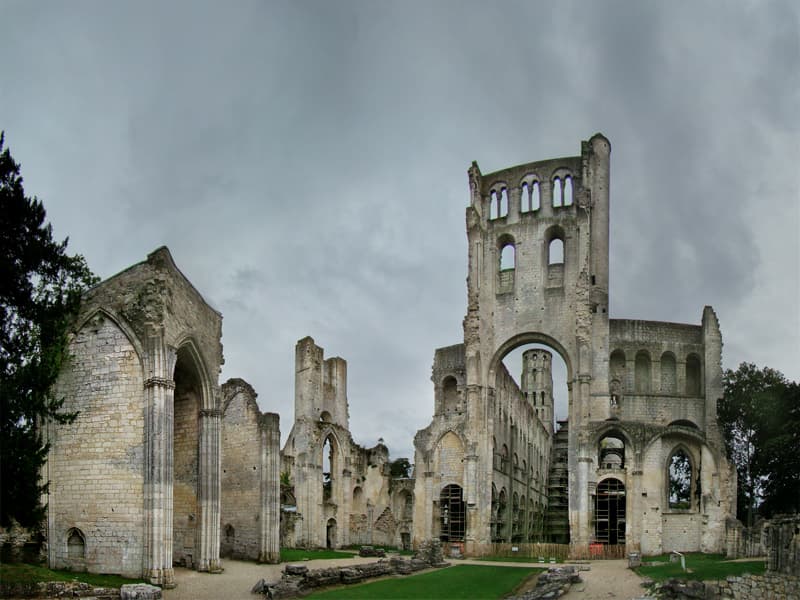
Jumièges Abbey
Jumièges Abbey, formally the Abbey of St Peter at Jumièges, was a significant Benedictine monastery founded in 654. Despite devastating raids by Vikings in 841, it was refounded and rebuilt under the patronage of the Dukes of Normandy, becoming a center of scholarship and a model for monastic life in the region. Today, its impressive ruins stand as a testament to its rich history, with notable surviving structures like its twin towers and western façade.

Noirmoutier Abbey
Noirmoutier Abbey, also known as the Abbey of Saint Philibert, was a significant Benedictine monastery founded in 674 on the island of Noirmoutier. Established by Saint Philibert, the abbey faced numerous destructions and relocations due to Viking raids and other conflicts, eventually becoming a priory under the Abbey of Tournus. Despite its turbulent history, the Merovingian crypt beneath the modern parish church of Saint-Philibert is a notable surviving remnant.

Chelles Abbey
Chelles Abbey was a significant Frankish monastery founded around 657/660, initially for women and later expanding into a double monastery due to its reputation for learning. It held strong royal connections throughout the Carolingian era and was renowned for its scriptorium. The abbey was dissolved during the French Revolution in 1790 and subsequently destroyed, with its remains incorporated into the modern town hall of Chelles.