
Noirmoutier Abbey
Noirmoutier Abbey, also known as the Abbey of Saint Philibert, was a significant Benedictine monastery founded in 674 on the island of Noirmoutier. Established by Saint Philibert, the abbey faced numerous destructions and relocations due to Viking raids and other conflicts, eventually becoming a priory under the Abbey of Tournus. Despite its turbulent history, the Merovingian crypt beneath the modern parish church of Saint-Philibert is a notable surviving remnant.
Key Facts
- ›Founded in 674 by Saint Philibert of Jumièges.
- ›The monastery was repeatedly destroyed and plundered by Saracens and Vikings.
- ›The monks undertook a long peregrination with the relics of Saint Philibert, eventually establishing the Abbey of St. Philibert in Tournus.
- ›Reduced to a priory under the Abbey of Tournus around the year 1000.
- ›A community of Cistercian monks later settled on the island in 1172.
- ›The only surviving architectural remnant is the Merovingian crypt.

Merovingian
Merovingian Crypt
Abbey of Saint Philibert, Abbey of Saint Philibert De Noirmoutier, Herio, Hermoutier
Philibert of JumièGes, Ansoald, Louis the Pious, Charles the Bald, Arnulf, Hibold, Geilo of Tournus
Destruction By Saracens, Attacked By Scandinavian Fleet, Pillaged By Normans and Vikings, Burning Down of the Abbey, Establishment of Cistercian Community
About Noirmoutier Abbey
Noirmoutier Abbey, also known as the Abbey of Saint Philibert, was a Benedictine monastery established in 674 on the island of Noirmoutier by Saint Philibert of Jumièges. The abbey's early history was marked by conflict, forcing Philibert to leave Jumièges and establish a new foundation on the island, then known as Herio.
History and Turmoil
The monastery, which later adopted the name Noirmoutier, flourished for a time, deriving sustenance from salt marshes and farming, and engaging in trade. However, its existence was repeatedly threatened by external invasions. It was destroyed by Saracens in 732 and subsequently plundered by Scandinavian fleets and Viking raiders on multiple occasions between 799 and 846. These repeated attacks led to the monks' dispersal and the eventual burning down of the abbey in 846.
Relocation and Legacy
Following the destruction, the monks embarked on a long and arduous journey, carrying the relics of Saint Philibert. This peregrination led them to various locations, including Déas, Cunault-sur-Loire, Messais, Saint-Pourçain-sur-Sioule, and finally Tournus, where they founded the Abbey of St. Philibert. Around the year 1000, the original site at Noirmoutier was reduced to a priory under the Abbey of Tournus. In 1172, a community of Cistercian monks also settled on the island, establishing the Abbey de la Blanche. The abbey remained in existence until the French Revolution in 1789.
Architectural Remains
Today, the only surviving architectural remnant of the original monastic complex is the Merovingian crypt, which can be found beneath the parish church of Saint-Philibert in Noirmoutier-en-l'Île, serving as a tangible link to the abbey's ancient past.
Source: Wikipedia ↗
Frequently Asked Questions
When was Noirmoutier Abbey founded?
Noirmoutier Abbey was founded in 674 by Saint Philibert of Jumièges. He died at the monastery on August 20, 684.
What was the religious order of Noirmoutier Abbey?
Noirmoutier Abbey was initially a Benedictine monastery. Later, a community of Cistercian monks also settled on the island.
What significant historical events affected the abbey?
The abbey was destroyed by Saracens in 732 and attacked by Scandinavian fleets in 799. It was subsequently pillaged several times by Normans and Vikings between 814 and 846, leading to its eventual burning down.
Where are the surviving remains of Noirmoutier Abbey located?
The only remaining structures from the old buildings are the Merovingian crypt, which is located beneath the parish church of Saint-Philibert in Noirmoutier-en-l'Île.
What happened to the monks and relics after the abbey was destroyed?
After being driven out by Vikings, the monks carried the reliquary containing the body of Saint Philibert. They took refuge in various locations, including Cunault-sur-Loire and Messais, before eventually founding the Abbey of St. Philibert in Tournus.
Related Monasteries

Crespin Abbey
Crespin Abbey was a Benedictine monastery founded around 648 by Landelin of Crespin, a reformed brigand who became its first abbot. The abbey, dedicated to Saint Peter, flourished due to its reputation for miracles but was destroyed by Vikings in the 9th century. Although rebuilt, it housed secular priests before Benedictine monks returned in 1080, continuing until its dissolution in 1802.
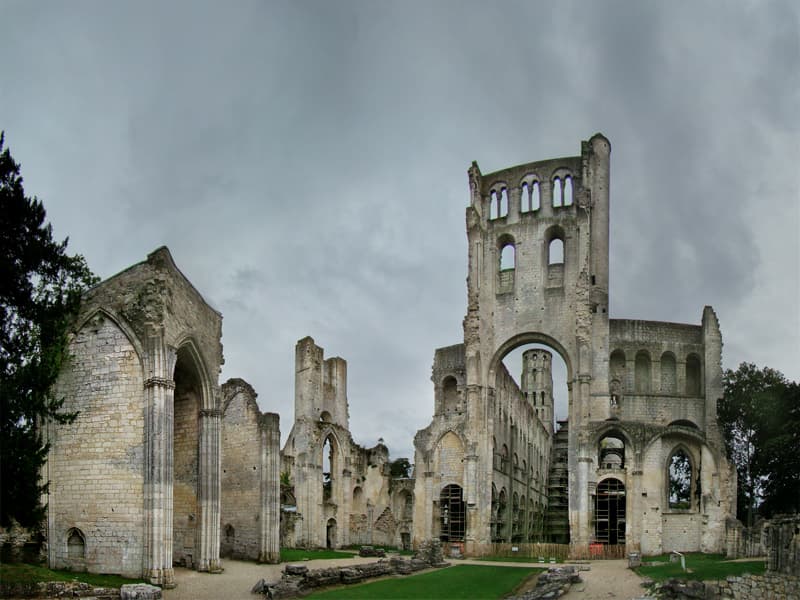
Jumièges Abbey
Jumièges Abbey, formally the Abbey of St Peter at Jumièges, was a significant Benedictine monastery founded in 654. Despite devastating raids by Vikings in 841, it was refounded and rebuilt under the patronage of the Dukes of Normandy, becoming a center of scholarship and a model for monastic life in the region. Today, its impressive ruins stand as a testament to its rich history, with notable surviving structures like its twin towers and western façade.

Chelles Abbey
Chelles Abbey was a significant Frankish monastery founded around 657/660, initially for women and later expanding into a double monastery due to its reputation for learning. It held strong royal connections throughout the Carolingian era and was renowned for its scriptorium. The abbey was dissolved during the French Revolution in 1790 and subsequently destroyed, with its remains incorporated into the modern town hall of Chelles.