
Erenagh Abbey
Christian·Northern Ireland·Ruins (site identified)·12th century
Erenagh Abbey, also known as Abbey of Carryke or Carrig, was a significant early monastic foundation in Ireland, established in 1127. It holds the distinction of being one of the first abbeys of a recognized religious order in Ireland following the Synod of Ráth Breasail. Although no physical remains are known to survive, the site has been recently identified by archaeologists, revealing early European cloister-style architecture. The abbey was destroyed in 1177 by John de Courcy but its legacy is tied to its role in introducing Cistercian practices to Ireland.
Key Facts
- ›Founded in 1127 near St. Finian’s Well in County Down, Northern Ireland.
- ›Notable as an early English monastic presence in Ireland, predating John de Courcy's invasion.
- ›Became part of the Cistercian Order in 1147 as a daughter house of Furness Abbey.
- ›Destroyed in 1177 by John de Courcy.
- ›The exact founder is debated, with figures like Magnellus Makenlefe and Niall Mac Dunlevi being considered.
- ›Archaeological efforts in 2025 have uncovered evidence suggesting the recovery of its site.

European Cloister-Style
- St. Finian’S Well
- Site Identified Through Archaeological Excavation
Abbey of Carryke, Carrig, Templenageerah
Magnellus Makenlefe, Niall Mac Dunlevi, Mcnoellus Makenlef, St. Malachy, Evodius, John De Courcy
- Founded In 1127.
- Joined the Cistercian Order In 1147.
- Destroyed In 1177 By John De Courcy.
- Site Identified Through Archaeological Excavation In 2025.
About Erenagh Abbey
Erenagh Abbey, also known by the names Abbey of Carryke and Carrig, was a significant monastic foundation established in 1127 in the townland of Erenagh, south of Downpatrick in County Down, Northern Ireland. It holds the distinction of being one of the earliest abbeys of a recognized religious order to be established in Ireland following the Synod of Ráth Breasail in 1111. The abbey's foundation is closely linked with figures such as Magnellus Makenlefe and Niall Mac Dunlevi, though scholarly debate continues regarding the precise identity of its founder.
Initially, Erenagh Abbey was part of the order of Savigny. This order was united with the Cistercian Order in 1147, and Erenagh subsequently became a daughter house of Furness Abbey, integrating into the wider Cistercian network. The abbey's early existence was marked by its strategic location and its role in introducing European monastic architectural styles, which contrasted with traditional Irish designs. However, its operational life was cut short when it was destroyed in 1177 by John de Courcy.
While no physical structures of Erenagh Abbey are currently visible, recent archaeological excavations in 2025 have yielded promising evidence, including sections of walls, pottery, and cut stones, leading archaeologists to express confidence in having located the abbey's site. This discovery is crucial for understanding the early monastic landscape of Ireland and the abbey's place within it. The nearby St. Finian’s Well, a natural spring, is also associated with the site and may indicate an even earlier monastic presence in the area, predating the 1127 foundation. The abbey was locally known as Templenageerah, meaning 'church of the sheep.'
Source: Wikipedia ↗
Frequently Asked Questions
When was Erenagh Abbey founded?
Erenagh Abbey was founded in 1127. This was a significant year, marking it as one of the first abbeys of a recognized religious order in Ireland after the Synod of Ráth Breasail in 1111.
Who founded Erenagh Abbey?
The exact founder is a subject of scholarly debate. Historical records mention a figure identified as 'Magnellus Makenlefe,' described as a king of Ulster, who is said to have founded the abbey. Many historians believe this name is a Latinized or corrupted form of Niall Mac Dunlevi, the ruler of the Dál Fiatach.
What religious order did Erenagh Abbey belong to?
Erenagh Abbey was initially associated with the order of Savigny. In 1147, the order of Savigny united with the Cistercian Order, and the community at Erenagh joined the Cistercian Order as a daughter house of Furness Abbey.
What happened to Erenagh Abbey?
In 1177, the abbey was destroyed by John de Courcy. He reportedly saw it as fortified against him. Later, in the 1180s, de Courcy rebuilt a monastery at Inch as a form of amends.
Are there any physical remains of Erenagh Abbey?
No physical remains of the abbey are known to survive. However, the nearby St. Finian’s Well still exists, and recent archaeological excavations in 2025 have uncovered sections of wall, pottery, and cut stones, leading archaeologists to be confident they have located the site.
What does the name 'Erenagh' mean?
The name Erenagh is derived from the Irish 'An Oireanach,' which means 'the cultivated place.' Locally, the abbey was also referred to as Templenageerah, meaning 'church of the sheep.'
Related Monasteries
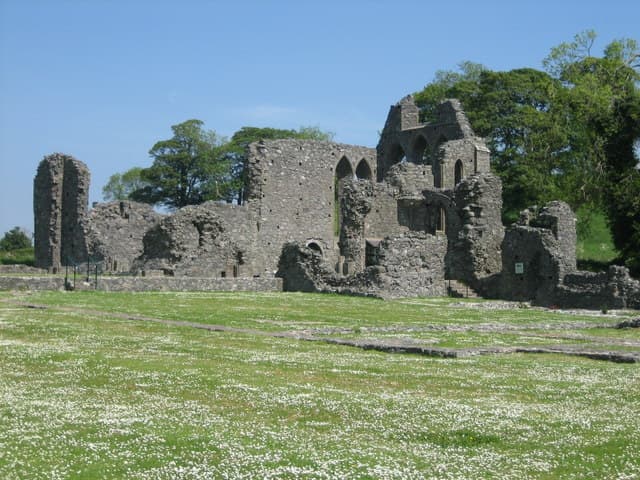
Inch Abbey
Inch Abbey is a ruined Cistercian monastery located near Downpatrick, County Down, Northern Ireland. Founded in the 12th century by John de Courcy and his wife Affreca, it was established as a penance for de Courcy's earlier destruction of Erenagh Abbey. The abbey, initially populated with monks from Furness Abbey, was dissolved in 1541 and has since fallen into ruin.
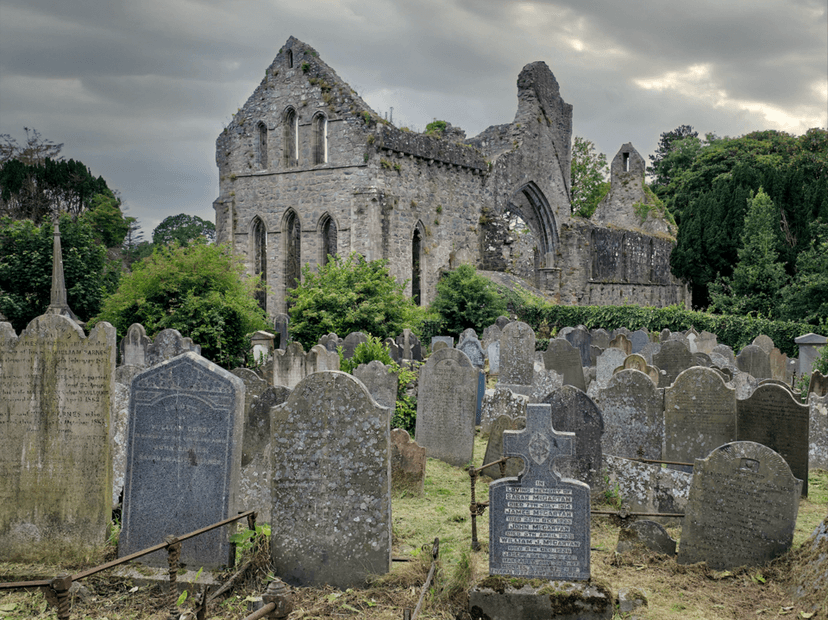
Grey Abbey
Grey Abbey is a ruined Cistercian priory located in Greyabbey, County Down, Northern Ireland. Founded in 1193 by Affreca, wife of John de Courcy, it holds historical significance as a rare example of a Cistercian site with a female patron. The abbey's architecture features early examples of Gothic style in Ireland, particularly in its pointed arches.

Abbaye Blanche
The Abbaye Blanche was a Benedictine nunnery founded in 1112 in Mortain, France, by Saint Vitalis. It was established for women with his sister, Adelina, as its first abbess. The community followed a strict interpretation of the Rule of Saint Benedict and later joined the Cistercian order in 1147. Though much has been lost to time, remnants of its Romanesque and Early Gothic architecture endure.