
Durham Cathedral Priory
Durham Cathedral Priory, originally the Cathedral Church of Christ, Blessed Mary the Virgin and St Cuthbert of Durham, is a significant Church of England cathedral with a history rooted in Anglo-Saxon monasticism. It succeeded Lindisfarne Priory, becoming a Benedictine monastery until its dissolution in 1541, after which it transitioned to a secular chapter. The current structure is a prime example of Norman Romanesque architecture, notable for its early ribbed vaulting, and houses the shrines of Saints Cuthbert and Bede, making it a long-standing pilgrimage site.
Key Facts
- ›Successor to the Anglo-Saxon Lindisfarne Priory, founded circa 635.
- ›Established as a Benedictine Priory in 1083 by William de St-Calais.
- ›The present building's substantial part was completed between 1093 and 1133.
- ›Houses the shrines of Anglo-Saxon saints Cuthbert and the Venerable Bede.
- ›Dissolved in 1541 and subsequently governed by a dean and chapter.
- ›Forms part of the Durham Castle and Cathedral World Heritage Site, designated in 1986.
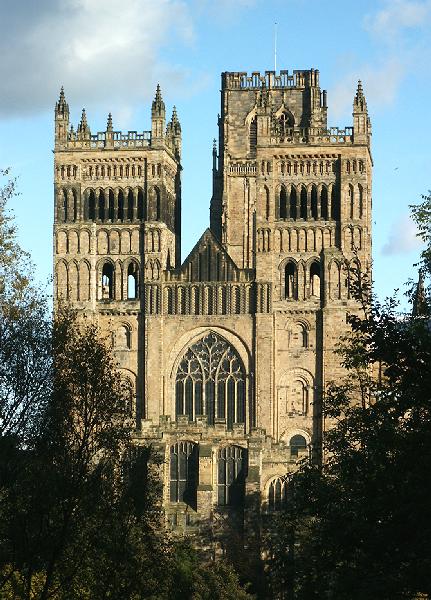
Romanesque, Norman, Early English Gothic, Perpendicular Gothic
- Shrines of Saints Cuthbert and Bede
- Earliest Surviving Example of A Pointed Rib Vault In the Nave Ceiling
- Galilee Chapel
- Chapel of the Nine Altars
- Monks' Refectory
- Prior Castell's Clock
- Cathedral Church of Christ, Blessed Mary the Virgin and St Cuthbert of Durham
- Durham Cathedral Priory
Saint Aidan, Oswald of Northumbria, Saint Cuthbert, the Venerable Bede, Aldhun, William De St-Calais, Aldwin, Turgot of Durham, Ranulf Flambard, Hugh De Puiset, Richard Le Poore, Richard Farnham, Thomas Barton, John Bell, Henry Viii, Hugh Whitehead, John Cosin, John Sudbury, George Nicholson, William Morpeth, James Wyatt, William Lloyd Wharton, Mr Carr, Anthony Salvin, George Gilbert Scott, Edward Robert Robson, Charles Hodgson Fowler, Joseph Barber Lightfoot, George Waddington, Clayton and Bell, William Van Mildert, Cyril Alington, Ninian Comper, Thetis Blacker, Hugh Ray Easton, Mark Angus, Josef Pyrz, Leonard Evetts, Paula Rego, Fenwick Lawson, Tom Denny, Michael Ramsey
- Abandonment of Lindisfarne Priory Due To Viking Raids
- Settlement At Chester-Le-Street
- Move To Durham and Founding of the Cathedral Site
- Foundation of the Benedictine Priory of St. Cuthbert
- Laying of Foundation Stone For the Present Cathedral
- Transfer of St. Cuthbert's Remains To the New Cathedral
- Dissolution of the Monastery
- Use As A Prison For Scottish Prisoners of War
- Destruction of St. Cuthbert's Tomb
About Durham Cathedral Priory
Durham Cathedral Priory, formally known as the Cathedral Church of Christ, Blessed Mary the Virgin and St Cuthbert of Durham, stands as a monumental edifice in the city of Durham, England. Its origins trace back to the Anglo-Saxon era, succeeding the Lindisfarne Priory which was established around 635 and abandoned in 875 due to Viking raids. The monks, carrying the relics of Saint Cuthbert, eventually settled at Durham in 995, leading to the construction of earlier churches on the site.
The present cathedral's foundation stone was laid in 1093 by Bishop William de St-Calais, who also established the Benedictine Priory of St. Cuthbert in 1083, replacing secular canons with Benedictine monks. The cathedral evolved significantly during the Norman period, with much of the present structure completed between 1093 and 1133. It is a paramount example of Romanesque architecture, renowned for its innovative ribbed vaulting in the nave, considered a turning point in architectural history. Subsequent additions were made in the Early English Gothic and Perpendicular Gothic styles.
Durham Cathedral Priory served as a monastic center until its dissolution in 1541 during the English Reformation, after which it transitioned to a secular chapter governed by a dean and chapter. The cathedral is notable for housing the shrines of two significant Anglo-Saxon saints: Saint Cuthbert and The Venerable Bede. Its historical importance is further underscored by its designation as a Grade I listed building and its inclusion as part of the Durham Castle and Cathedral World Heritage Site in 1986. The site has also witnessed significant historical events, including its use as a prison for Scottish prisoners of war following the Battle of Dunbar in 1650.
Source: Wikipedia ↗
Frequently Asked Questions
When was Durham Cathedral Priory founded?
The origins of the See of Durham trace back to the Diocese of Lindisfarne, founded by Saint Aidan around 635. The Benedictine Priory of St. Cuthbert at Durham was founded in 1083 by William de St-Calais.
What is the architectural style of Durham Cathedral?
The cathedral is a significant example of the Romanesque architectural style, with a substantial part of the present building completed between 1093 and 1133. It also features additions in the Early English Gothic and Perpendicular Gothic styles.
What notable relics are housed at Durham Cathedral?
Durham Cathedral is home to the shrines of the Anglo-Saxon saints Cuthbert and the Venerable Bede. The relics of Saint Cuthbert were transferred to the new cathedral in 1104 and remained there until the dissolution of the monasteries.
Has Durham Cathedral always been a place of worship?
The site has a continuous history of religious use for over 1000 years. It began as an Anglo-Saxon priory, became a Benedictine monastery, and after the dissolution in 1541, it became a Church of England cathedral.
Is Durham Cathedral a UNESCO World Heritage Site?
Yes, in 1986, Durham Cathedral, along with Durham Castle, was designated a UNESCO World Heritage Site. It is recognized for its monumental Norman architecture and its continuity of use as a place of religious worship, learning, and residence.
What historical events have taken place at Durham Cathedral?
During the Wars of the Three Kingdoms in the 17th century, the cathedral was used as a prison for Scottish prisoners of war, with many dying within its walls. The shrine of Saint Cuthbert was destroyed in 1538 during the English Reformation.
Related Monasteries

Canterbury Cathedral Priory
Canterbury Cathedral Priory, formally known as the Priory of Christ Church, Canterbury, was a Benedictine monastic community intrinsically linked to the seat of the Archbishop of Canterbury. Founded in 597 AD, it underwent significant rebuilding and expansion throughout its history, notably after fires in 1174 and a major reconstruction in the Gothic style. Its importance was amplified by its role as a major pilgrimage site, particularly for the shrine of Thomas Becket, which significantly funded its later architectural developments.

Évora
Évora is a historic city in Portugal's Alentejo region, renowned for its remarkably well-preserved old town center, medieval walls, and numerous monuments spanning various historical periods. Originally founded by the Celtici as Ebora, it flourished under Roman rule, became an important center during Arab Islamic rule, and was a significant royal residence during Portugal's Middle Ages, particularly the 15th century. Its rich cultural and artistic heritage, evidenced by diverse architectural styles and numerous historical sites, led to its designation as a UNESCO World Heritage Site in 1986.

Tournai
Tournai is one of Belgium's oldest cities, situated on the river Scheldt and historically significant as the first capital of the Frankish Empire. Its cultural heritage is marked by its Romanesque and Gothic cathedral and its influential role in medieval art and textiles. The city has experienced periods of French, English, and Spanish rule, reflecting its strategic importance throughout European history.