
Colchester — St John's Abbey
Colchester — St John's Abbey was a Benedictine monastic institution founded in 1095 by Eudo Dapifer and dissolved in 1539. Situated in Colchester, Essex, it played a significant role in the town's medieval history, experiencing periods of prosperity, conflict with townspeople and other religious houses, and internal discipline issues. Following its dissolution, most of the abbey was demolished, with only the gatehouse substantially surviving, while the abbey church's foundations were rediscovered in 2010.
Key Facts
- ›Founded in 1095 by Eudo Dapifer on the site of a former Saxon church.
- ›Became a Benedictine priory, then an abbey in 1104.
- ›Suffered a major fire in 1133, necessitating significant reconstruction.
- ›Dissolved in 1539, with its last abbot, John Beche, executed for treason.
- ›The elaborate gatehouse is the most substantial surviving remnant.
- ›Foundations of the abbey church were rediscovered in 2010.

Elaborate Gatehouse, Foundations of the Abbey Church, Relic of St Thomas Becket's Blood
Colchester Abbey
Eudo Dapifer, Siric/Sigeric, Bishop of London, Ralph, Abbot Stephen of York, Hugh, St Thomas Becket, King Henry Iii, Bishop Baldock, Berengar De Monte Alto, John Beche, Sir Thomas Darcy, Lucas Family, Sir Charles Lucas, Viscount Lovell, Richard of Shrewsbury, Duke of York, Cecily Neville, John Howard, 1st Duke of Norfolk
- Founding of the Monastery
- Granting of Abbey Status
- Major Fire and Reconstruction
- Receiving the Relic of St Thomas Becket's Blood
- Disputes With Townspeople and St Botolph's Priory
- Black Death Epidemic
- Peasants' Revolt
- Dissolution of the Monasteries
- Destruction During the Siege of Colchester
- Rediscovery of Abbey Church Foundations
About Colchester — St John's Abbey
Colchester — St John's Abbey, also known as Colchester Abbey, was a prominent Benedictine monastic institution located in Colchester, Essex. Founded in 1095 by Eudo Dapifer, the abbey's establishment marked a significant Norman presence in the town, evolving from a priory to an abbey in 1104. The site was chosen due to its association with a Saxon church dedicated to St. John the Baptist or St. John the Evangelist, where miraculous voices were reputedly heard.
History and Significance
The abbey's early years were marked by a devastating fire in 1133, which led to substantial reconstruction and a redesign of the monastic layout. Throughout the medieval period, St. John's Abbey was a focal point of religious life but also a site of considerable conflict. It engaged in long-standing disputes with the townspeople of Colchester over jurisdiction and rights, and experienced confrontations with the nearby St. Botolph's Priory. The abbey housed a prized relic, a vial of St. Thomas Becket's blood, believed to possess healing powers.
Dissolution and Later History
The abbey's history concluded with the Dissolution of the Monasteries under Henry VIII. Despite initial resistance, St. John's Abbey was dissolved in 1539, and its last abbot, John Beche, was executed for treason. Following the dissolution, most of the abbey's structures were demolished. A manor house was constructed on the site, which was subsequently destroyed during the English Civil War's Siege of Colchester in 1648. Today, the most significant surviving element is the abbey's elaborate gatehouse, with the substantial foundations of the abbey church only being rediscovered through archaeological excavations in 2010.
Source: Wikipedia ↗
Frequently Asked Questions
When was St John's Abbey founded?
St John's Abbey was founded in 1095 by Eudo Dapifer. The outline of the building was marked on the ground on August 29, 1096, and construction took place between 1096 and 1115.
What religious order was St John's Abbey part of?
St John's Abbey was a Benedictine monastic institution. It began as a priory and was granted abbey status in 1104.
What happened to St John's Abbey after its dissolution?
Following its dissolution in 1539, most of the abbey buildings were demolished. A large private house was built on the site, which was itself destroyed during the 1648 siege of Colchester.
What remains today of St John's Abbey?
The most substantial remnant of St John's Abbey is its elaborate gatehouse. The foundations of the abbey church were rediscovered in 2010 through archaeological excavations.
Was St John's Abbey involved in any conflicts?
Yes, St John's Abbey was involved in numerous disputes and confrontations throughout its history. These included conflicts with the townspeople of Colchester, the Augustinian convent of St Botolph's Priory, and rebels during the Peasants' Revolt.
What was the significance of the relic at St John's Abbey?
The abbey's most treasured relic was a vial of St Thomas Becket's blood, received around 1170. Supernatural healing powers were attributed to it.
Related Monasteries

Barnwell Priory
Barnwell Priory was an Augustinian priory founded around 1092 by Picot of Cambridge and his wife Hugolina. It served as a house of Canons Regular and played a role in the early establishment of the University of Cambridge due to its scriptorium and library. The priory was dissolved in 1538, and most of its buildings were later destroyed, with only a 13th-century claustral building and scattered remnants surviving.

Bromley-by-Bow Priory
Bromley-by-Bow is a district in East London with a history stretching back to at least the year 1000, when it was a manor belonging to St Paul's Cathedral. It was historically known as Bromley and later Bromley-by-Bow to distinguish it from other places named Bromley. The area was once home to St Leonard's Priory, a Benedictine nunnery, and later saw the construction of royal palaces and significant industrial development. Despite losing many historic buildings, it remains a vibrant community with ongoing redevelopment and a notable connection to Mahatma Gandhi's 1931 visit.
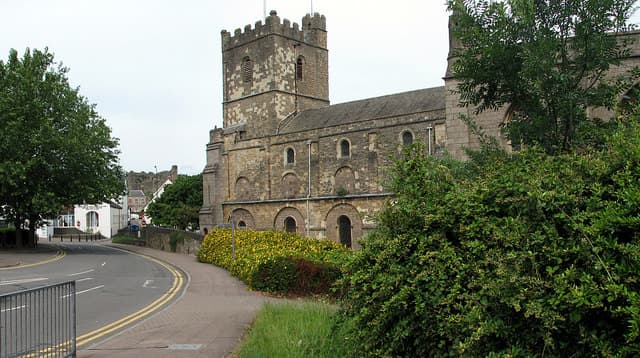
Chepstow Priory
Chepstow Priory, officially the Parish and Priory Church of St Mary, is a historic Benedictine monastery located in Chepstow, Monmouthshire, south east Wales. Founded around 1072 by William Fitzosbern, parts of its Norman church, including its ornate west doorway, survive and are contemporary with the nearby Chepstow Castle. Though it likely never housed more than a dozen monks, the priory played a significant role in the development of Chepstow as a market town and port, with its nave serving as the parish church. The priory was suppressed in 1536 during the Dissolution of the Monasteries, leading to the demolition of most of its buildings.