
Barnwell Priory
Barnwell Priory was an Augustinian priory founded around 1092 by Picot of Cambridge and his wife Hugolina. It served as a house of Canons Regular and played a role in the early establishment of the University of Cambridge due to its scriptorium and library. The priory was dissolved in 1538, and most of its buildings were later destroyed, with only a 13th-century claustral building and scattered remnants surviving.
Key Facts
- ›Founded circa 1092 by Picot of Cambridge and his wife Hugolina.
- ›Operated as a house of Canons Regular following the Rule of St. Augustine.
- ›Home to an anonymous chronicler who wrote about King John's reign.
- ›Contributed to the early establishment of the University of Cambridge.
- ›Dissolved in 1538 as part of the Dissolution of the Monasteries.
- ›The only surviving substantial part is a 13th-century claustral building, Grade II* listed.

Gothic
- 13th-Century Claustral Building
- Remnants In Abbey House Walls, Cellar, and Gardens
- Scriptorium and Library
- Barnwell Chronicler
Picot of Cambridge, Hugolina, Henry I, Pain Peverel, Anthony Brown, Edward, Lord Clinton
- Founded As A House of Canons Regular
- Moved and Expanded By Pain Peverel
- Targeted During the Peasants' Revolt
- Hosted the Cambridge Parliament
- Dissolved As Part of the Dissolution of the Monasteries
About Barnwell Priory
Barnwell Priory was an Augustinian priory located in Barnwell, Cambridgeshire, England. Founded around 1092 by Picot of Cambridge, the High Sheriff of Cambridgeshire, and his wife Hugolina, it was established as a house of Canons Regular adhering to the Rule of St. Augustine. The priory's strategic location and its role as a landowner contributed to its wealth and influence.
History and Significance
The foundation of Barnwell Priory likely stemmed from a vow made by Hugolina. Initially established by Picot at St Giles' Church by Cambridge Castle, it was later moved and expanded to its Barnwell site by Pain Peverel, with land granted by Henry I. Over time, Barnwell Priory grew, accommodating up to 30 canons and holding an annual fair that augmented its income. The priory possessed an active scriptorium and a well-stocked library, which, along with its extensive landholdings, is believed to have aided in the early establishment of the University of Cambridge. Much of the understanding of English Augustinian life in the 13th century comes from the "Barnwell Observances" written there.
The priory's prosperity made it a target during the Peasants' Revolt in 1381. It also served as a venue for the Cambridge Parliament, which met there between September 10 and October 17, 1388. Barnwell Priory was dissolved on November 11, 1538, as part of King Henry VIII's Dissolution of the Monasteries. Its lands were subsequently granted to individuals like Anthony Brown and Edward, Lord Clinton.
Surviving Structures
Following its dissolution, the priory's buildings largely fell into ruin and were substantially destroyed by 1810. The only surviving major component of Barnwell Priory is a 13th-century claustral building, which is now a Grade II* listed monument. Additional remnants of the priory can be found incorporated into the walls, cellar, and gardens of the modern-day Abbey House.
Source: Wikipedia ↗
Frequently Asked Questions
When was Barnwell Priory founded?
Barnwell Priory was founded in approximately 1092. The foundation was initiated by Picot of Cambridge, the High Sheriff of Cambridgeshire, and his wife Hugolina.
What religious order was Barnwell Priory a part of?
Barnwell Priory was a house of Canons Regular, following the Rule of St. Augustine. This order combined monastic life with pastoral duties.
What is the current status of Barnwell Priory?
Barnwell Priory no longer exists as an active monastic institution. It was dissolved in 1538, and most of its structures were later destroyed, though some remnants survive.
Are there any surviving parts of Barnwell Priory?
Yes, the only surviving significant part of Barnwell Priory is a 13th-century claustral building, which is a Grade II* listed structure. Remnants are also found in the walls, cellar, and gardens of the adjacent Abbey House.
What was the significance of Barnwell Priory?
Barnwell Priory was notable for its scriptorium, well-stocked library, and its role as a landlord, which helped in the early establishment of the University of Cambridge. It was also home to the Barnwell chronicler.
Related Monasteries

Colchester — St John's Abbey
Colchester — St John's Abbey was a Benedictine monastic institution founded in 1095 by Eudo Dapifer and dissolved in 1539. Situated in Colchester, Essex, it played a significant role in the town's medieval history, experiencing periods of prosperity, conflict with townspeople and other religious houses, and internal discipline issues. Following its dissolution, most of the abbey was demolished, with only the gatehouse substantially surviving, while the abbey church's foundations were rediscovered in 2010.

Bromley-by-Bow Priory
Bromley-by-Bow is a district in East London with a history stretching back to at least the year 1000, when it was a manor belonging to St Paul's Cathedral. It was historically known as Bromley and later Bromley-by-Bow to distinguish it from other places named Bromley. The area was once home to St Leonard's Priory, a Benedictine nunnery, and later saw the construction of royal palaces and significant industrial development. Despite losing many historic buildings, it remains a vibrant community with ongoing redevelopment and a notable connection to Mahatma Gandhi's 1931 visit.
Chepstow Priory
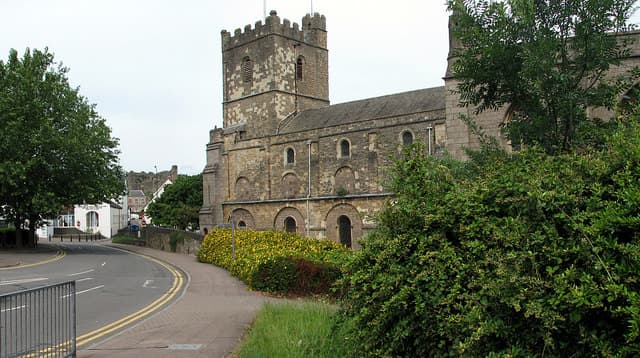
Chepstow Priory, officially the Parish and Priory Church of St Mary, is a historic Benedictine monastery located in Chepstow, Monmouthshire, south east Wales. Founded around 1072 by William Fitzosbern, parts of its Norman church, including its ornate west doorway, survive and are contemporary with the nearby Chepstow Castle. Though it likely never housed more than a dozen monks, the priory played a significant role in the development of Chepstow as a market town and port, with its nave serving as the parish church. The priory was suppressed in 1536 during the Dissolution of the Monasteries, leading to the demolition of most of its buildings.