
Bromley-by-Bow Priory
Bromley-by-Bow is a district in East London with a history stretching back to at least the year 1000, when it was a manor belonging to St Paul's Cathedral. It was historically known as Bromley and later Bromley-by-Bow to distinguish it from other places named Bromley. The area was once home to St Leonard's Priory, a Benedictine nunnery, and later saw the construction of royal palaces and significant industrial development. Despite losing many historic buildings, it remains a vibrant community with ongoing redevelopment and a notable connection to Mahatma Gandhi's 1931 visit.
Key Facts
- ›The name Bromley likely derives from the Saxon words for 'bramble' and 'field'.
- ›St Leonard's Priory, a Benedictine nunnery, was founded in the time of William the Conqueror.
- ›The priory was destroyed during the Dissolution of the Monasteries in 1536.
- ›Bromley-by-Bow was historically part of the county of Middlesex.
- ›Mahatma Gandhi stayed at Kingsley Hall in Bromley-by-Bow for three months in 1931.
- ›The area has undergone significant redevelopment, particularly in the Lower Lea Valley.

St Leonard's Priory, Bromley Hall, Kingsley Hall, Victorian Gasholders, Lea Valley Walk
Bromley, Bromley-St Leonards
William the Conqueror, Geoffrey Chaucer, Sir Ralph Sadleir, Henry Viii, James I, Charles Ii, James Ii, Oliver Cromwell, Mahatma Gandhi, Dr. Thomas Barnardo, Henry Grattan Guinness, Revd Richard Enraght, Andrew Mawson, John Bastow, William Harold Joseph Childs, William Faulkner, Tommy Flowers, Jack Warner, Elsie Waters, Doris Waters, Mary Price, Professor Ralph Kekwick
- Founding of St Leonard's Priory
- Destruction of St Leonard's Priory During the Dissolution
- Creation of the Parish of Bromley St Leonard
- Construction of A Palace For James I
- Mahatma Gandhi's Stay At Kingsley Hall
- Heavy Bombing During the Blitz
- Destruction of St Leonards Church
- Redevelopment of Aberfeldy Estate
- Construction of Blackwall Tunnel Approach Road
- R. D. Laing's Clinic At Kingsley Hall
- Renaming of Bromley Tube Station
- Introduction of London Underground District and Hammersmith & City Lines To Bromley-By-Bow Station
- Closure of St Andrew's Hospital
- Opening of Langdon Park Dlr Station
- Relocation of Bow School To A New Building In Bromley-By-Bow
- Filming of Apple Tree House On the Devons Estate
About Bromley-by-Bow Priory
Bromley-by-Bow
Bromley-by-Bow is a historic district situated in East London, within the London Borough of Tower Hamlets. Its origins trace back to at least the year 1000, when it was recorded as a manor belonging to St Paul's Cathedral. The name itself, likely derived from the Saxon words for 'bramble' and 'field', evolved over time, with the '-by-Bow' suffix being adopted to distinguish it from other places named Bromley, a practice with roots in historical usage.
Historical Significance and Institutions
The area was once home to St Leonard's Priory, a Benedictine nunnery established during the era of William the Conqueror and even referenced in Geoffrey Chaucer's "Canterbury Tales." This priory met its end during the Dissolution of the Monasteries in 1536. Following this, the priory chapel was repurposed as the parish church for the newly formed parish of Bromley St Leonard in 1537. The area also witnessed the construction of a royal palace for James I in 1606, which served as a hunting lodge and grand residence, with some of its stonework sourced from the remnants of the priory. Later centuries saw the area develop industrially, with institutions such as the Bromley Hall, thought to be London's oldest brick house, and the Poplar and Stepney Sick Asylum (later St Andrew's Hospital).
Notable Events and Figures
Bromley-by-Bow holds a significant place in 20th-century history due to the stay of Mahatma Gandhi at Kingsley Hall for three months in 1931. He chose to live among the working-class residents of the East End during his visit for talks with the British government. The area also endured considerable damage during the Blitz in World War II, with St Leonards Church being destroyed in 1941. In more recent times, Kingsley Hall has continued its role as a community hub, also hosting a therapeutic clinic run by R. D. Laing. The district is currently undergoing substantial redevelopment, particularly in the Lower Lea Valley, aiming to introduce new housing and employment opportunities.
Source: Wikipedia ↗
Frequently Asked Questions
What is the origin of the name Bromley-by-Bow?
The name Bromley likely originates from the Saxon words 'Brembel' meaning bramble, and 'lege' meaning field. The addition of '-by-Bow' was adopted to prevent confusion with Bromley South station and has historical precedent, appearing in correspondence from Oliver Cromwell.
What was St Leonard's Priory?
St Leonard's Priory was a Benedictine nunnery founded in the area during the reign of William the Conqueror. It is even mentioned in Geoffrey Chaucer's Canterbury Tales. The priory was destroyed during the Dissolution of the Monasteries in 1536.
When did Bromley-by-Bow become a parish?
The area became a parish in 1537 when it separated from Stepney. The boundaries of this new parish were established based on older, pre-existing estates.
What is the significance of Kingsley Hall in Bromley-by-Bow?
Kingsley Hall is famous for hosting Mahatma Gandhi during his 1931 visit to London for discussions on India's future. It also served as a therapeutic clinic run by psychologist R. D. Laing from 1965 and remains an active community centre today.
Has Bromley-by-Bow suffered damage historically?
Yes, the area suffered heavily during the Blitz in World War II. St Leonards Church was destroyed by enemy action in 1941, and areas around Aberfeldy Street were heavily bombed and subsequently redeveloped.
Is Bromley-by-Bow undergoing redevelopment?
Yes, the land between the River Lea and the A11 is currently undergoing extensive redevelopment. The London Thames Gateway Development Corporation aims to create new homes and jobs in the area, with adjacent developments also underway.
Related Monasteries

Llanarthney
Llanarthney is a village and community located in Carmarthenshire, south-west Wales, situated between the towns of Carmarthen and Llandeilo. The community is notable for being the location of the National Botanic Garden of Wales, which has been established there since 2000. Its population has seen a slight increase between the 2001 and 2011 censuses.
Chepstow Priory
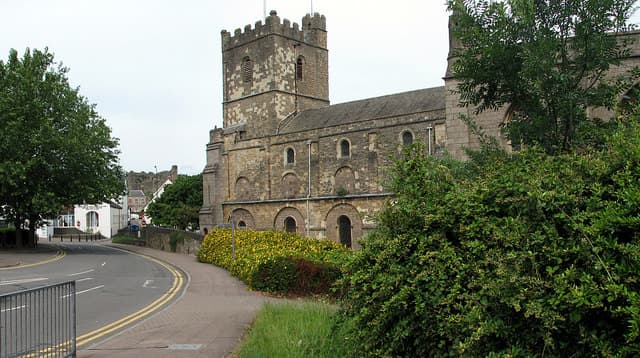
Chepstow Priory, officially the Parish and Priory Church of St Mary, is a historic Benedictine monastery located in Chepstow, Monmouthshire, south east Wales. Founded around 1072 by William Fitzosbern, parts of its Norman church, including its ornate west doorway, survive and are contemporary with the nearby Chepstow Castle. Though it likely never housed more than a dozen monks, the priory played a significant role in the development of Chepstow as a market town and port, with its nave serving as the parish church. The priory was suppressed in 1536 during the Dissolution of the Monasteries, leading to the demolition of most of its buildings.

Colchester — St John's Abbey
Colchester — St John's Abbey was a Benedictine monastic institution founded in 1095 by Eudo Dapifer and dissolved in 1539. Situated in Colchester, Essex, it played a significant role in the town's medieval history, experiencing periods of prosperity, conflict with townspeople and other religious houses, and internal discipline issues. Following its dissolution, most of the abbey was demolished, with only the gatehouse substantially surviving, while the abbey church's foundations were rediscovered in 2010.