
Saxon
Saxon is a municipality in the Valais canton of Switzerland, first mentioned in 1153. It is situated in the Martigny district along the left bank of the Rhone River, with its territory extending from the Pierre-à-Voir mountain down to the river. The municipality encompasses the main village of Saxon, the village of Gottefrey, and several smaller hamlets. Its economy is diverse, with significant employment in agriculture, industry, and services.
Key Facts
- ›First mentioned in historical records in 1153 as 'de Saxone'.
- ›Located in the Martigny district of the canton of Valais, Switzerland.
- ›Covers an area of 23.2 square kilometers, with a significant portion dedicated to forests (50.6%) and agriculture (31.9%).
- ›Its territory stretches from the Pierre-à-Voir mountain down to the Rhone River.
- ›The primary language spoken is French, accounting for 85.9% of the population in 2000.
- ›In 2000, 77.8% of the population identified as Roman Catholic.

Pierre-à-Voir Mountain, Rhone River, BibliothèQue Communale Et Scolaire Library
Sasson
About Saxon
Saxon is a municipality located in the Martigny district of the canton of Valais, Switzerland. Its name is recorded in historical documents as early as 1153, when it was referred to as 'de Saxone'. The municipality's territory is geographically diverse, stretching from the significant elevation of the Pierre-à-Voir mountain, which reaches 2,476 meters, down to the level of the Rhone River. This varied terrain includes the main village of Saxon, the smaller village of Gottefrey, and a number of scattered hamlets.
Geography and Land Use
As of 2011, Saxon encompassed an area of 23.2 square kilometers. The land use within the municipality is varied, with 50.6% dedicated to forests, 31.9% to agricultural purposes, 9.3% to settled areas including buildings and roads, and 8.1% classified as unproductive land. This distribution highlights a balance between natural environments and human development.
Demographics and Language
In December 2020, Saxon had a population of 6,278 residents. The linguistic landscape of Saxon is predominantly French-speaking, with 85.9% of the population reporting French as their first language as of the 2000 census. Portuguese and Albanian were the next most common languages. The population has experienced significant growth over the decade from 2000 to 2010, with a 29.8% increase, largely driven by migration.
Economy
The economy of Saxon is multifaceted, supporting employment across primary, secondary, and tertiary sectors. As of 2010, the unemployment rate stood at 9.7%. The primary sector, largely agricultural, employed 225 people. The secondary sector involved 229 individuals, with manufacturing and construction being key areas. The tertiary sector was the largest employer, with 734 people engaged in wholesale, retail, hospitality, technical professions, healthcare, and education. Saxon is a net exporter of workers, indicating that more residents commute out of the municipality for employment than commute in.
Religion
Religious affiliation in Saxon, as per the 2000 census, showed a strong Roman Catholic presence, with 77.8% of the population identifying with this faith. The Swiss Reformed Church was the second largest denomination. Other Christian traditions, Islam, Buddhism, and Judaism were also represented among the residents, with a notable portion of the population identifying as agnostic or atheist.
Source: Wikipedia ↗
Frequently Asked Questions
When was Saxon first documented?
Saxon is first mentioned in historical records in the year 1153. At that time, it was referred to as 'de Saxone'.
Where is Saxon located?
Saxon is situated in the Martigny district, within the canton of Valais, in Switzerland. It lies along the left bank of the Rhone River.
What is the primary language spoken in Saxon?
The most commonly spoken language in Saxon is French. In the year 2000 census, 85.9% of the population reported French as their first language.
What is the religious composition of Saxon?
According to the 2000 census, the majority of Saxon's population, 77.8%, identified as Roman Catholic. Other Christian denominations and Islam were also represented among the residents.
What is the geographical extent of Saxon?
Saxon's area spans 23.2 square kilometers. Its territory extends from the high elevation of the Pierre-à-Voir mountain down to the Rhone River.
Related Monasteries
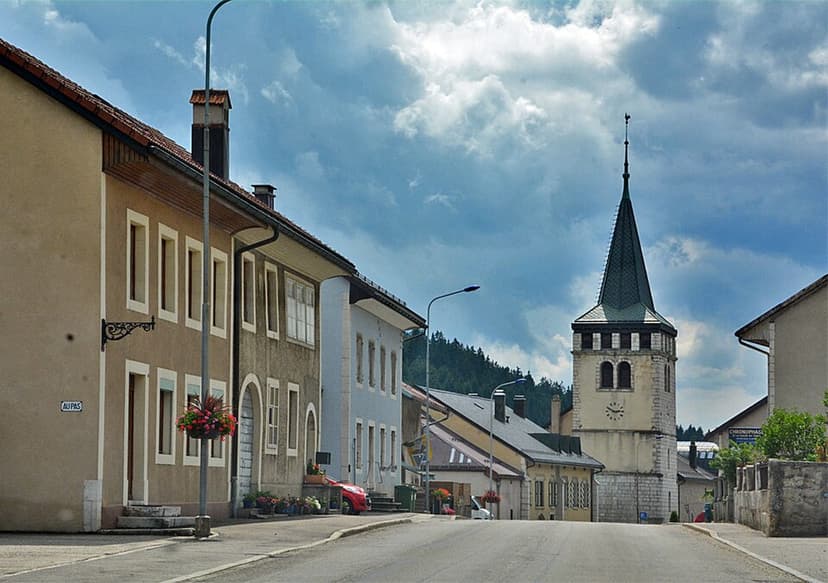
Le Lieu
Le Lieu is a Swiss municipality located in the canton of Vaud, within the Jura-Nord Vaudois district. First mentioned in 1155 as a place inhabited by a hermit, the area has historical roots tied to religious settlement. Today, it comprises several villages and hamlets, situated on the eastern shore of Lac de Joux, and is recognized for its significant forested and agricultural land.

Küsnacht
Küsnacht is a municipality situated in the district of Meilen within the Swiss canton of Zürich, located on the Goldküste of Lake Zurich. Its history stretches back to the Stone Age, with evidence of Roman settlement and a name likely derived from a Roman villa. The area was historically governed by local aristocrats and later by Zürich, transforming into a suburban center with the advent of the railway.

Amay
Amay is a municipality in the province of Liège, Belgium, situated on the Meuse River. Its origins trace back to a Gallo-Roman vicus, and it later developed around a medieval ford. The area is known for its historical sites, including the 16th-century Castle of Jehay-Bodegnée, and has been home to notable figures like mathematician François Walther de Sluze and inventor Zénobe Gramme.