
Küsnacht
Küsnacht is a municipality situated in the district of Meilen within the Swiss canton of Zürich, located on the Goldküste of Lake Zurich. Its history stretches back to the Stone Age, with evidence of Roman settlement and a name likely derived from a Roman villa. The area was historically governed by local aristocrats and later by Zürich, transforming into a suburban center with the advent of the railway.
Key Facts
- ›First mentioned in 1188 as 'de Cussenacho'.
- ›Earliest settlement findings date back to the Stone Age.
- ›Roman settlement evidence includes a mansion named 'fundus Cossiniacus'.
- ›Historically governed by the House of Regensberg and later by Zürich.
- ›Became a suburb of Zürich with the railway development in 1896.
- ›Notable residents have included Carl Jung, Thomas Mann, and Tina Turner.

Lake Zurich, C. G. Jung Institute, KüSnachter Tobel, Johanniterkomturei Building, Oberen MüHle, Seeclub KüSnacht Boathouse, Church of St Georg, Ruins of Wulp Castle, KüSnachter Horn
Carl Jung, Thomas Mann, Tina Turner, Eugen Sutermeister, Paul Sutermeister, Meinrad Lienert, Emma Jung, Albin Zollinger, Albert Frey-Wyssling, Bernard Von Brentano, Hermann Haller, Marie-Louise Von Franz, Ursula Biemann, Rolf DöRig, Mario Fehr, Monisha Kaltenborn, Severino Minelli, Martin Studach, Karl Grob
- Development of the Railway Link In 1896 Led To Suburban Growth.
About Küsnacht
Küsnacht is a municipality located in the district of Meilen within the Swiss canton of Zürich. It is situated on the northeastern bank of Lake Zurich, an area often referred to as the Goldküste. Archaeological findings indicate settlement in the region dating back to the Stone Age, with further evidence from the Bronze Age and Roman periods, including a Roman mansion that may be the origin of the town's name.
History and Development
The earliest recorded mention of Küsnacht is from 1188 as 'de Cussenacho'. Historically, the area was governed by local nobility, notably the House of Regensberg who resided in Wulp Castle, and later by the city of Zürich after 1531. A significant transformation occurred in 1896 with the development of the railway link, which facilitated Küsnacht's growth into a suburb of Zürich. This development marked a shift from its historical governance to a more modern, residential role.
Notable Residents and Cultural Significance
Küsnacht has attracted and been home to several internationally recognized figures. The renowned psychiatrist Carl Jung established his clinic here, drawing patients from around the globe. The writer Thomas Mann resided in Küsnacht between 1933 and 1939, having been forced to leave Germany by the Nazis. More recently, the iconic singer Tina Turner lived in Küsnacht until her death in 2023, further cementing the town's association with prominent cultural personalities.
Geography and Demographics
With an area of 12.3 km², Küsnacht features a mix of agricultural land, forests, and settled areas. Its location on Lake Zurich provides scenic beauty and recreational opportunities. The municipality has a substantial population, with a diverse demographic makeup. As of recent records, a significant portion of the population has completed higher education, and the economy is primarily driven by the tertiary sector. Religious affiliations show a balance between Protestant and Catholic communities, with smaller percentages belonging to other religions or identifying as atheist or agnostic.
Source: Wikipedia ↗
Frequently Asked Questions
What is the origin of the name Küsnacht?
The name Küsnacht is believed to originate from the Roman period. It is likely derived from 'fundus Cossiniacus', the name of a Roman mansion located in the area.
When was Küsnacht first mentioned in historical records?
Küsnacht is first mentioned in historical records in the year 1188. At that time, it was recorded as 'de Cussenacho'.
What historical periods have evidence of settlement in Küsnacht?
Evidence of settlement in Küsnacht dates back to the Stone Age. There are also findings from the Bronze Age, indicating continuous habitation over millennia. During Roman times, a mansion was present in the area.
Who governed Küsnacht during the Middle Ages?
During the Middle Ages, the land in Küsnacht was governed by the House of Regensberg, who resided in the castle of Wulp. Following 1531, Küsnacht came under the governance of Zürich.
What significant changes occurred in Küsnacht with the development of the railway?
With the development of the railway link in 1896, Küsnacht began to transform. Like many other municipalities along Lake Zurich, it started to become a suburb of the city of Zürich.
Which notable figures have lived in Küsnacht?
Küsnacht has been home to several prominent individuals. These include the psychiatrist Carl Jung, who had his clinic there, the writer Thomas Mann, and most recently, the singer Tina Turner.
Related Monasteries
Le Lieu
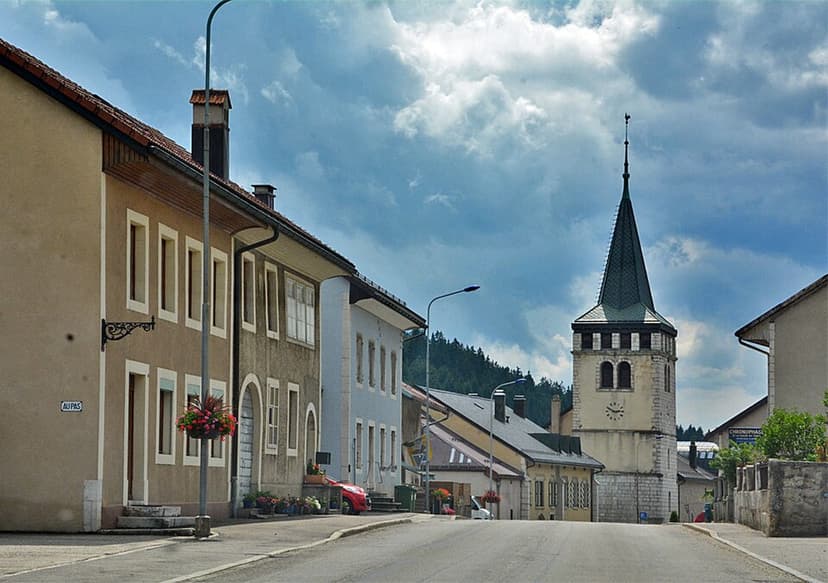
Le Lieu is a Swiss municipality located in the canton of Vaud, within the Jura-Nord Vaudois district. First mentioned in 1155 as a place inhabited by a hermit, the area has historical roots tied to religious settlement. Today, it comprises several villages and hamlets, situated on the eastern shore of Lac de Joux, and is recognized for its significant forested and agricultural land.

Saxon
Saxon is a municipality in the Valais canton of Switzerland, first mentioned in 1153. It is situated in the Martigny district along the left bank of the Rhone River, with its territory extending from the Pierre-à-Voir mountain down to the river. The municipality encompasses the main village of Saxon, the village of Gottefrey, and several smaller hamlets. Its economy is diverse, with significant employment in agriculture, industry, and services.

Amay
Amay is a municipality in the province of Liège, Belgium, situated on the Meuse River. Its origins trace back to a Gallo-Roman vicus, and it later developed around a medieval ford. The area is known for its historical sites, including the 16th-century Castle of Jehay-Bodegnée, and has been home to notable figures like mathematician François Walther de Sluze and inventor Zénobe Gramme.