
Bellelay Abbey
Premonstratensian·Switzerland·Psychiatric clinic, heritage site·12th century
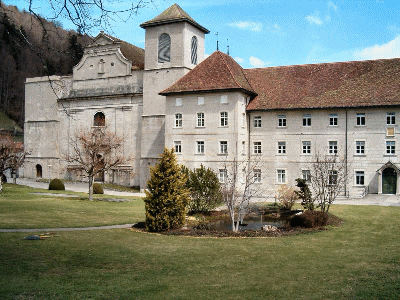
Bellelay Abbey, a former Premonstratensian monastery in the Bernese Jura, Switzerland, was legendarily founded in 1136 and confirmed by Pope Innocent II in 1142. Known for its 18th-century Baroque architecture and as the origin of the Tête de Moine cheese, the abbey reached a golden age as an educational institution for nobility. Secularized in 1797, its buildings have since housed a psychiatric clinic and served as a venue for cultural events.
Key Facts
- ›Legendary founding year: 1136; confirmed founding year: 1142.
- ›Home to the origin of the Tête de Moine cheese, first made by monks in the 12th century.
- ›The abbey church and other buildings were reconstructed in the Baroque style during the 18th century.
- ›Served as a renowned educational institution for European nobility in the 18th century.
- ›Secularized in 1797 and later acquired by the Canton of Bern in 1890 for use as a psychiatric clinic.
- ›Recognized as a heritage site of national significance in Switzerland.
Baroque
TêTe De Moine Cheese, 18th-Century Baroque Church, Painted Stucco Interior Decoration
Belle Laie, Balelaia, Belelagia, Belelai, Belilaia, Bellale, Bella Lagia, Bellelagia, Bellilagia
Siginand
Ransacked During the Swabian War, Secularized By French Troops
About Bellelay Abbey
Bellelay Abbey is a significant former Premonstratensian monastery located in the Bernese Jura region of Switzerland. While legend attributes its founding to Siginand, prior of Moutier-Grandval, in 1136 after a hunting mishap, historical confirmation places its official foundation in 1142, with subsequent confirmation by Pope Innocent II. The monastery's name has seen numerous variations throughout history, ultimately deriving from the Vulgar Latin 'bella lagia,' meaning 'beautiful forest,' reflecting its woodland setting. Bellelay Abbey was not only a religious center but also a secular lordship with considerable estates and influence, being the mother-house to several other foundations.
History and Development
Bellelay Abbey operated under the authority of the diocese of Basel but maintained a degree of independence through protection contracts with Bern and Solothurn. Despite the abbot receiving rights to symbols of high ecclesiastical rank, it is not believed Bellelay was ever an Imperial abbey. The complex suffered damage during the Swabian War in 1499, and some residents converted during the Reformation. However, a treaty with Solothurn helped it avoid the worst effects of the Thirty Years' War. The 18th century marked a golden age for Bellelay, which became a renowned educational institution for the sons of European nobility. During this period, the monastery buildings underwent significant reconstruction, culminating in the dedication of a new church in 1714. The monastery university, established in 1772, grew to accommodate around 100 students by 1797.
Dissolution and Modern Use
The French occupation in 1797 led to the secularization of Bellelay Abbey, with its valuable furnishings being sold. In the 19th century, the premises were repurposed for industrial activities, serving as a watch factory, brewery, and glass factory. The Canton of Bern acquired the site in 1890, and since then, the former monastery buildings have been utilized as a psychiatric clinic. From the late 1960s onwards, the Fondation de l'Abbatiale de Bellelay has also used the premises to host concerts and exhibitions, continuing to animate the historic site.
Architectural and Culinary Heritage
The present abbey church of the Assumption, constructed between 1708 and 1714 by Franz Beer, exemplifies the Vorarlberg Baroque model, complete with two towers and an interior adorned with painted stucco from the Wessobrunn School. The surrounding 18th-century monastery buildings also reflect Baroque architectural principles. Beyond its historical and architectural significance, Bellelay Abbey is celebrated as the origin of the distinctive Tête de Moine cheese, a culinary tradition dating back to the 12th century, first crafted by the monks within its walls.
Source: Wikipedia ↗
Frequently Asked Questions
When was Bellelay Abbey founded?
According to legend, Bellelay Abbey was founded in 1136. Other sources suggest a founding influenced by the Bishop of Basel. The foundation was officially confirmed by Pope Innocent II in 1142.
What is Bellelay Abbey famous for, besides its history?
Bellelay Abbey is famously known as the origin of the Tête de Moine cheese, which was first produced by the monks in the 12th century. The abbey complex itself is also a heritage site of national significance.
What is the current use of Bellelay Abbey?
After being secularized in 1797, the buildings of Bellelay Abbey have been used for various purposes, including a watch factory, brewery, and glass factory. Since 1890, the premises have been used as a psychiatric clinic. The site also hosts concerts and exhibitions.
What architectural style is prominent at Bellelay Abbey?
The abbey church of the Assumption and other monastery buildings were largely rebuilt in the 18th century in the Baroque style. The church, built between 1708 and 1714, features a Vorarlberg Baroque model.
What was the significance of Bellelay Abbey in the 18th century?
In the 18th century, Bellelay Abbey experienced its golden age as a distinguished center of education for the sons of European nobility. A monastery university was opened in 1772, attracting students from across the continent.
Related Monasteries

Churwalden Abbey
Churwalden Abbey was a former Premonstratensian monastery located in the Canton of Graubünden, Switzerland. Founded around 1150, it served as a resting place and hospital for travelers along alpine trade routes. Following the Protestant Reformation in the 16th century, the abbey was gradually dissolved, with its formal dissolution occurring in 1803. Today, it is recognized as a Swiss heritage site of national significance, with remnants including the abbot's tower and the Church of St. Maria and Michael.

Gottstatt Abbey
Gottstatt Abbey was a Premonstratensian monastery established in 1255 by Count Rudolf I von Neuchâtel-Nidau in what is now Switzerland. It served as a local pilgrimage site and the burial church for the Counts of Neuchâtel-Nidau before being acquired by Bern. The monastery was closed during the Reformation in 1528 and its buildings were later used as a secular administrative seat before being returned to the Reformed Church and now functions as a parish church.

Geras Abbey
Geras Abbey is a Premonstratensian monastery located in Geras, Lower Austria. Founded in 1153 as a daughter house of Seelau Abbey, it has continuously operated to the present day, having survived the monastic reforms and closures of Emperor Joseph II in 1783. The abbey is known for its Romanesque basilica, which was significantly reworked in the Baroque style and later designated a minor basilica.