
Churwalden Abbey
Premonstratensian·Switzerland·Ruins/Heritage Site·12th century
Churwalden Abbey was a former Premonstratensian monastery located in the Canton of Graubünden, Switzerland. Founded around 1150, it served as a resting place and hospital for travelers along alpine trade routes. Following the Protestant Reformation in the 16th century, the abbey was gradually dissolved, with its formal dissolution occurring in 1803. Today, it is recognized as a Swiss heritage site of national significance, with remnants including the abbot's tower and the Church of St. Maria and Michael.
Key Facts
- ›Founded around 1150 by the Freiherr von Vaz.
- ›Served as a resting place and hospital for travelers on alpine trade routes.
- ›Suffered significant damage from fires, notably in the 15th century.
- ›Formally dissolved in 1803 after the Protestant Reformation led to its decline.
- ›Designated as a Swiss heritage site of national significance.
- ›Remnants include the abbot's tower and the Church of St. Maria and Michael.

Romanesque, Gothic, Renaissance
Abbot's Tower, Church of St. Maria and Michael, Traces of Late-Gothic Murals, Renaissance Wooden Panels
S. Maria In Silva Augeria
Freiherr Von Vaz
Uprising of Lay Brothers, Fire Destroying Monastery Complex, Fire Destroying Church of St. Michael, Spread of Protestant Reformation, Formal Dissolution
About Churwalden Abbey
Churwalden Abbey, located in the municipality of Churwalden in the Canton of Graubünden, Switzerland, was a significant former Premonstratensian monastery. Founded around 1150 by the Freiherr von Vaz, the abbey played a crucial role as a resting place and hospital for travelers traversing the alpine trade routes of Graubünden.
History and Development
The abbey's church, dedicated to Saint Mary, was first mentioned in 1149. Its strategic location along a main trade road facilitated its development into a vital stop for travelers. The community initially comprised Premonstratensian canons regular, with Augustinian nuns also residing there soon after its founding. The abbey experienced periods of turmoil, including an uprising of lay brothers in 1208 that led to the expulsion of the provost and his supporters. Significant destruction occurred around 1400 due to a fire, necessitating gradual rebuilding. The institution was elevated from a monastery to an abbey in 1446.
Further challenges arose with fires in the late 15th century, which destroyed the Church of St. Michael and parts of the abbot's tower. The Church of St. Michael was rebuilt in the Gothic style, consecrated in 1502, and eventually became part of the Church of St. Maria and Michael. The abbot's tower, constructed around the mid-15th century and rebuilt in the 16th century, still retains traces of late-Gothic murals and Renaissance wooden panels.
Decline and Dissolution
The advent of the Protestant Reformation in the early 16th century profoundly impacted Churwalden Abbey. By 1527, the region had partially adopted Protestantism, leading to the confiscation of abbey lands and the prohibition of accepting new novices. The monastic community dwindled significantly, with only a few members remaining by the early 17th century. The church was eventually designated for shared use by both Catholic and Protestant services. The abbey was formally dissolved in July 1803, following the closure of Roggenburg Abbey and the transfer of Churwalden's remaining lands to the seminary at St. Luzi. Today, Churwalden Abbey is recognized as a Swiss heritage site of national significance, with the abbot's tower and the Church of St. Maria and Michael being the primary surviving structures.
Source: Wikipedia ↗
Frequently Asked Questions
When was Churwalden Abbey founded?
Churwalden Abbey was founded around 1150, with some sources suggesting 1164 as the specific year. The original church on the site, mentioned as S. Maria in silva Augeria, was first noted in 1149.
What was the historical significance of Churwalden Abbey?
The abbey was strategically located along a major trade route over the alpine passes of Graubünden. It functioned as a resting place and hospital for travelers, contributing to its importance in the region.
What happened to Churwalden Abbey after the Protestant Reformation?
The Protestant Reformation led to the confiscation of abbey lands and a prohibition on accepting new novices. The abbey's monastic community dwindled, and its administration was eventually managed from Roggenburg.
What remains of Churwalden Abbey today?
After its formal dissolution in 1803, the abbey buildings largely fell into ruin and were demolished. The surviving structures are the abbot's tower and the Church of St. Maria and Michael.
What architectural styles are present in the remaining structures?
The Church of St. Maria and Michael was rebuilt in the Gothic style after a fire in the 15th century. The bell tower of the church dates from the 13th to 14th centuries. The abbot's tower shows traces of late-Gothic murals and Renaissance wooden panels.
Related Monasteries
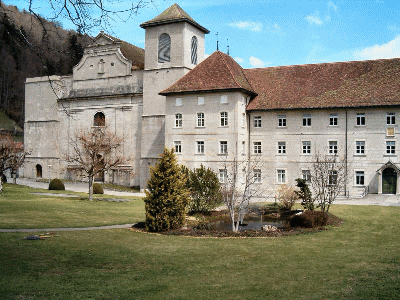
Bellelay Abbey
Bellelay Abbey, a former Premonstratensian monastery in the Bernese Jura, Switzerland, was legendarily founded in 1136 and confirmed by Pope Innocent II in 1142. Known for its 18th-century Baroque architecture and as the origin of the Tête de Moine cheese, the abbey reached a golden age as an educational institution for nobility. Secularized in 1797, its buildings have since housed a psychiatric clinic and served as a venue for cultural events.

Gottstatt Abbey
Gottstatt Abbey was a Premonstratensian monastery established in 1255 by Count Rudolf I von Neuchâtel-Nidau in what is now Switzerland. It served as a local pilgrimage site and the burial church for the Counts of Neuchâtel-Nidau before being acquired by Bern. The monastery was closed during the Reformation in 1528 and its buildings were later used as a secular administrative seat before being returned to the Reformed Church and now functions as a parish church.

Averbode Abbey
Averbode Abbey is a Premonstratensian monastery in Belgium with a history dating back to its founding around 1134. Throughout its existence, it has experienced periods of growth, suppression, and reestablishment, notably serving as a leading children's publisher in Belgium during the 20th century. The abbey church is a distinct blend of Baroque and Gothic architectural styles, constructed with local sandstone.