
Basel
Basel, a significant city in northwestern Switzerland, boasts a rich history dating back to Roman times. It rose to prominence as the seat of a Prince-Bishopric and later joined the Swiss Confederacy in 1501. Renowned as a cultural and intellectual hub, Basel is celebrated for its early public art collection, oldest university in Switzerland, and as a historical sanctuary for scholars, becoming a vital center for humanism, commerce, and later, the chemical and pharmaceutical industries.
Key Facts
- ›The city's name is first recorded as Basilia in the 3rd century AD.
- ›Basel became the seat of a Prince-Bishopric starting in the 11th century.
- ›It joined the Swiss Confederacy in 1501 as its eleventh canton.
- ›The University of Basel, founded in 1460, is the oldest in Switzerland.
- ›Basel hosted the first World Zionist Congress in 1897 and ten times thereafter.
- ›It is a major center for the chemical and pharmaceutical industries, hosting Novartis and Roche.

Romanesque, Gothic
Kunstmuseum, University of Basel, Rhine River, Basel Minster
Basilia
Erasmus of Rotterdam, Holbein Family, Friedrich Nietzsche, Carl Jung, Hermann Hesse, Karl Jaspers, Albert Hofmann, Roger Federer, Paracelsus, MatthäUs Merian, Michel Von Tell, Stephan Remmler, Leonhard Euler, Jakob Bernoulli, Johann Bernoulli, Daniel Bernoulli, Andreas Vesalius, John Calvin, Theodor Herzl, Felix V
- Battle of Solicinium
- Great Invasion of Ad 406
- Treaty of Verdun
- Treaty of Meerssen
- Destruction By Magyars
- Donation of Moutier-Grandval Abbey
- Construction of Basel Minster Began
- Black Death Reached Basel
- Basel Massacre
- Basel Earthquake
- BöSe Fasnacht
- Battle of Sempach
- Council of Basel
- Election of Antipope Felix V
- University of Basel Endowed
- Swabian War
- Treaty of Basel
- Joined Swiss Confederacy
- Reformation
- Publication of Calvin's Institutes
- Publication of Vesalius's De Humani Corporis Fabrica
- Amerbasches Kabinett Purchased
- Republic of Rauracia Created
- Civil War
- First World Zionist Congress
- Lsd Synthesized
- Picasso Purchase Vote
About Basel
Basel: A Historical and Cultural Nexus in Switzerland
Basel is a prominent city in northwestern Switzerland, situated on the Rhine River, marking a significant geographical transition. Its history is deeply rooted, with evidence of settlement dating back to prehistoric times and a recorded name, Basilia, from the 3rd century AD. The city evolved from a Roman castrum and later became the seat of a Prince-Bishopric from the 11th century onwards.
A pivotal moment in its history was its accession to the Swiss Confederacy in 1501, becoming its eleventh member. Basel has consistently been a center of intellectual and cultural life. The University of Basel, established in 1460, is the oldest in Switzerland and has attracted notable scholars and thinkers, contributing to the city's reputation as a haven for humanism.
Economically, Basel has transitioned from a medieval commercial hub to a modern powerhouse in the chemical and pharmaceutical industries. It is also globally recognized for its cultural institutions, including the Kunstmuseum, the world's first public art collection, and its role as the birthplace of the international Art Basel fair. The city's strategic location and historical significance have made it a frequent site for international meetings and negotiations throughout its long and varied history.
Source: Wikipedia ↗
Frequently Asked Questions
What is the historical significance of Basel's name?
The name Basel is first recorded as Basilia in the 3rd century, likely derived from a personal name or a toponym. Popular etymology has also associated the city with the basilisk, which has been used as a heraldic supporter since 1448.
When was Basel founded?
While traces of settlement date back to the 5th century BC, the Roman castrum was built on the site of the current city. The name Basilia is first recorded in the 3rd century AD, and a bishopric was established in the 8th century.
What is Basel most famous for historically?
Basel is historically significant as the seat of a Prince-Bishopric, a focal point of Western Christendom during the Council of Basel, and a sanctuary for scholars like Erasmus of Rotterdam. It also became a vital center for printing and later for the chemical and pharmaceutical industries.
What major historical events took place in Basel?
Key events include the Treaty of Basel ending the Swabian War in 1499, the city joining the Swiss Confederacy in 1501, and the first World Zionist Congress in 1897. The city also witnessed the synthesis of LSD in 1938.
What is the Baselstab?
The Baselstab is a representation of a bishop's crozier, first appearing in the 12th century and becoming a symbol of the Basel diocese. In black, it serves as the coat of arms for the city of Basel, while in red, it represents the bishop.
Related Monasteries

Auxerre
Auxerre is a historic city in the Burgundy region of France, with a history dating back to Roman times. It served as a significant Gallo-Roman center and later became the seat of a bishopric and a provincial capital of the Roman Empire. The city is renowned for its religious architecture, including the Cathedral of St. Étienne and the Abbey of Saint-Germain, which houses some of the oldest mural paintings in France. Auxerre is also a commercial and industrial hub, known for its food production, woodworking, and proximity to Burgundy wine regions.

Great St. Bernard Hospice
The Great St. Bernard Hospice, founded around 1050 by Saint Bernard of Menthon, is a historic hospice and hostel for travelers situated at the Great St. Bernard Pass in the Swiss Alps. Operated by a community of canons regular, it has a long tradition of aiding those crossing the treacherous mountain pass. The hospice is famously associated with the development of the St. Bernard dog breed, originally used for rescue operations.
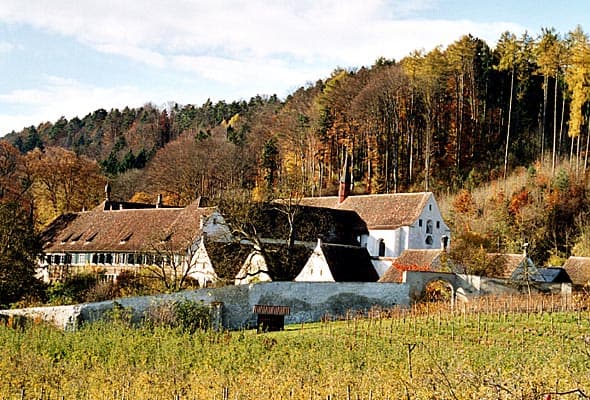
Ittingen Charterhouse
Ittingen Charterhouse, located near Warth in Switzerland's Canton Thurgau, was initially founded as a monastery for Canons Regular in 1150. It later became a Carthusian monastery in 1461, enduring destruction during the Reformation and eventual dissolution in 1848. Today, the meticulously restored precinct serves as an education and seminar center, housing museums, a farm, hotels, and a residential home for individuals with mental illnesses or learning difficulties.