
Abbeydorney Abbey
Cistercian·Ireland·Ruins/Cemetery·12th century
Abbeydorney Abbey, also known as Kyrie Eleison Abbey or Odorney, was established in 1154 by the O Torna chieftains for the Cistercian order, serving as the sole medieval Cistercian foundation in County Kerry. The abbey church, dating from the 15th century, and parts of its claustral buildings remain visible today, with the grounds now functioning as a cemetery populated by gravestones.
Key Facts
- ›Founded in 1154 by the O Torna chieftains.
- ›Established for the Cistercian order, a daughter-house of Monasteranenagh.
- ›The only medieval Cistercian house in County Kerry.
- ›The Cistercians named it Kyrie Eleison, meaning 'Lord have Mercy'.
- ›The foundation was dissolved in 1537.
- ›Visible remains include the 15th-century abbey church with a west tower and some claustral buildings.

Gothic
15th-Century Abbey Church, West Tower, Claustral Buildings, Gravestones
Kyrie Eleison Abbey, Odorney
Christian O'Conarchy
- Founded In 1154
- Christian O'Conarchy Buried In 1186
- Abbot Deposed In 1227 Due To Involvement In the Conspiracy of Mellifont
- Dissolved In 1537
About Abbeydorney Abbey
Abbeydorney Abbey, also historically known as Kyrie Eleison Abbey or Odorney, is a former monastic site located in County Kerry, Ireland. Its origins trace back to 1154 when it was founded by the O Torna, chieftains of the region, for the Cistercian order. This foundation held the distinction of being the sole medieval Cistercian house established within County Kerry.
The Cistercians themselves bestowed upon the abbey the name Kyrie Eleison, a Greek phrase meaning 'Lord Have Mercy'. This naming convention was characteristic of the order's tradition, often selecting names that resonated with the local geography. In this instance, the word 'Kyrie' bore a phonetic similarity to 'Ciarrai', the Irish name for the county itself.
The abbey played a role in the broader history of the Cistercian order in Ireland. Christian O'Conarchy, the initial abbot of the influential Mellifont Abbey, retired to Abbeydorney and spent his final years there, passing away and being buried on the site in 1186. Later, in 1227, a subsequent abbot faced deposition following his involvement in the significant 'Conspiracy of Mellifont', a period of internal conflict within the Irish Cistercian houses.
The monastic community at Abbeydorney was ultimately dissolved in 1537 as part of the wider dissolution of monasteries. Today, the remnants of the abbey are visible, primarily comprising the 15th-century abbey church, which features a notable west tower, and sections of the original claustral buildings. The grounds are presently utilized as a cemetery, marked by numerous gravestones.
Source: Wikipedia ↗
Frequently Asked Questions
When was Abbeydorney Abbey founded?
Abbeydorney Abbey was founded in 1154. It was established by the O Torna, chieftain of the region, for the Cistercian order.
What is the significance of the name Kyrie Eleison?
The Cistercians named the abbey Kyrie Eleison, which is Greek for 'Lord Have Mercy'. This was in keeping with the order's tradition of bestowing names that reflected the locality, with 'Kyrie' being similar to 'Ciarrai', the Irish name for County Kerry.
What remains of Abbeydorney Abbey today?
The visible remains include the abbey church, which dates from the 15th century and features a west tower. Portions of the claustral buildings are also still present on the site.
What is the current use of the Abbeydorney Abbey grounds?
The grounds of Abbeydorney Abbey are currently in use as a cemetery. The area is largely occupied by gravestones.
Who was Christian O'Conarchy and what is his connection to Abbeydorney Abbey?
Christian O'Conarchy, the first abbot of Mellifont, retired to Abbeydorney Abbey and spent his remaining years there. He was buried at the abbey in 1186.
Related Monasteries

Baltinglass Abbey
Baltinglass Abbey, a ruined medieval Cistercian monastery in County Wicklow, Ireland, was founded in 1148 by Diarmait Mac Murchada. It served as a daughter house of Mellifont Abbey and later became the mother house of Jerpoint Abbey. The abbey was suppressed in 1536 during the Dissolution of the Monasteries and is now a National Monument.
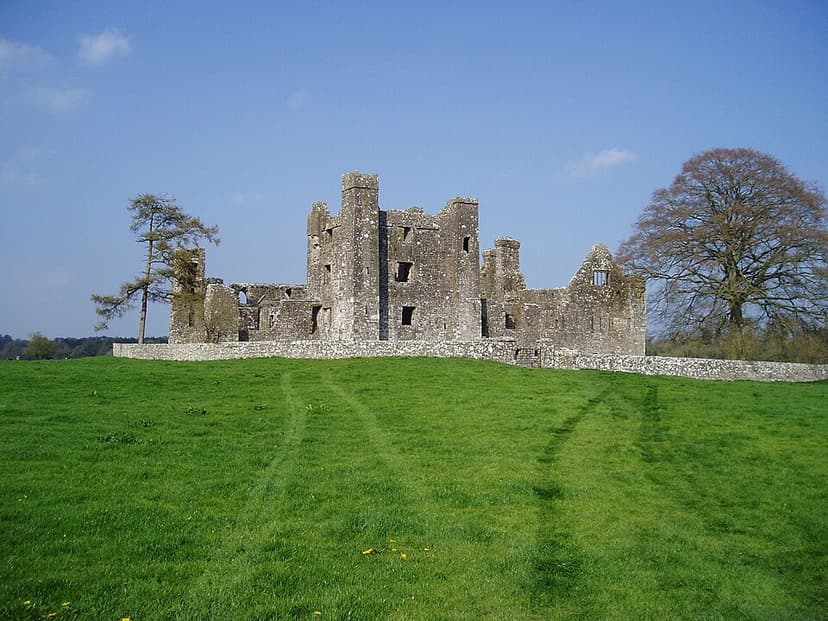
Bective Abbey
Bective Abbey is a well-preserved Cistercian abbey located on the River Boyne in County Meath, Ireland. Founded in 1147 as a daughter house of Mellifont Abbey, its remaining structures and ruins primarily date from the 15th century, though it also features an early 13th-century church and a 16th-century tower. The abbey's lands were confiscated during the Dissolution of the Monasteries and its buildings were later partially converted into a manor house.

Boyle Abbey
Boyle Abbey is a ruined Cistercian friary in County Roscommon, Ireland, founded by Saint Malachy in 1161. Despite interruptions from invasions and fires, its construction was completed and consecrated in 1218. The abbey became a significant Cistercian foundation in Ireland, known for its impressive architecture featuring influences from Burgundy and the West of England, and its squat square tower added in the thirteenth century.