
Tripurantaka
Tripurantaka, also known as Tripurari, is a fearsome manifestation of the Hindu deity Shiva. He is primarily known for his legendary feat of destroying the three celestial cities of the asuras, known as Tripura, with a single arrow. This act established his significance as a powerful destroyer of evil and protector of the cosmos.
Key Facts
- ›Tripurantaka is a form of Lord Shiva.
- ›He destroyed the three cities of the asuras, collectively named Tripura.
- ›The destruction of Tripura was accomplished with a single arrow.
- ›He is associated with the destruction of evil and darkness.
- ›His iconography often depicts him as an archer.
- ›He is celebrated on Kartik Purnima and Maha Shivaratri.
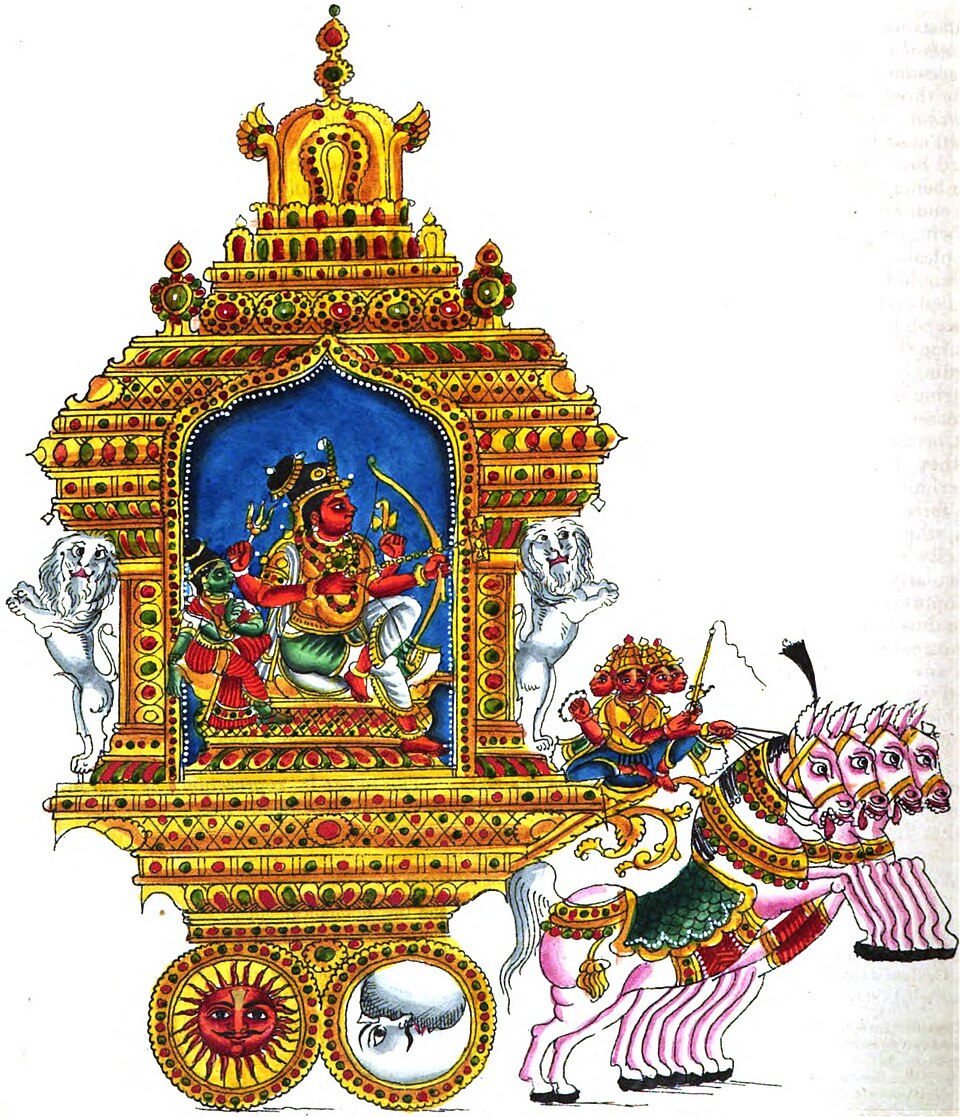
Tripurari
- Portrayed As An Archer
- Four Arms
- Third Right Arm Carrying the Trishula
- Fourth Left Arm Holding the Damaru
- In Other Two Arms, Holds the Pinaka Bow Releasing the Pashupatastra Missile
- Depicted As A Giant Person of Light Showering Light At Darkness
Padma Purana, Yajurveda
Kartik Purnima, Maha Shivaratri
Veeratteswarar Temple At Tiruvatikai, Tiruvirkolam
Pashupatastra Missile
Manifestation of Shiva
About Tripurantaka
Tripurantaka, also known as Tripurari, is a significant manifestation of the Hindu deity Shiva, celebrated for his role as the destroyer of evil. His name directly translates to 'destroyer of Tripura,' referring to his legendary feat of annihilating three celestial cities built by the asuras.
Legend of the Three Cities
The legend, notably found in the Padma Purana and alluded to in the Yajurveda, describes how the sons of the asura Taraka—Tarakaksha, Kamalaksha, and Vidyunmali—received a boon from Brahma to build three indestructible cities. These cities, made of iron, silver, and gold, were located in hell, on Earth, and in heaven, respectively. The boon stipulated that they could only be destroyed by Shiva when the three cities were aligned in a straight line and under the specific astrological condition of the Pushya Nakshatra conjoining the Moon.
After the asuras began to oppress the righteous, the devas (gods) approached Brahma and then Shiva for aid. Shiva agreed to confront them, constructing a cosmic war chariot for the battle. This chariot was composed of celestial elements: the Earth formed its body, the Sun and Moon its wheels, Brahma its charioteer, Mount Meru its bow, Vasuki its bowstring, Vishnu the arrow, Agni the arrowhead, and Vayu the fletchings. In some accounts, Shiva's consort Parvati is depicted seated with him. When the cities aligned, Shiva shot a single arrow, setting all three ablaze and destroying them along with their inhabitants. This act solidified his epithet, Tripurantaka.
Significance and Iconography
Tripurantaka embodies Shiva's fierce aspect, representing the destruction of ignorance, pride, and evil. The story is allegorically interpreted, with Stella Kramrisch noting its representation of how pride can lead to the destruction of dharma within the human microcosm. Iconographically, Tripurantaka is typically depicted as a four-armed archer. He is often shown holding a trishula (trident) and a damaru (drum), while his other two hands are engaged with the Pinaka bow, from which he looses the Pashupatastra missile. His form is sometimes described as a giant person of light dispelling darkness.
Worship and Festivals
Tripurantaka is primarily celebrated on Kartik Purnima, the full moon day in the Hindu month of Kartika. He is also venerated during Maha Shivaratri as a vital manifestation of Shiva. Devotees offer prayers and sacred offerings, with Rudra yajna being performed to honor him as the protector of the universe. Notable sites associated with his worship include the Veeratteswarar temple at Tiruvatikai and Tiruvirkolam near Chennai, which are considered Veerata sthalas commemorating Shiva's victories over evil forces.
Source: Wikipedia ↗
Frequently Asked Questions
Who is Tripurantaka?
Tripurantaka is a manifestation of the Hindu god Shiva. He is known for his power as a destroyer of evil forces and is often depicted as an archer.
What is the legend of Tripurantaka?
The legend states that the asura Taraka's three sons built three indestructible cities. These cities could only be destroyed by Shiva when they were aligned and under a specific astrological configuration, which Shiva then achieved with a single arrow.
What are the three cities destroyed by Tripurantaka?
The three cities were built by the asura architect Mayasura. One city was made of iron and located in hell, the second of silver was on Earth, and the third of gold was in Heaven.
What is the significance of Tripurantaka?
Tripurantaka is significant as a symbol of Shiva's power to destroy evil and darkness. The story also carries allegorical meanings, such as pride leading to the destruction of dharma.
How is Tripurantaka depicted in iconography?
Tripurantaka is usually portrayed as an archer with four arms. He is depicted holding a trishula (trident) and a damaru (drum), and in his other hands, he holds the Pinaka bow from which he releases the Pashupatastra missile.
When is Tripurantaka celebrated?
Tripurantaka is primarily celebrated on Kartik Purnima, the full moon day in the Hindu month of Kartika. He is also worshiped during Maha Shivaratri as an important manifestation of Shiva.
Related Hindu deities

Narayana
Narayana is a significant form and epithet of the Hindu deity Vishnu, often depicted in yogic slumber on the cosmic ocean. He symbolizes the masculine principle and is revered as the Supreme Being in Vaishnavism, also known as Purushottama. His name is associated with the primordial waters and his role as the foundation of all existence.

Kalaratri
Kalaratri is the seventh of the nine Navadurga forms of the goddess Mahadevi, revered as one of her fiercest manifestations. She is depicted as the destroyer of demons, ghosts, evil spirits, and negative energies, while also bestowing courage and auspicious results upon her devotees. Her worship is particularly emphasized on the seventh day of Navaratri.

Bhairava
Bhairava is a fearsome manifestation of the Hindu deity Shiva, often depicted as a protector and punisher of sins. He is also adopted in Buddhist traditions as a wrathful emanation. Bhairava is widely worshipped across India, Nepal, and other parts of Asia, with numerous temples and festivals dedicated to him.