
Agni
Agni is the Hindu god of fire, a Vedic deity who serves as the messenger between humans and the gods. He is revered as the guardian of the southeast direction and is integral to many Hindu rituals, including weddings and festivals, symbolizing transformative energy and knowledge.
Key Facts
- ›Agni is the Hindu god of fire and a significant Vedic deity.
- ›He is considered the messenger between humans and the gods, conveying offerings.
- ›Agni is the guardian deity of the southeast direction.
- ›He is a central witness in Hindu wedding ceremonies (Saptapadi).
- ›Agni represents transformative energy, knowledge, and the element of fire.
- ›He is conceptualized to exist at three levels: earth (fire), atmosphere (lightning), and sky (sun).
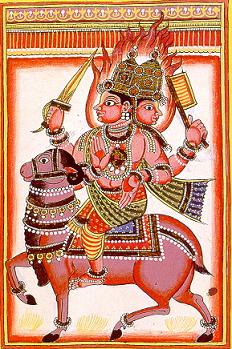
Aggi, Pāvaka, Havyavāhana, Saptajihvi, Vahni, Anala, Hutāśana, Chitrabhānu, Jvalana, Vaiśvānara, Vibhāvasu, Dhumaketu, Śikhī, Pingesa, Plavanga, Bhūritejaḥ, Rudragarva, Hiraṇyakṛta, Jātaveda, Kravyāda
- One To Three Heads
- Two To Four Arms
- Red Or Smoky-Grey Complexion
- Standing Next To Or Riding A Ram
- Dramatic Halo of Flames Leaping Upwards From His Crown
- Strong Looking Man, Sometimes Bearded, With A Large Belly
- Golden Brown Hair, Eyes, and Mustache
- Holds A Rosary and A Sphere
- Holds An Ax, Torch, Spoon, and Flaming Spear
- Seven Rays of Light Or Flames Emit From His Body
- Shown In Rohitasva Form With A Chariot Pulled By Seven Red Horses
- Depicted With A Rhinoceros As Vahana In Cambodian Art
- Iconography Sometimes Symbolized By Three Heads Or Three Legs
- May Wear A Garland of Fruits Or Flowers
Vedas, Rigveda, Brahmanas, Upanishads, ChhāNdogya Upanishad, Isha Upanishad, Maitri Upanishad, Kena Upanishad, Prashna Upanishad, Mundaka Upanishad, RudrahṛDaya Upanishad
Deepavali, Arti, Holi
Ax, Torch, Flaming Spear
Ram
About Agni
Agni: The Hindu God of Fire
Agni (Sanskrit: अग्नि) is the Hindu god of fire, a central and ancient deity in the Vedic tradition. As the guardian of the southeast direction, he is prominently featured in Hindu temples and rituals. Agni represents the element of fire, one of the five fundamental components of the material world, and is conceptualized to exist across earth, atmosphere, and sky.
Role and Significance
In the Vedas, Agni is one of the most invoked gods, serving as the mouth of the deities and the essential medium for carrying sacrificial offerings from humans. He acts as a messenger, bridging the gap between the mortal and divine realms. His importance evolved over time, and in later Upanishads and Hindu literature, Agni became a metaphor for all transformative energy, knowledge, and the immortal principle within humans. He is an integral part of significant life rituals, including the Saptapadi (seven steps) in Hindu weddings, the Upanayana ceremony, and festivals like Deepavali and Arti, where lamps are lit in his remembrance.
Iconography and Symbolism
Agni's iconography typically depicts him with one to three heads and two to four arms, often red or smoky-grey complexioned, and riding or standing beside a ram. He is characterized by a halo of flames and is sometimes shown with a large belly, symbolizing his all-consuming nature. His attributes include a rosary, a sphere, an ax, or a flaming spear. Seven rays of light or flames emanating from his body symbolize his vast reach. Agni symbolizes heat, combustion, energy, the transformation of the gross to the subtle, and the life-giving force. He also represents willpower united with wisdom and the destruction of ignorance.
Texts and Traditions
Agni is extensively mentioned in the Vedas, with over 200 hymns dedicated to him in the Rigveda. He also features prominently in the Brahmanas and Upanishads, where his role is explored in philosophical contexts, such as being a manifestation of Brahman. His presence is vital in rites of passage and festivals like Holi and Deepavali, where bonfires and lamps are lit to honor him. Agni's dual forms, Jātaveda (conveyor of offerings, identified with knowledge) and Kravyāda (consumer of corpses, associated with cremation), highlight his multifaceted nature.
Source: Wikipedia ↗
Frequently Asked Questions
Who is Agni in Hinduism?
Agni is the Hindu god of fire, a prominent deity in Vedic traditions. He is revered as the messenger of the gods and the guardian of the southeast direction. Agni symbolizes transformative energy, knowledge, and the fundamental element of fire.
What is Agni's role in Vedic rituals?
In Vedic rituals, Agni is crucial as the mouth of the gods, serving as the medium to convey offerings to them. He is invoked in numerous hymns, particularly in the Rigveda, and is central to sacrificial rites like the homa. His presence ensures the offerings reach the divine.
How is Agni represented in Hindu weddings?
Agni is a central witness to Hindu wedding ceremonies, particularly the Saptapadi (seven steps). The couple circles the sacred fire, making vows to each other with Agni as the divine observer, symbolizing the sanctity and permanence of their union.
What are some of Agni's alternative names and their meanings?
Agni is known by many names, including Pāvaka (the sanctifier), Havyavāhana (carrier of sacrificial butter), and Vahni (one who travels with wind). These epithets highlight his various roles and attributes, such as purification, conveyance, and immense energy.
How has Agni's significance evolved in Hindu thought?
While Agni was a major god in the Vedic era, his importance was later internalized in post-Vedic literature, becoming a metaphor for all transformative energy and knowledge in the Upanishads. He remains vital in rituals and symbolism, representing the essence of Brahman and the pursuit of enlightenment.
What are the three forms or levels of Agni?
Agni is conceptualized to exist at three levels: as earthly fire, atmospheric lightning, and the celestial sun. This triple presence allows him to act as a messenger connecting the divine realm with the human world.
Related Hindu deities
Pūshan
Pūshan is a Vedic solar deity and one of the Adityas, revered as the god of meetings, marriages, journeys, and the protection of roads and travelers. He is known as a psychopomp, guiding souls to the afterlife, and is invoked to ensure prosperity and protect against dangers. His name is traditionally linked to the concept of "causing to thrive."

Bhairava
Bhairava is a fearsome manifestation of the Hindu deity Shiva, often depicted as a protector and punisher of sins. He is also adopted in Buddhist traditions as a wrathful emanation. Bhairava is widely worshipped across India, Nepal, and other parts of Asia, with numerous temples and festivals dedicated to him.

Nandi
Nandi is the sacred bull vahana (mount) of the Hindu god Shiva and the guardian deity of his abode, Kailash. He is widely depicted as a seated bull facing the main shrine in Shiva temples worldwide. Nandi symbolizes devotion and the soul's focus on the divine, and is also revered as a guru in Shaiva Siddhanta.