
Pūshan
Pūshan is a Vedic solar deity and one of the Adityas, revered as the god of meetings, marriages, journeys, and the protection of roads and travelers. He is known as a psychopomp, guiding souls to the afterlife, and is invoked to ensure prosperity and protect against dangers. His name is traditionally linked to the concept of "causing to thrive."
Key Facts
- ›Pūshan is a Vedic solar deity and one of the Adityas.
- ›He is the god of meetings, marriages, journeys, and the feeding of cattle.
- ›He is a psychopomp, guiding souls to the other world.
- ›Pūshan protects travelers from bandits and wild beasts.
- ›His chariot is pulled by goats.
- ›He is associated with divine paths and the path between earth and heaven.
Pūṣan
Braided Hair, Beard, Golden Axe, Awl, Goad
Rigveda, Shatapatha Brahmana, Taittiriya Samhita, Ramayana, Mahabharata, Puranas
Son of Aditi
Golden Axe
About Pūshan
Pūshan, also transliterated as Pūṣan, is a significant deity within the Hindu Vedic pantheon, recognized as one of the Adityas. His primary roles encompass being the god of meetings, marriages, journeys, and roads, as well as overseeing the feeding and protection of cattle. He is also revered as a psychopomp, a guide for souls, responsible for conducting them to the afterlife.
Etymology and Significance
The name Pūshan is traditionally derived from the Sanskrit verb 'pūṣyati,' meaning 'to cause to thrive,' highlighting his association with prosperity and well-being. Modern scholarship suggests a potential connection to the Proto-Indo-European deity *Péh₂usōn, a cognate of the Greek god Pan.
Role in Mythology and Texts
Ten hymns in the Rigveda are dedicated to Pūshan, underscoring his importance in early Vedic tradition. He is described as driving the sun and is seen as a guardian of flocks and herds. His chariot is drawn by goats, and he is depicted with braided hair, a beard, and carries symbolic implements such as a golden axe, an awl, and a goad. He is married to Sūryā, the daughter of the Sun.
Mythological accounts, found in texts like the Taittiriya Samhita, Ramayana, Mahabharata, and Puranas, recount an incident where Pūshan's teeth were broken. This occurred during a sacrifice where Rudra (or Shiva) became enraged and, in his anger, struck Pūshan as he attempted to partake in the sacrificial offering.
Pūshan's role extends to protecting travelers from dangers on roads, such as bandits and wild beasts, and safeguarding individuals from exploitation. He is also intimately familiar with the divine paths, including the one connecting earth and heaven, which enables him to guide souls. His invocations are common for guarding livestock and recovering lost animals, further emphasizing his benevolent and protective nature.
Source: Wikipedia ↗
Frequently Asked Questions
What does the name Pūshan mean?
Traditionally, the name Pūshan is said to be derived from the Sanskrit verb 'pūṣyati,' which means 'to cause to thrive.' This etymology reflects his role in fostering prosperity and well-being.
What are Pūshan's primary responsibilities?
Pūshan is primarily responsible for overseeing marriages, journeys, and roads. He also plays a crucial role in the feeding and protection of cattle and is invoked to find lost livestock.
How is Pūshan depicted and what are his attributes?
Pūshan is described as having braided hair and a beard. He carries a golden axe, an awl, and a goad. He is also said to eat gruel and was historically depicted as toothless in some texts.
What is Pūshan's role as a psychopomp?
As a psychopomp, Pūshan acts as a guide for souls. He is familiar with the divine paths and is believed to lead souls to heaven, facilitating their transition to the afterlife.
What is Pūshan's significance in Vedic texts?
Pūshan is prominently featured in the Rigveda, with ten hymns dedicated to him, including some shared with other deities. He is also mentioned in later texts like the Shatapatha Brahmana, Ramayana, Mahabharata, and Puranas.
How did Pūshan lose his teeth according to mythology?
According to narratives in the Taittiriya Samhita, Ramayana, Mahabharata, and Puranas, Pūshan lost his teeth when Rudra (or Shiva) became angry during a sacrifice. In some versions, Shiva kicked Pūshan, knocking out his teeth as he attempted to partake in the oblation.
Related Hindu deities
Bhaga
Bhaga is a Vedic god associated with wealth, prosperity, and the distribution of goods. As an Āditya, he is one of the celestial sons of Aditi. Bhaga's role involves ensuring individuals receive their rightful share of life's blessings, and he is also linked to successful marriages.
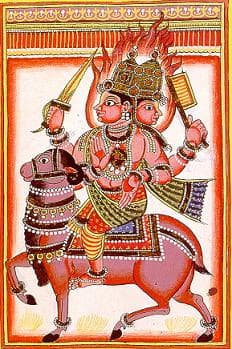
Agni
Agni is the Hindu god of fire, a Vedic deity who serves as the messenger between humans and the gods. He is revered as the guardian of the southeast direction and is integral to many Hindu rituals, including weddings and festivals, symbolizing transformative energy and knowledge.

Bhairava
Bhairava is a fearsome manifestation of the Hindu deity Shiva, often depicted as a protector and punisher of sins. He is also adopted in Buddhist traditions as a wrathful emanation. Bhairava is widely worshipped across India, Nepal, and other parts of Asia, with numerous temples and festivals dedicated to him.