
Kalaratri
Donkey·Female
Kalaratri is the seventh of the nine Navadurga forms of the goddess Mahadevi, revered as one of her fiercest manifestations. She is depicted as the destroyer of demons, ghosts, evil spirits, and negative energies, while also bestowing courage and auspicious results upon her devotees. Her worship is particularly emphasized on the seventh day of Navaratri.
Key Facts
- ›Kalaratri is the seventh form of the Navadurga, the nine aspects of the goddess Mahadevi.
- ›She is considered a fearsome form of the goddess, known for destroying evil and negative forces.
- ›Worshipped traditionally on the seventh day of Navaratri, she is believed to make her devotees fearless.
- ›She is also known as Shubankari, meaning auspicious, as she always provides positive results to her devotees.
- ›Her name can also mean 'the one who is the death of time,' embodying the power of time and night.
- ›Kalaratri is associated with the crown chakra, believed to grant knowledge, power, and wealth.

Shubankari, Raudri, Dhumorna, Kalika
- Black Complexion
- Four Hands
- Holds A Scimitar In One Left Hand
- Holds A Thunderbolt In Another Left Hand
- Right Hands In Varada and Abhaya Mudras
- Garland Shines Like the Moon
- Three Eyes That Emanate Rays Like Lightning
- Flames Emanate From Nostrils When She Breathes
- Wears A Red Robe
Devi Mahatmya, Mahabharata, Markandeya Purana, Skanda Purana, Devi Bhagavata Purana, Lalita Sahasranama, Lakshmi Sahasranama, Saudhikagama, Mahanirvana Tantra, Rigveda
Form of Mahadevi, Associated With Parvati
Navaratri
- Kalratri -Varanasi Temple, D.8/17, Kalika Galli, Varanasi
- Kalaratri Temple, Dumri Buzurg, Nayagaon, Bihar
- Kalratri -Vindhyachal, Mirzapur
- Kalratri Temple- Patiala, Punjab
- Kalratri Temple- Sangrur, Punjab
Scimitar, Thunderbolt
Fierce Form, Destroyer of Evil
About Kalaratri
Kalaratri: The Fierce Night of the Goddess
Kalaratri stands as the seventh of the nine Navadurga forms of the goddess Mahadevi, representing one of her most fearsome and potent manifestations. Her name, derived from Sanskrit words for 'time' and 'night,' signifies her dominion over the dark hours and the relentless passage of time, capable of consuming all. She is prominently featured in scriptures such as the Devi Mahatmya, Mahabharata, and Markandeya Purana, where her appearance is often described as terrifying, with a dark complexion, three fiery eyes, and a fearsome demeanor.
Role and Significance
Kalaratri is primarily revered as the destroyer of all wicked forces, including demons, ghosts, evil spirits, and negative energies. Her very presence is said to invoke fear in these entities, causing them to flee. Despite her intimidating form, Kalaratri is also known as Shubankari, meaning 'auspicious,' as she is believed to always bring positive outcomes and courage to her devotees. Her worship is particularly significant during the Navaratri festival, especially on the seventh day, where she is invoked to overcome obstacles and gain inner strength.
Iconography and Worship
Visually, Kalaratri is depicted with a dark, black complexion, four arms, and three eyes that gleam like lightning. She often holds a scimitar and a thunderbolt in her hands, while her other hands are in gestures of blessing and protection. Flames are sometimes shown emanating from her nostrils with each breath, and she is often adorned with a garland that shines like the moon. Her vehicle is typically a donkey. Her association with the crown chakra (sahasrara chakra) suggests her role in granting spiritual attainments, knowledge, power, and wealth to her worshippers.
Source: Wikipedia ↗
Frequently Asked Questions
Who is Kalaratri?
Kalaratri is the seventh of the nine Navadurga forms of the goddess Mahadevi. She is one of the fiercest and most powerful manifestations of the divine feminine, known for her destructive power against evil.
What is Kalaratri known for?
She is known for destroying demons, ghosts, evil spirits, and negative energies. Despite her fearsome appearance, she is also considered auspicious and bestows courage and positive results upon her devotees.
When is Kalaratri worshipped?
Kalaratri is traditionally worshipped during the nine nights of Navaratri, with a special emphasis on the seventh day of the celebration.
What does the name Kalaratri mean?
The name Kalaratri is derived from 'kala,' meaning time or black, and 'ratri,' meaning night. It can be interpreted as 'the dark night' or 'the one who is the death of time,' signifying her power over time and darkness.
What are Kalaratri's powers and associations?
She is believed to have the power to destroy all forms of negativity and evil. Kalaratri is also associated with the crown chakra, believed to grant siddhis (supernatural skills) and nidhis (riches).
Are Kali and Kalaratri the same deity?
While the names Kali and Kalaratri are sometimes used interchangeably, some scholars argue they are separate deities. Kali is first mentioned as a distinct goddess around 300 BCE, while Kalaratri is referenced in texts like the Devi Mahatmya.
Related Hindu deities

Narayana
Narayana is a significant form and epithet of the Hindu deity Vishnu, often depicted in yogic slumber on the cosmic ocean. He symbolizes the masculine principle and is revered as the Supreme Being in Vaishnavism, also known as Purushottama. His name is associated with the primordial waters and his role as the foundation of all existence.

Manjunatha
Shiva, also known as Mahadeva and Hara, is a principal deity in Hinduism and the Supreme Being in Shaivism. He is revered as the creator, protector, and transformer of the universe, and is also known as The Destroyer within the Trimurti. Shiva embodies both benevolent and fearsome aspects, often depicted as an ascetic yogi or a householder, and is considered the patron god of yoga, meditation, and the arts.
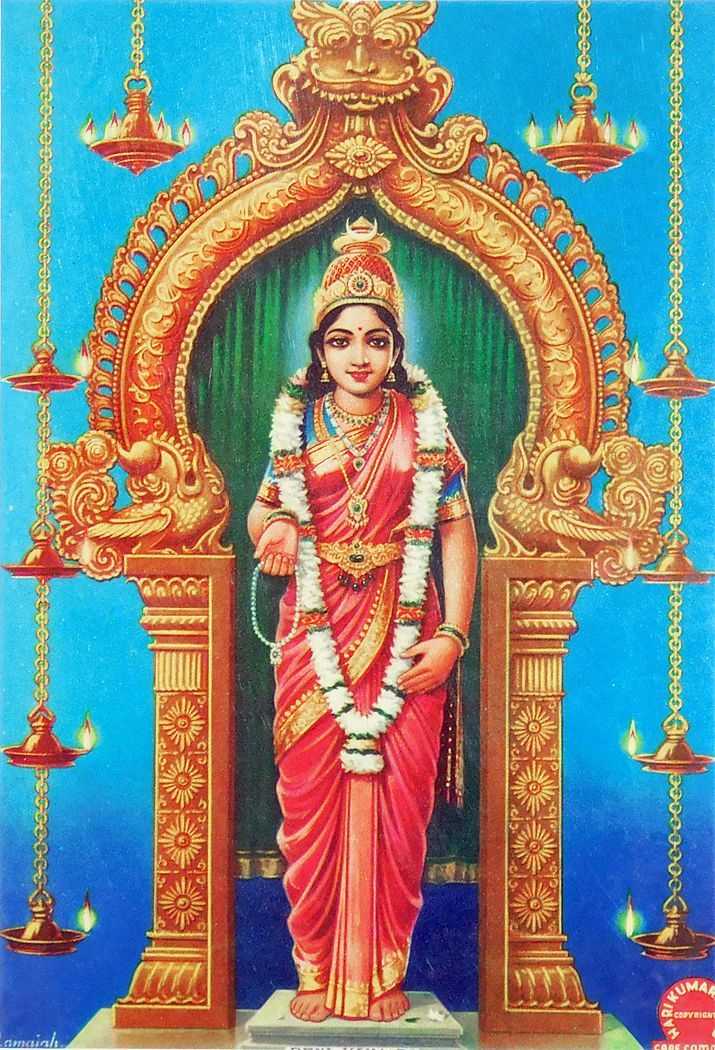
Devi Kanya Kumari
Devi Kanya Kumari is a prominent Hindu goddess, a manifestation of Mahadevi in the form of an adolescent girl. She is revered as a form of Parvati or Lakshmi, and is particularly known for her role in slaying the demon Banasura. Her worship is deeply tied to the town of Kanyakumari at the southernmost tip of India.