
Purushottama
Purushottama is an epithet for the Hindu preserver deity, Vishnu, signifying the "Supreme Purusha" or "Supreme Being." This name highlights Vishnu's role as the ultimate source of liberation, knowledge, and the highest of all existences in Vaishnavism. It denotes a being superior to both the perishable and imperishable realms.
Key Facts
- ›Purushottama is an epithet of the Hindu deity Vishnu.
- ›The name translates to "Supreme Purusha," "Supreme being," or "Supreme God."
- ›It signifies a being beyond both the destructible (Prakriti) and the indestructible (Atman).
- ›Purushottama is the 24th name in the Vishnu Sahasranama from the Mahabharata.
- ›The Bhagavad Gita uses this epithet to describe Krishna as superior to the perishable and imperishable.
- ›In the Harivamsha, Brahma refers to Vishnu as Purushottama before the Samudra Manthana.

Supreme Purusha, Supreme Being, Supreme God
Mahabharata, Bhagavad Gita, Harivamsha, Garuda Purana
Preserver Deity, Liberator
About Purushottama
Purushottama is a significant epithet for the Hindu deity Vishnu, widely revered within Vaishnavism. The name itself, derived from Sanskrit, translates to "Supreme Purusha," "Supreme Being," or "Supreme God." This title signifies Vishnu's ultimate status as the highest of all existences, the source of liberation (moksha), the fountainhead of knowledge, and the liberator of sins.
Etymology and Meaning
The epithet "Purushottama" is composed of "purusha," meaning "person," "personal animating principle," or "soul," and "uttama," meaning "highest." Together, it denotes the highest personal principle or the supreme soul. It is also interpreted as referring to a being who transcends both the "kshara" (the destructible, referring to Prakriti or material nature) and the "akshara" (the indestructible, referring to the Atman or soul).
Scriptural Mentions
Purushottama is recognized as the 24th name in the Vishnu Sahasranama, a hymn to Vishnu found in the epic Mahabharata. The Bhagavad Gita prominently uses this epithet, with Krishna describing Himself as Purushottama, a being who is superior to both the perishable and the imperishable. In the Bhagavad Gita (verse 15.18), Krishna states, "And because I am beyond the kshara and superior to the akshara as well, I am therefore celebrated in both general speech and in the Veda as 'Purushottama.'" The Harivamsha also features Brahma addressing Vishnu by this name prior to the events of the Samudra Manthana, acknowledging Vishnu as the origin and ordainer of the universe.
Significance in Devotion
Within Vaishnavism, Purushottama embodies the ultimate divine reality. The epithet highlights Vishnu's role not just as a preserver, but as the supreme entity from whom all existence emanates and to whom all return. Philosophers have also interpreted Purushottama as representing a phenomenon that lies beyond even the undifferentiated Godhead, underscoring its profound theological depth. While avatars like Rama are called Maryada Purushottama and Krishna is known as Leela Purushottama, the epithet Purushottama itself refers to the supreme, transcendental nature of Vishnu.
Source: Wikipedia ↗
Frequently Asked Questions
What does the epithet Purushottama mean?
The epithet Purushottama translates from Sanskrit as the "Supreme Purusha," "Supreme Being," or "Supreme God." It also carries the meaning of being beyond the kshara (destructible) and akshara (indestructible).
Where does the name Purushottama appear in Hindu scriptures?
Purushottama is listed as the 24th name in the Vishnu Sahasranama found within the Mahabharata. It is also invoked in the Bhagavad Gita and the Harivamsha.
How is Purushottama described in the Bhagavad Gita?
In the Bhagavad Gita, Krishna defines Purushottama as a being who is superior to both the perishable (kshara) and the imperishable (akshara). Arjuna acknowledges Krishna with this epithet, recognizing Him as the source of all creation.
Is Purushottama associated with specific avatars of Vishnu?
Yes, specific avatars of Vishnu are referred to by related epithets. Rama is known as Maryada Purushottama, and Krishna is known as Leela Purushottama.
What is the significance of Purushottama in Vaishnavism?
In Vaishnavism, Purushottama represents Vishnu as the ultimate source of moksha (liberation), the remover of sins, the fount of knowledge, and the highest of all beings. He is considered the supreme deity.
Related Hindu deities
Dhāta
Dhata, also known as Dhatr, is a solar deity and one of the Adityas in Hinduism, revered as a god of health and magic. He is invoked in tantric practices and Vedic hymns, and plays a role in major sacrifices like the Ashwamedha yagna. Dhata is depicted in Hindu epics as a participant in significant events and is described as the seventh son of Aditi and Kashyapa.

Nataraja
Nataraja is a depiction of the Hindu deity Shiva as the divine cosmic dancer, known for his tandava dance. This iconic form symbolizes Shiva's cosmic functions of creation, preservation, and destruction, and is widely revered as one of the highest forms of Shiva, particularly in Tamil Nadu. The Nataraja sculpture is a significant symbol of Indian culture and Hindu art, representing the interconnectedness of religion and the arts.
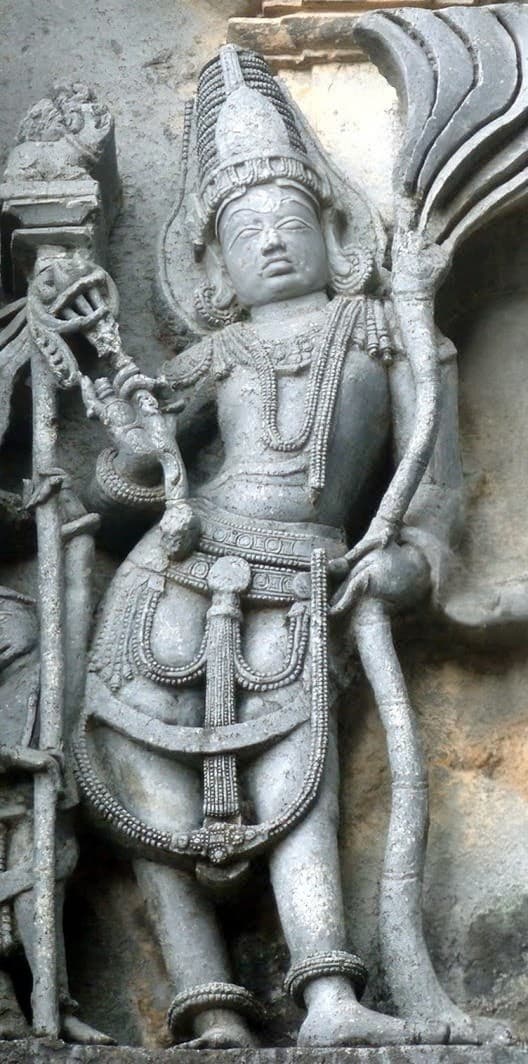
Kamadeva
Kamadeva is the Hindu god of love, attraction, pleasure, and beauty, as well as the personification of kāma (desire). He is depicted as a handsome youth armed with a bow of sugarcane and flower arrows, often accompanied by his consort Rati. Kamadeva's mythology is prominent in the Puranas, where he is known for being incinerated by Shiva's third eye and subsequently reborn as Pradyumna.