
Maheshvara
Parameshvara, meaning 'highest supreme ruler,' is an epithet used in Hindu literature to denote the Supreme Being and Supreme Reality. Both Vaishnavas and Shaivas use this term, identifying Vishnu and Shiva respectively as Parameshvara. This ultimate reality is believed to eternally pervade all matter and control the forces of creation, preservation, and destruction.
Key Facts
- ›Parameshvara literally translates to 'highest supreme ruler' from Sanskrit.
- ›Vaishnavas consider Vishnu and his avatars as Parameshvara.
- ›Shaivas consider Shiva as Parameshvara.
- ›The term signifies the ultimate reality that pervades all matter.
- ›Parameshvara is believed to control creation, preservation, and destruction.
- ›In Vedanta, Parameshvara is often used synonymously with Parabrahman.
Supreme Lord, Highest Supreme Ruler
Bhagavata Purana, Vishnu Purana, Padma Purana, Pancharatra Agamas, Vaikhanasa Agamas, PāRameśVarasaṃHitā, Shukla Yajurveda, Bhagavad Gita, Vishnu Sahasranama
About Maheshvara
Parameshvara
Parameshvara is an epithet deeply ingrained in Hindu literature, signifying the Supreme Being and the ultimate Supreme Reality. The term itself is a Sanskrit compound, with 'Param' meaning 'Supreme' and 'Ishvara' meaning 'Lord,' thus translating to 'highest supreme ruler.' This concept is central to various Hindu traditions, where different deities are identified as Parameshvara, underscoring the diverse yet unified understanding of the divine.
Vaishnavism and Shaivism
Within Vaishnavism, Lord Vishnu and his various avatars, such as Rama and Krishna, are revered as Parameshvara. These traditions, supported by scriptures like the Bhagavata Purana and Vishnu Purana, view Vishnu as the progenitor of Brahma and Shiva. Similarly, in Shaivism, Lord Shiva is considered Parameshvara. Shaiva Siddhanta describes Parameshvara as the supreme being, distinct from the individual souls (pashu) and worldly bonds (pasam), possessing unique divine attributes.
Philosophical Significance
Beyond specific sectarian identifications, Parameshvara represents the ultimate reality that permeates all existence eternally. Devotees perceive this supreme entity as the totality itself, holding dominion over the fundamental cosmic functions of creation, preservation, and destruction. In philosophical schools like Vedanta, the term Parameshvara is often used synonymously with Parabrahman, highlighting its role as the absolute, unqualified divine principle that transcends all forms and limitations.
Source: Wikipedia ↗
Frequently Asked Questions
What does the term Parameshvara mean?
Parameshvara is a Sanskrit term that literally means 'highest supreme ruler'. It is a compound word formed from 'Param' meaning 'Supreme' and 'Ishvara' meaning 'Lord'.
Who is considered Parameshvara in Vaishnavism?
In Vaishnavism traditions, Lord Vishnu and his avatars, such as Rama and Krishna, are considered to be Parameshvara. They are seen as the progenitor of other deities like Brahma and Shiva.
Who is considered Parameshvara in Shaivism?
Shaivism identifies Lord Shiva as Parameshvara. In Shaiva Siddhanta, Shiva is the supreme being, and Parameshvara is one of his distinct manifestations.
What is the significance of Parameshvara in Hinduism?
Parameshvara represents the Supreme Being and Supreme Reality in Hinduism. Devotees believe this ultimate reality eternally pervades all matter and governs the fundamental forces of the universe: creation, preservation, and destruction.
Are there other terms used similarly to Parameshvara?
Yes, other traditions of Hinduism, such as Vedanta and Vaishnavism, use Parameshvara as a synonym for Parabrahman within their philosophical frameworks. It signifies the absolute and ultimate divine principle.
Related Hindu deities
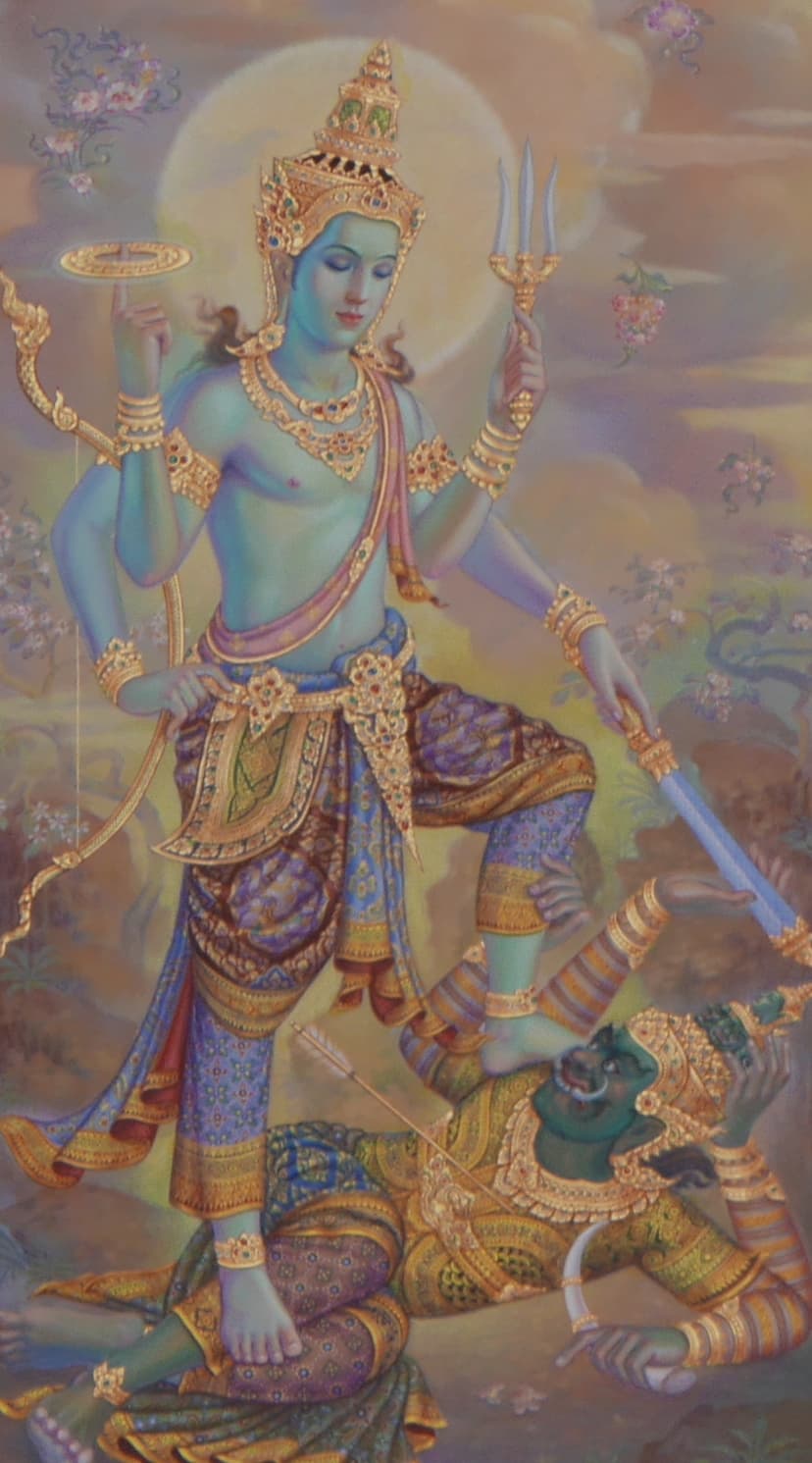
Rama
Rama is a major deity in Hinduism, revered as the seventh and one of the most popular avatars of Vishnu. He is considered the ideal man and the central figure of the epic Ramayana, embodying dharma and righteous living. His story, marked by exile, the abduction of his wife Sita, and a subsequent war to rescue her, illustrates duties, rights, and social responsibilities.

Madhava
Madhava is a significant epithet primarily associated with the Hindu deities Vishnu and Krishna. The name derives from 'Madhu,' meaning honey, and can refer to Krishna's lineage or his role as the consort of Lakshmi, the mother of the universe. He is invoked in scriptures for protection and is depicted as a powerful deity wielding divine weapons.

Hara
Shiva, also known as Mahadeva and Hara, is a principal deity in Hinduism and the Supreme Being in Shaivism. He is revered as the creator, protector, and transformer of the universe. Shiva embodies both benevolent and fearsome aspects, appearing as an ascetic yogi, a householder, and a slayer of demons, making him the patron god of yoga, meditation, and the arts.