
Madhava
Madhava is a significant epithet primarily associated with the Hindu deities Vishnu and Krishna. The name derives from 'Madhu,' meaning honey, and can refer to Krishna's lineage or his role as the consort of Lakshmi, the mother of the universe. He is invoked in scriptures for protection and is depicted as a powerful deity wielding divine weapons.
Key Facts
- ›Madhava is an epithet for Vishnu and Krishna.
- ›The name 'Madhava' is derived from the Sanskrit word 'Madhu,' meaning honey.
- ›It can refer to Krishna's appearance in the Madhu dynasty.
- ›Madhava is interpreted as the consort of Lakshmi, the 'mother of the universe'.
- ›He is depicted as wielding a conch, discus, and mace.
- ›The epithet is found in the Bhagavad Gita, Skanda Purana, Garuda Purana, and Harivamsa Purana.

Mādhava
Holds the Conch, Discus, and Mace
Bhagavad Gita, Skanda Purana, Garuda Purana, Harivamsa Purana
Conch, Discus, Mace
About Madhava
Madhava is a significant epithet for the Hindu deities Vishnu and Krishna, widely recognized within Vaishnavism. The name itself is derived from the Sanskrit word 'Madhu,' meaning honey, and carries multiple layers of meaning. It can signify Krishna's lineage as a member of the Madhu dynasty or, as interpreted by Adi Shankara, refer to Vishnu as the consort ('dhava') of Lakshmi, the divine mother of the universe.
Literary and Scriptural Significance
The epithet Madhava appears in several key Hindu scriptures, underscoring its importance. In the Bhagavad Gita, Arjuna addresses Krishna as Madhava, a term signifying 'lord of fortune.' The Skanda Purana mentions Madhava as an epithet of Vishnu, describing him as the one who holds the conch, discus, and mace. The Garuda Purana includes a hymn to Vishnu where the devotee craves the mercy of Madhava and Janardana for protection. The Harivamsa Purana recounts an episode where Madhava, identified with Krishna, demonstrates his prowess in battle by disabling an opponent's chariot.
Interpretations and Associations
Beyond its literal meanings, Madhava is associated with concepts of auspiciousness and divine knowledge. One interpretation suggests it refers to the deity being 'fit to be known through Madhu-vidya,' a form of meditative knowledge. Another meaning proposed is 'the one who is the lord of ma, or knowledge.' These interpretations highlight Madhava's multifaceted divine nature, encompassing power, fortune, and wisdom.
Source: Wikipedia ↗
Frequently Asked Questions
What does the name Madhava mean?
The name Madhava is a Sanskrit term derived from 'Madhu,' which means honey. It can refer to a deity's lineage or their divine attributes.
Who is Madhava associated with?
Madhava is primarily an epithet for Vishnu or Krishna. He is also understood as the consort of Lakshmi, the mother of the universe.
In which scriptures is Madhava mentioned?
The epithet Madhava appears in significant Hindu scriptures such as the Bhagavad Gita, Skanda Purana, Garuda Purana, and Harivamsa Purana.
What is Madhava known for in mythology?
In the Harivamsa Purana, Madhava is depicted in battle, cutting off a chariot's standard and the charioteer's head, showcasing his power. He is also described as wielding a conch, discus, and mace.
What is the significance of Madhava in relation to Lakshmi?
According to Adi Shankara's commentary, Madhava can mean the consort ('dhava') of the mother ('ma'), referring to Lakshmi, who is considered the 'mother of the universe'.
Related Hindu deities
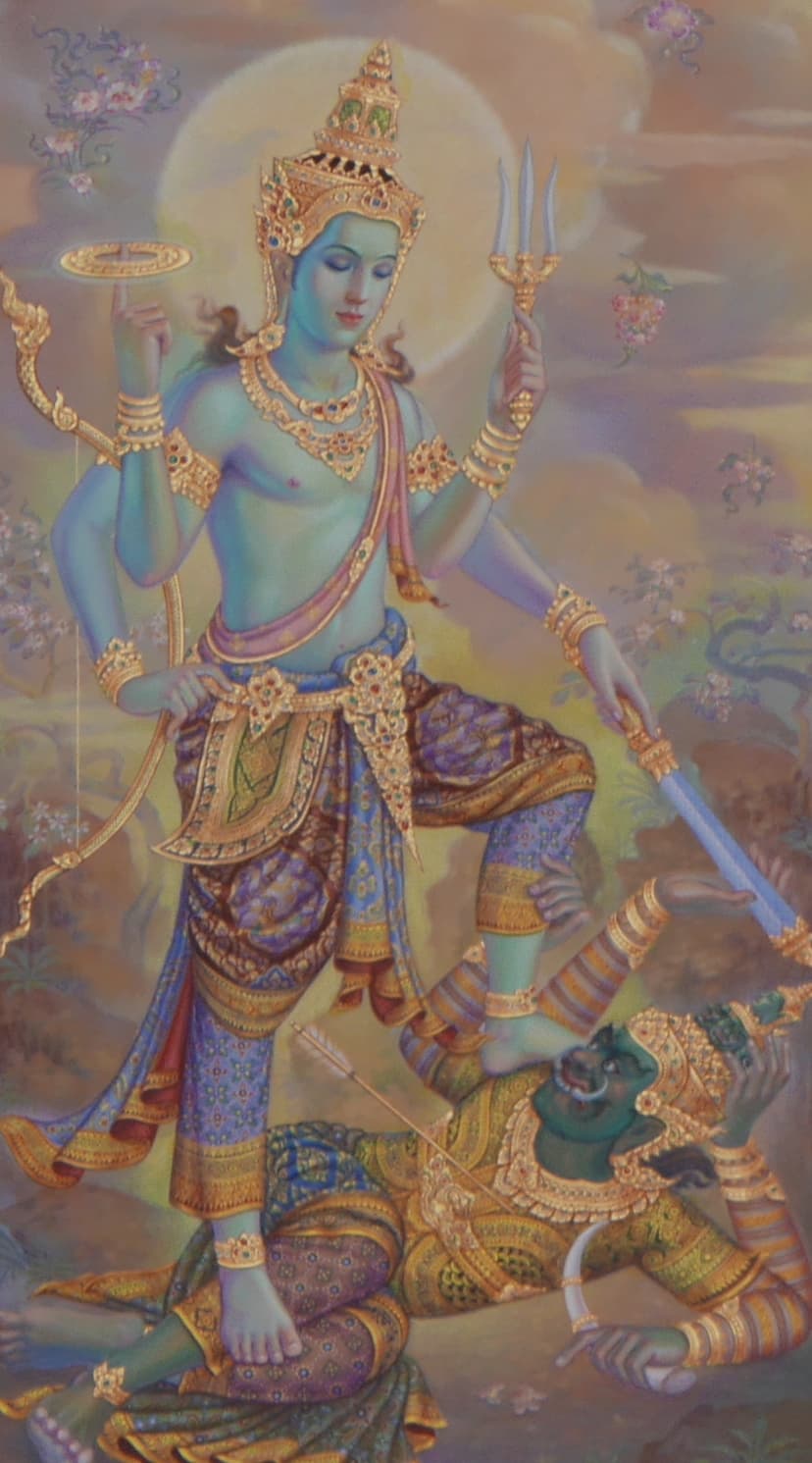
Rama
Rama is a major deity in Hinduism, revered as the seventh and one of the most popular avatars of Vishnu. He is considered the ideal man and the central figure of the epic Ramayana, embodying dharma and righteous living. His story, marked by exile, the abduction of his wife Sita, and a subsequent war to rescue her, illustrates duties, rights, and social responsibilities.
Maheshvara
Parameshvara, meaning 'highest supreme ruler,' is an epithet used in Hindu literature to denote the Supreme Being and Supreme Reality. Both Vaishnavas and Shaivas use this term, identifying Vishnu and Shiva respectively as Parameshvara. This ultimate reality is believed to eternally pervade all matter and control the forces of creation, preservation, and destruction.

Bholenath
Bholenath, meaning 'lord of innocence,' is a popular epithet for the Hindu deity Shiva. This name highlights Shiva's aspect as the benevolent and guileless lord. The epithet is often invoked in narratives emphasizing Shiva's vulnerability and divine protection.