
Lingodbhava
Lingodbhava, meaning "the emergence of the Linga," is an iconic representation of the Hindu god Shiva, particularly prevalent in temples in Tamil Nadu. It depicts Shiva emerging from a pillar of light, symbolizing his aniconic representation and the origin of the lingam. This representation illustrates a legend where Shiva appeared as a pillar of light to end a dispute between Vishnu and Brahma about their supremacy.
Key Facts
- ›Lingodbhava represents Shiva emerging from a pillar of light, illustrating the legend of the lingam's origin.
- ›The icon features smaller images of Vishnu as a boar at the bottom and Brahma as a gander at the top.
- ›The legend is found in various Puranas and is seen as an assimilation of older pillar-veneration cults.
- ›Earliest literary evidence of this iconic representation dates to the 7th century works of Shaiva saints Appar and Sambandar.
- ›The Tirukkural, a Tamil text from around the 5th century, also contains an indicative mention of the concept.
- ›Lingodbhava is commonly depicted on the western wall of the sanctum in many Shiva temples.
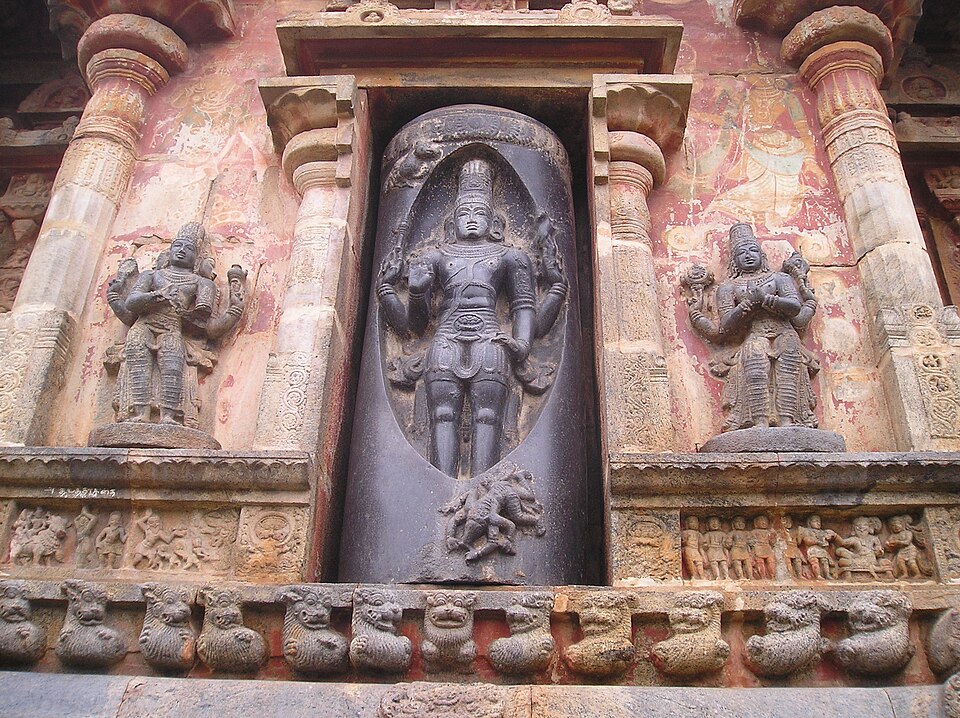
Lingobhava
Shiva Emerging From A Pillar of Light, Vishnu As A Boar At the Bottom, Brahma As A Gander At the Top, Pillar of Light
Puranas, Tirukkural
Thiruvathirai Festival, Shivaratri
Tamil Nadu
Iconic Representation
About Lingodbhava
Lingodbhava, a term translating to "the emergence of the Linga," is a significant iconic representation of the Hindu deity Shiva, particularly prominent in temples located in Tamil Nadu. This iconography visually narrates the legend concerning the origin of the lingam, Shiva's aniconic form that is widely worshipped.
Legend and Significance
The iconography of Lingodbhava depicts Shiva arising from a colossal pillar of light. This visual narrative stems from a legend where Vishnu and Brahma engaged in a debate about their superiority. To settle this dispute, Shiva manifested as an immense pillar of light, challenging both deities to discover its beginning or end. Brahma assumed the form of a gander and flew upwards, while Vishnu transformed into the boar Varaha and burrowed downwards. Neither deity could ascertain the pillar's extent.
While Vishnu conceded his inability to find the source, Brahma falsely claimed to have reached the top. Angered by Brahma's dishonesty, Shiva, in the form of Bhairava, severed one of Brahma's heads. As a consequence of this act, Shiva was burdened with the sin of brahmahatyāpāpa (the murder of a Brahmin or a comparable offense) and had to wander as Bhikshatana, a mendicant, to find absolution. This sin was eventually absolved at Varanasi on the banks of the Ganga River. The legend of Lingodbhava underscores Shiva's supreme and infinite nature, transcending the comprehension of even the most powerful deities.
Iconography and Literary Mentions
The Lingodbhava icon is frequently installed on the western wall of the sanctum in many Shiva temples. The depiction typically includes smaller images of Vishnu as a boar at the base of the lingam and Brahma as a gander at its apex. In some representations, Brahma and Vishnu are shown worshipping Shiva as he emerges from the column of fire, with Brahma to Shiva's right and Vishnu to his left. This imagery is believed to be an assimilation of ancient cults that venerated pillars.
Literary evidence for this iconographic representation appears as early as the 7th century in the works of the Shaiva saints Appar and Sambandar. The Tirukkural, a classical Tamil text dated to around the 5th century, also contains an indicative mention of the dispute between Vishnu and Brahma, setting the stage for the Lingodbhava narrative. The Thiruvathirai festival, celebrated during the Tamil month of Margazhi, commemorates Shiva's cosmic dance and, according to the Arunachala Puranam, is also considered the day Shiva manifested as a column of fire, an event known as the Lingothbhavar day, signifying the genesis of Shiva's form and formless manifestation.
Source: Wikipedia ↗
Frequently Asked Questions
What does Lingodbhava represent?
Lingodbhava is an iconic representation of the Hindu god Shiva, specifically illustrating the legend of the origin of the lingam. It depicts Shiva emerging from a pillar of light, which is a significant aniconic form of the deity.
What is the legend behind Lingodbhava?
The legend describes a dispute between Vishnu and Brahma over their superiority. Shiva appeared as a massive pillar of light, challenging them to find its source. Brahma, in the form of a gander, flew upwards, and Vishnu, as a boar, dug downwards, but neither could find the end.
What are the visual elements of the Lingodbhava icon?
The icon typically shows Shiva emerging from a pillar of light. Vishnu, in the form of a boar, is usually depicted at the bottom of the pillar, while Brahma, as a gander, is shown at the top.
Where is the Lingodbhava icon typically found?
The Lingodbhava icon is commonly found in Shiva temples, particularly in Tamil Nadu. It is often depicted on the western wall of the sanctum, behind the main image of Shiva.
What is the significance of the pillar of light in the Lingodbhava legend?
The pillar of light represents Shiva's supreme, formless, and infinite nature. The inability of Vishnu and Brahma to find its source demonstrates that Shiva's essence transcends their understanding and power.
When did the concept of Lingodbhava first appear in literature?
Literary evidence for the iconic representation of Lingodbhava dates back to the 7th century, with mentions in the works of the Shaiva saints Appar and Sambandar. An earlier, indicative mention is found in the 5th-century Tamil text, the Tirukkural.
Related Hindu deities
Dakshinamurti
Dakshinamurti is a South-facing aspect of the Hindu god Shiva, embodying him as the ultimate guru, the personification of supreme awareness, understanding, and knowledge. He is revered as the god of wisdom and meditation, teaching yoga, music, and the Shastras, and is depicted as the destroyer of ignorance. His iconography often features four arms, seated under a banyan tree, with a mudra signifying knowledge, and his presence is a significant element in Shiva temples.

Manjunatha
Shiva, also known as Mahadeva and Hara, is a principal deity in Hinduism and the Supreme Being in Shaivism. He is revered as the creator, protector, and transformer of the universe, and is also known as The Destroyer within the Trimurti. Shiva embodies both benevolent and fearsome aspects, often depicted as an ascetic yogi or a householder, and is considered the patron god of yoga, meditation, and the arts.

Lingam
The Lingam is an abstract and aniconic representation of the Hindu deity Shiva, primarily in the Shaivism tradition. It is typically a cylindrical pillar-like symbol, often accompanied by a disc-shaped platform called the yoni, symbolizing the union of masculine and feminine principles and the cosmic creative process. The Lingam is considered a profound emblem of Shiva's generative and destructive power, representing the formless reality and the merging of primordial matter with pure consciousness.