
Lingam
The Lingam is an abstract and aniconic representation of the Hindu deity Shiva, primarily in the Shaivism tradition. It is typically a cylindrical pillar-like symbol, often accompanied by a disc-shaped platform called the yoni, symbolizing the union of masculine and feminine principles and the cosmic creative process. The Lingam is considered a profound emblem of Shiva's generative and destructive power, representing the formless reality and the merging of primordial matter with pure consciousness.
Key Facts
- ›The Lingam is an abstract or aniconic symbol of the Hindu god Shiva.
- ›It is often depicted as a cylindrical pillar, usually accompanied by a disc-shaped yoni.
- ›The Lingam symbolizes Shiva's generative and destructive powers, as well as the union of masculine and feminine principles.
- ›It represents the 'formless reality' and the merging of primordial matter (Prakṛti) with pure consciousness (Purusha).
- ›The Lingam is the primary devotional image in many Hindu temples dedicated to Shiva.
- ›The word 'lingam' in Sanskrit means 'sign, symbol, or mark'.

Linga, Shiva Linga
- Short Cylindrical Pillar-Like Symbol
- Often Represented Within A Disc-Shaped Platform
- Can Have Faces Carved On It
- Can Feature Miniature Lingas Carved On the Main Lingam
- Can Have Fluted Facets
- Can Represent Shiva Emerging From A Fiery Pillar
Upanishads, Epic Literature, Shvetashvatara Upanishad, Samkhya, Vaisheshika, Vaisheshika Sutras, Nyaya School Texts, Samkhya Sutras, Gaudapada's Commentary On Samkhyakarika, Purva Mimamsa Sutra, Vedanta Sutra, Atharva Veda Samhita, Linga Purana
Kashi, Prayaga, Naimisha, Gaya
Symbolic Representation
About Lingam
What is the Lingam?
The Lingam (IAST: liṅga), also known as Linga or Shiva Linga, is an abstract or aniconic representation of the Hindu god Shiva, primarily within the Shaivism tradition. The word 'lingam' itself, found in Sanskrit texts like the Upanishads and epic literature, means 'mark, sign, emblem, or characteristic,' serving as evidence or proof of Shiva and his power.
Iconography and Symbolism
The Lingam is typically a short, cylindrical pillar-like symbol, often made of stone, metal, wood, or clay. It is frequently placed upon a disc-shaped platform known as the yoni, which represents the feminine counterpart. Together, the Lingam and yoni symbolize the union of the masculine and feminine principles, representing the divine, eternal process of creation and regeneration, and the merging of the microcosmos and macrocosmos. This iconography signifies the totality of existence and the union that recreates all life.
Meaning and Significance
In Shaivism, the Lingam is regarded as an emblem of both generative and destructive power. While it may be rooted in representations of the male sexual organ, its deeper meaning is that of an 'outward symbol' of the 'formless reality.' It symbolizes the merging of 'primordial matter' (Prakṛti) with 'pure consciousness' (Purusha) in a transcendental context. For many devotees, the Lingam speaks the 'language of silence,' signifying formlessness, oneness, and the eternal, immortal essence of the universe, identical with the innermost Self (Atman) and the Supreme Brahman. It is considered the primary devotional image in many Hindu temples dedicated to Shiva.
Historical Development and Interpretations
While the word 'lingam' itself is not found in the Rigveda, the worship of the Lingam is believed to have originated from a hymn in the Atharva Veda Samhita praising the Yupa-Stambha, or sacrificial post, which represented the eternal Brahman. This concept evolved to represent Shiva. Archaeological finds from the Indus Valley Civilization have been interpreted by some scholars as potential evidence of early lingam-like worship, though this remains a subject of scholarly debate. Interpretations of the Lingam have varied over time, with some scholars viewing it primarily as a phallic symbol, while traditional Shaiva philosophy emphasizes its abstract spiritual meaning as a symbol of cosmic creation and Shiva's formless nature.
Source: Wikipedia ↗
Frequently Asked Questions
What is a Lingam?
The Lingam is an abstract or aniconic representation of the Hindu god Shiva, particularly within the Shaivism tradition. It is often a cylindrical pillar-like symbol that represents Shiva's generative and destructive powers.
What does the Lingam symbolize?
The Lingam symbolizes the formless reality of Shiva and the merging of primordial matter (Prakṛti) with pure consciousness (Purusha). Together with the yoni, it represents the union of masculine and feminine principles and the eternal process of creation and regeneration.
What is the significance of the yoni accompanying the Lingam?
The yoni is a disc-shaped platform that serves as the feminine counterpart to the Lingam. Together, the Lingam and yoni symbolize the divine eternal process of creation and regeneration, and the union of the feminine and masculine principles that recreates all of existence.
What materials are Lingams made from?
Lingams can be made from various materials including stone, metal, gems, wood, clay, or precious stones. They are also found as self-manifested natural objects.
Is the Lingam a phallic symbol?
While some scholars view the Lingam as extrapolations of a phallic symbol, traditional interpretations within Shaivism emphasize its representation of abstract spiritual truths, cosmic mysteries, and creative powers rather than solely the male sexual organ. It is seen as a symbol of Shiva's formless being and light of consciousness.
Related Hindu deities
Dakshinamurti
Dakshinamurti is a South-facing aspect of the Hindu god Shiva, embodying him as the ultimate guru, the personification of supreme awareness, understanding, and knowledge. He is revered as the god of wisdom and meditation, teaching yoga, music, and the Shastras, and is depicted as the destroyer of ignorance. His iconography often features four arms, seated under a banyan tree, with a mudra signifying knowledge, and his presence is a significant element in Shiva temples.

Manjunatha
Shiva, also known as Mahadeva and Hara, is a principal deity in Hinduism and the Supreme Being in Shaivism. He is revered as the creator, protector, and transformer of the universe, and is also known as The Destroyer within the Trimurti. Shiva embodies both benevolent and fearsome aspects, often depicted as an ascetic yogi or a householder, and is considered the patron god of yoga, meditation, and the arts.
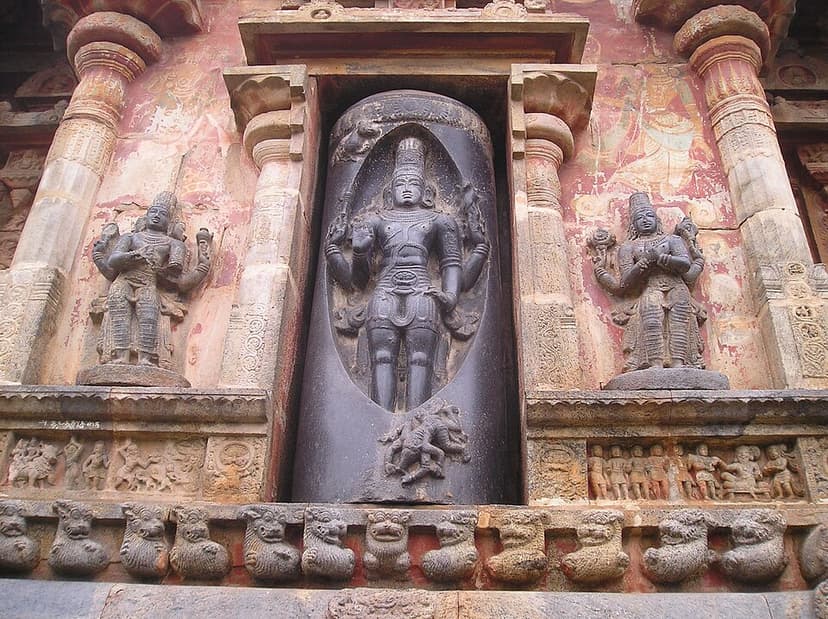
Lingodbhava
Lingodbhava, meaning "the emergence of the Linga," is an iconic representation of the Hindu god Shiva, particularly prevalent in temples in Tamil Nadu. It depicts Shiva emerging from a pillar of light, symbolizing his aniconic representation and the origin of the lingam. This representation illustrates a legend where Shiva appeared as a pillar of light to end a dispute between Vishnu and Brahma about their supremacy.