
Kamakhya
Kamakhya is a prominent Shakta Tantric mother goddess, embodying Kama (desire) and revered as the goddess of longing. Her primary abode is the Kamakhya Temple in Assam, India, situated on Nilachal hills. She is worshipped in a non-iconic, un-anthropomorphic form of a stone shaped like a yoni, symbolizing her connection to creation and fertility.
Key Facts
- ›Kamakhya is a Shakta Tantric mother goddess, representing desire.
- ›Her main temple is located on Nilachal hills in Assam, India.
- ›She is worshipped in a non-iconic form: a stone shaped like a yoni.
- ›The Kamakhya Temple is considered the primary among the 51 Shakta pithas.
- ›She is identified with Kali and associated with the Mahavidyas.
- ›The mythical origin of her site is linked to the yoni of Sati falling to earth.

Kāmākhyā, Mahamaya, Kameshvari, Tripura Sundari, Shodashi
- Twelve Arms
- Six Heads of Varying Colors
- Opulent Jewelry
- Red Flowers
- Holds Lotus, Trident, Sword, Bell, Discus, Bow, Arrows, Club/Scepter, Goad, Shield In Ten Hands
- Holds A Bowl In Remaining Two Hands
- Seated Upon A Lotus Representing Brahma, On Top of Sweta Preta Symbolizing Shiva
Kalika Purana, Yoginitantra, Kamakhya Tantra
Ambubachi Mela
Kamakhya Temple, Nilachal Hills, Kamarupa Region
Trident, Sudarshana Chakra
About Kamakhya
Kamakhya is a revered mother goddess within Shakta Tantric traditions, widely understood as the embodiment of Kama, or desire, and thus the goddess of longing. Her principal sanctuary is the Kamakhya Temple, situated on Nilachal hills in the Kamarupa region of Assam, India. Originally a goddess of Kirata origin, she resides on the Nilachal hills overlooking the Brahmaputra River. The current temple structure dates back to a rebuilding in 1565 CE, though evidence of a temple complex exists from the 10th/11th century.
Form of Worship
Kamakhya is uniquely worshipped in a non-iconic and un-anthropomorphic manner. Her shrine consists of a stone shaped like a yoni (vulva or womb), which is perpetually nourished by a natural spring. This form symbolizes her profound connection to creation, fertility, and the generative forces of the universe. The Kamakhya Temple is considered paramount among the 51 Shakti Pithas, sites of immense divine feminine power.
Mythical Origins
The sacredness of the Kamakhya site is deeply rooted in the myth of Sati, the wife of Shiva. According to tradition, after Sati immolated herself, Shiva, in his grief, performed his cosmic dance of destruction, carrying her dismembered body. As Vishnu intervened by sending his Sudarshana Chakra to sever the body, pieces fell across the subcontinent. The Kamakhya site is believed to be where Sati's yoni descended, marking it as a potent seat of divine feminine energy. Devotees worship this yoni as the source of creation and the womb that nurtures all existence.
Legends and Associations
Kamakhya's legends often intertwine with local traditions and Puranic narratives. One notable story involves the demon Narakasura, who, driven by desire, attempted to marry Kamakhya. She playfully set an impossible condition: he had to build a staircase from the hill's base to the temple before dawn. Narakasura was tricked into believing dawn had arrived prematurely, leaving the task unfinished. Later, Lord Krishna, in his avatar as Vishnu, defeated Narakasura.
Kamakhya is identified in scriptures like the Kalika Purana as Mahamaya, the 'great goddess of illusion,' and is also known as Kameshvari, the 'beloved goddess of desire.' She is considered a form of Tripura Sundari and is identified with Kali, representing wisdom and divine power. She is closely associated with Durga and is part of the pantheon of the Mahavidyas, a group of ten powerful Tantric goddesses, many of whom have shrines within the Kamakhya temple complex, signifying their close connection to Kamakhya herself.
Source: Wikipedia ↗
Frequently Asked Questions
What is Kamakhya known for?
Kamakhya is known as the mother goddess embodying Kama, or desire, and is revered as the goddess of longing. Her most significant aspect is her association with fertility and creation, symbolized by her worship in the form of a yoni.
Where is the Kamakhya Temple located?
The Kamakhya Temple, the primary abode of the goddess Kamakhya, is located on Nilachal hills in the Kamarupa region of Assam, India, west of Guwahati, on the banks of the Brahmaputra River.
How is Kamakhya worshipped?
Kamakhya is worshipped in a non-iconic and un-anthropomorphic form. Her shrine is a stone shaped like a yoni, which is fed by a perennial stream, symbolizing her connection to the creative and generative powers.
What is the mythical origin of the Kamakhya site?
According to myth, the site of Kamakhya is where the yoni (vulva) of Goddess Sati fell to earth after her body was dismembered. This place is considered a Shakti Pitha and is believed to be the source of creation and the womb from which the world arises.
What is Kamakhya's connection to other goddesses?
Kamakhya is identified with Kali in several scriptures and is closely associated with Durga. She is also linked to the Mahavidyas, a group of ten Tantric goddesses, and some of these goddesses are worshipped as forms of Kamakhya herself.
What legend is associated with Narakasura and Kamakhya?
The legend tells of the demon Narakasura attempting to marry Kamakhya under a condition to build a staircase overnight. He was deceived by Kamakhya, who tricked him into believing dawn had arrived prematurely. Later, Krishna, as an avatar of Vishnu, slays Narakasura.
Related Hindu deities
Bhima Kali
Rudrani is an epithet for the consort of the Vedic deity Rudra, who is considered a form of Shiva in contemporary Hinduism. Primarily identified with Parvati, Rudrani represents the active energy of Rudra and embodies the inseparable union of "Energy and Being." She is also recognized as one of the Saptamatrikas (Seven Mothers) and is associated with fierce aspects of the Goddess.
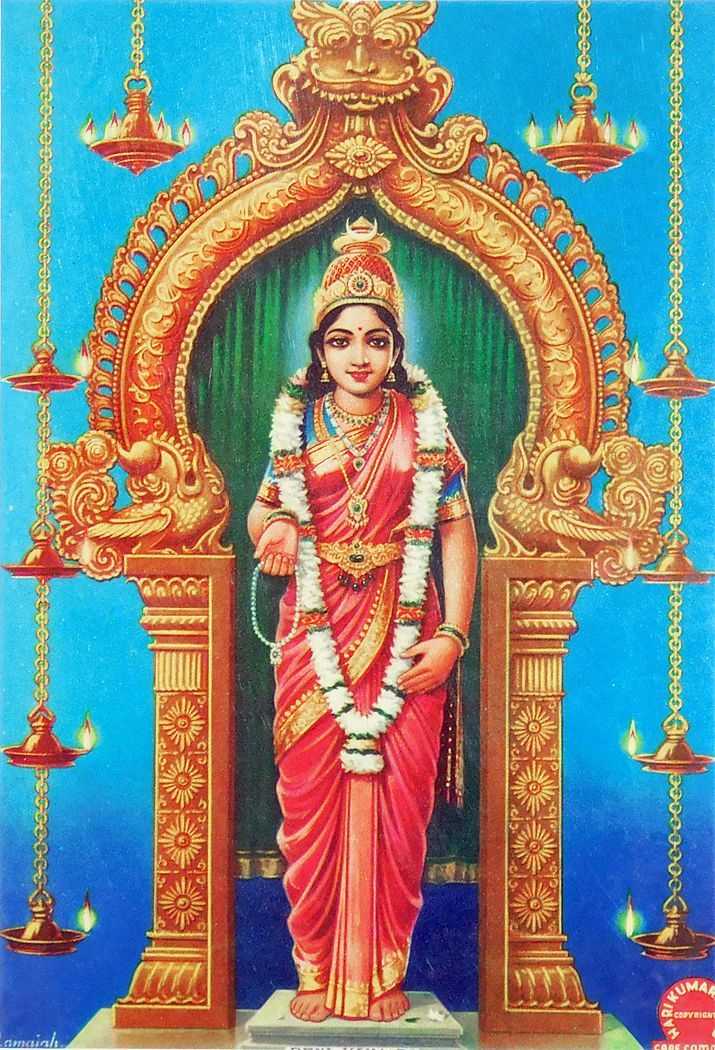
Devi Kanya Kumari
Devi Kanya Kumari is a prominent Hindu goddess, a manifestation of Mahadevi in the form of an adolescent girl. She is revered as a form of Parvati or Lakshmi, and is particularly known for her role in slaying the demon Banasura. Her worship is deeply tied to the town of Kanyakumari at the southernmost tip of India.

Chandraghanta
Chandraghanta is a powerful form of the Hindu goddess Mahadevi, revered as the destroyer of demons and the protector of her devotees. She is the third of the Navadurga and is prominently worshipped on the third day of Navaratri. Her name, meaning 'adorned with the moon as her bell,' refers to the crescent moon on her forehead, and she is depicted with ten arms holding various weapons and a bell.