
Junior wives of Krishna
The junior wives of Krishna refer to the approximately 16,000 women Krishna married after rescuing them from the demon Narakasura. These women are often identified as manifestations of Lakshmi, Krishna's eternal consort. Their story highlights Krishna's divine power and compassion in saving and providing for them.
Key Facts
- ›Krishna married approximately 16,000 women after rescuing them from the demon Narakasura.
- ›These women were princesses of defeated nations, daughters of gods, siddhas, demons, and kings, or apsaras.
- ›Krishna rescued them from captivity in Narakasura's kingdom, Pragjyotisha.
- ›Each junior wife was provided a home and Krishna simultaneously manifested to be with each of them.
- ›Some accounts suggest a curse led to them being wives of Vishnu in a future birth.
- ›After Krishna's death, many of them performed sati (immolation on the funeral pyre).
16,000 junior queens, 16,100 junior queens
Bhagavata Purana, Mahabharata, Vishnu Purana, Harivamsa, Kalika Purana, Adi Parva, Shanti Parva, Bhavishya Purana, Skanda Purana, Varaha Purana
Consort of Vishnu
Diptiman, Tamratapta
About Junior wives of Krishna
The Junior Wives of Krishna
The junior wives of Krishna represent a significant group of consorts in Hindu mythology, numbering approximately 16,000, as detailed in scriptures like the Bhagavata Purana and the Mahabharata. These women were not ordinary consorts but were rescued by Krishna from the clutches of the demon Narakasura. Their story emphasizes Krishna's role as a protector and divine savior, as well as the multifaceted nature of divine love and presence.
Background and Rescue
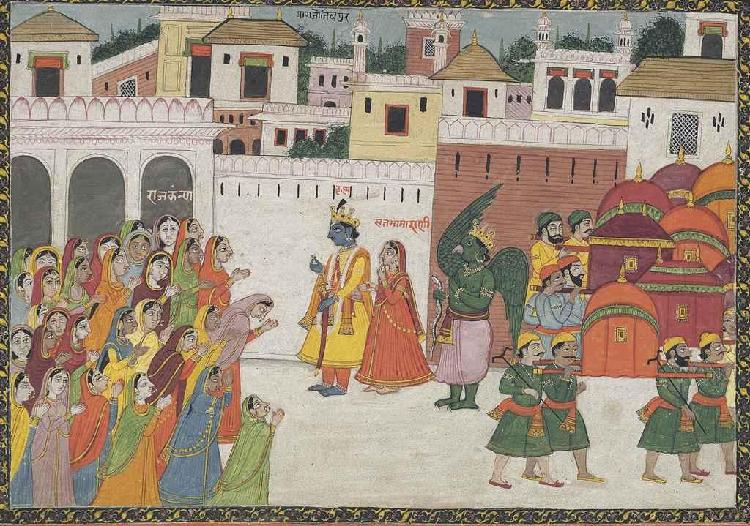
According to various Puranic texts, these women were princesses of defeated nations, daughters of gods, saints, demons, and kings, or celestial spirits known as apsaras. Narakasura, the son of the boar avatar of Vishnu (Varaha) and the earth goddess Bhumi, had conquered the three worlds and imprisoned these women in his kingdom. Krishna, along with his wife Satyabhama, journeyed to Pragjyotisha to defeat Narakasura. After slaying the demon, Krishna liberated the captive women. Each of them implored him to accept them as his wife, and he complied, marrying them and bringing them to his capital, Dvaraka.
Divine Presence and Marital Life
The scriptures describe Krishna's extraordinary ability to be present with all his 16,000 wives simultaneously. He would divide himself into numerous forms, spending time with each wife in her own dwelling, engaging in domestic life and caring for their children. This phenomenon was observed by the sage Narada, who marveled at Krishna's divine power and his capacity for manifold manifestations, solidifying Krishna's status as the supreme divine being.
Later Life and Interpretations
Following Krishna's departure from the world, as described in the Mausala Parva of the Mahabharata, many of his junior wives performed sati, immolating themselves on his funeral pyre. Some were abducted by robbers, and the survivors eventually retired to the forest for spiritual austerities. The concept of these 16,000 wives is also interpreted allegorically, sometimes relating to the Gopis, the milkmaids devoted to the young Krishna, or to the 16,000 ragas (musical modes) in Indian classical music, with the wives personifying the Raginis.
Source: Wikipedia ↗
Frequently Asked Questions
Who were the junior wives of Krishna?
The junior wives of Krishna are a group of approximately 16,000 women whom Krishna married after rescuing them from the demon Narakasura. They are often described as princesses and daughters of various divine and human beings.
How did Krishna come to marry so many women?
Krishna married these women after defeating the demon Narakasura, who had imprisoned them. By marrying them, Krishna saved them from destitution and infamy.
What is the significance of these 16,000 wives?
They are often identified as manifestations of Goddess Lakshmi, Krishna's eternal consort, highlighting his divine nature and his role as a protector. The story also illustrates his ability to be present and attend to each of them simultaneously.
Are these wives named in scriptures?
Generally, the 16,000 junior wives are unnamed in the scriptures. However, some commentators identify Rohini as their leader. The Bhagavata Purana names two of their sons, Diptiman and Tamratapta.
What happened to Krishna's junior wives after his death?
Following Krishna's funeral, many of his junior wives are described as immolating themselves on his funeral pyre in an act of sati. Others were attacked by robbers, and the remaining widows retired to the forest for austerities.
Related Hindu deities

Perumal
Perumal, also known as Tirumal, is a major Hindu deity, primarily worshipped by Tamil Hindus in South India and the diaspora. He is widely considered a form of Vishnu, the preserver deity in the Hindu trinity. Perumal is celebrated for his grace and is the supreme deity in Vaishnavism, with numerous temples dedicated to him across India and beyond.

Gopis
Gopis, also known as Gopikas, are a group of milkmaids from the Braj region of India, revered in Hinduism as devoted consorts of Krishna. They are celebrated in scriptures like the Bhagavata Purana for their unconditional love and devotion (Bhakti) towards Krishna, with Radha being considered the chief among them. The Gopis' devotion and their ecstatic dance with Krishna, known as the Raslila, have significantly inspired art, literature, and performance traditions.

Durvasa
Durvasa is a legendary sage in Hindu scriptures, known for his irascible nature, short temper, and his ability to bestow both curses and boons. He is considered a partial avatar of Shiva and is revered by both humans and deities. His interactions often involve dramatic events, shaping the destinies of many significant figures in Hindu mythology.