
Perumal
Perumal, also known as Tirumal, is a major Hindu deity, primarily worshipped by Tamil Hindus in South India and the diaspora. He is widely considered a form of Vishnu, the preserver deity in the Hindu trinity. Perumal is celebrated for his grace and is the supreme deity in Vaishnavism, with numerous temples dedicated to him across India and beyond.
Key Facts
- ›Perumal is identified with Vishnu, the preserver deity.
- ›He is a central figure in Tamil Hinduism and Vaishnavism.
- ›His name is derived from Tamil words meaning "great god" or "Great Measurer".
- ›Perumal is associated with the pastoral landscape (mullai tiṇai) in early Tamil literature.
- ›His consort is Lakshmi, the goddess of fortune.
- ›Major temples dedicated to Perumal include those in Tirupati, Srirangam, and Kanchipuram.

Tirumal, Mayon, Māyavan, Māmiyon, Netiyōn, Māl
Dark Complexion, Golden Disc
ParipāṭAl, Purananuru, Pattupattu, Tolkappiyam, AkanaṉūṟU, Manimekalai, Cilappatikaram, Kural, Nalayira Divya Prabandham, Vedas
Consort of Lakshmi
Temple Car Processions
Tirupati, Srirangam, Kanchipuram, Thiruvananthapuram, Thirunavaya, Ahobilam, Madurai, T-Nagar, Ambattur, Mogappair, Udumalpet, Colombo, Kandy, Dondra, Vallipuram, Klang, Batu Caves, Kajang, Subang Jaya, Puchong, Port Klang, Kuala Lumpur, United States, Singapore
Sudarshana Chakra
About Perumal
Perumal, also known by the name Tirumal, is a significant Hindu deity revered primarily by Tamil Hindus in South India and the Tamil diaspora. He is widely understood to be a manifestation of Vishnu, the preserver god in the Hindu Trimurti. Perumal holds a position as the supreme deity within the Vaishnava tradition, and his worship is deeply ingrained in the religious and cultural landscape of Tamil Nadu.
Etymology and Significance
The name Perumal is believed to originate from Tamil words signifying "great god" or "Great Measurer," reflecting his supreme status and benevolent nature. Scholars suggest the term may trace back to ancient tribal titles. In early Tamil literature from the Sangam era, Perumal is identified with Mayon, a dark-complexioned deity associated with the pastoral lands. He was considered the supreme being responsible for creation, sustenance, and destruction, and was revered for his ability to grant moksha.
Iconography and Worship
Perumal is often depicted with a dark complexion and is associated with the Sudarshana Chakra, his divine discus. His consort is Lakshmi, the goddess of fortune and prosperity, whose presence is noted from ancient Tamil poetry. The worship of Perumal is prominent in numerous temples, with some of the most significant complexes being the Venkateswara temple in Tirupati, Andhra Pradesh, and the Ranganathaswamy temple in Srirangam, Tamil Nadu. These sites, along with others like the Varadaraja Perumal temple in Kanchipuram, are central to Vaishnava pilgrimage.
Literary and Historical Context
Perumal is extensively mentioned in early Tamil literature, including the Sangam anthologies like Paripāṭal, Purananuru, and Pattupattu, as well as later epics such as Manimekalai and Cilappatikaram. These texts highlight his role as a supreme deity and detail narratives that echo Puranic legends. The devotional hymns composed by the Alvars, particularly the Tirupallantu, further glorify Perumal and have become integral to his worship, especially within the Sri Vaishnava tradition. Festivals dedicated to Perumal frequently involve elaborate chariot processions, a vibrant expression of devotion that draws large numbers of followers.
Source: Wikipedia ↗
Frequently Asked Questions
Who is Perumal?
Perumal, also known as Tirumal, is a Hindu deity prominently worshipped by Tamil Hindus. He is predominantly considered a form of Vishnu, the preserver god in Hinduism, and is revered as the supreme deity in Vaishnavism.
What is the meaning of the name Perumal?
The name Perumal is believed to be derived from the Tamil words 'Perum' meaning 'great' and 'al' meaning 'person' (used for a deity), thus signifying 'great god' who bestows divine grace. Another interpretation suggests it means 'Great Measurer'.
What is Perumal's significance in early Tamil literature?
Perumal, or Mayon as he was known, is referenced in early Tamil literature from the Sangam era, such as Paripāṭal. He was associated with the pastoral landscape (mullai tiṇai) and regarded as the supreme deity who created, sustained, and destroyed the universe.
Who is Perumal's consort?
Perumal's consort is Lakshmi, the goddess of fortune, beauty, and prosperity. Their association is noted even in the earliest strata of Tamil poetry.
Where are major temples dedicated to Perumal located?
Significant temples dedicated to Perumal are found in South India, including the Venkateswara temple in Tirupati, the Ranganathaswamy temple in Srirangam, and the Varadaraja Perumal temple in Kanchipuram. Many of these are among the 108 Divya Desams revered by Alvar saints.
How is Perumal venerated during festivals?
Temple festivals for Perumal often feature grand chariot processions (temple car processions). During these events, images of the deity and his consorts are elaborately adorned and paraded through the streets on a chariot, accompanied by music, chanting, and devotees.
Related Hindu deities
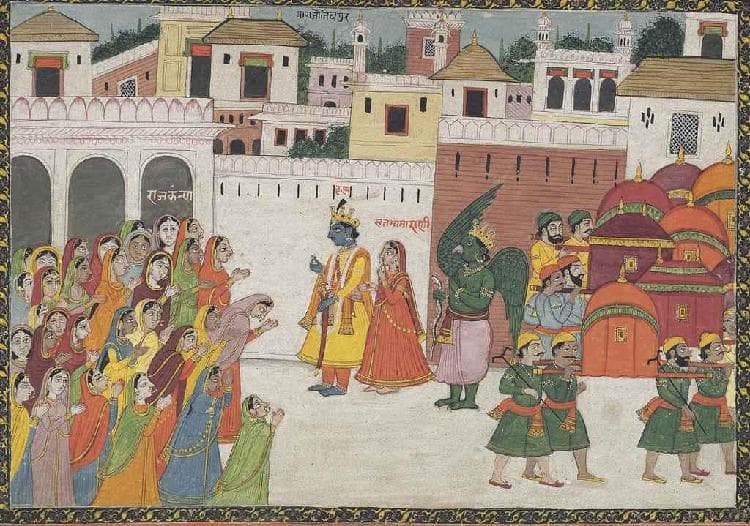
Junior wives of Krishna
The junior wives of Krishna refer to the approximately 16,000 women Krishna married after rescuing them from the demon Narakasura. These women are often identified as manifestations of Lakshmi, Krishna's eternal consort. Their story highlights Krishna's divine power and compassion in saving and providing for them.

Kali
Kali is a prominent Hindu goddess associated with time, death, and destruction, but also with transcendental knowledge. She is considered the Divine Mother, the Mother of the Universe, and the Divine feminine energy, offering liberation to her devotees. Kali is a central figure in Tantric traditions and goddess-centric sects, and her terrifying iconography symbolizes her embrace of life's grim realities.
Jagannatha
Jagannatha, meaning 'Lord of the Universe', is a major Hindu deity primarily worshipped in eastern India, particularly in Odisha. He is venerated as the supreme god, a regional form of Krishna, or even a tantric manifestation of Shiva. Jagannatha is known for his unique, abstract wooden idol and the grand Ratha Yatra festival, which gave rise to the English word 'juggernaut'.