
Dyauṣ
Dyauṣ is a prominent sky deity in the Rigveda, revered as the archetypal father figure in early Hindu scriptures. He is often depicted as being paired with his consort, Prithvi, the Earth goddess, and together they represent the cosmic parents. Dyauṣ is known for his paternal role, with various deities and beings described as his offspring.
Key Facts
- ›Dyauṣ is the Rigvedic sky deity.
- ›He is considered the archetypal father in the Rigveda, paired with his consort Prithvi (Earth).
- ›His daughter is Uṣas, the personification of dawn.
- ›He is associated with multiple offspring, including the gods Sūrya, Agni, Parjanya, the Ādityas, the Maruts, and the Angirases.
- ›The Ashvins are referred to as his progeny or grandsons.
- ›In the Mahabharata, Bhishma is described as a human incarnation of Dyauṣ.

Dyauṣpitṛ́
- Visualized As A Roaring Animal, Often A Bull, Fertilizing the Earth
- Described As A Black Stallion Studded With Pearls, Akin To the Night Sky
Rigveda, Mahabharata
Consort of Prithvi, Father of UṣAs, Father of SūRya, Father of Agni, Father of Parjanya, Father of the āDityas, Father of the Maruts, Father of the Angirases, Ancestor of the Ashvins
UṣAs, SūRya, Agni, Parjanya, āDityas, Maruts, Angirases
Bull, Stallion
Sky Deity, Father Figure, Divine Parent
Archetypal Figure
About Dyauṣ
Dyauṣ, also known as Dyauṣpitṛ́, is a significant deity in the Rigvedic tradition of Hinduism, primarily representing the sky. He is revered as the archetypal father figure and, along with his consort Prithvi, the Earth goddess, forms the primordial cosmic parents in the Rigveda. The name 'Dyauṣ' itself derives from Proto-Indo-European roots meaning 'daylight-sky god', linking him to similar deities in other Indo-European mythologies.
Role and Mythology
Dyauṣ's most defining characteristic is his paternal role. His daughter is Uṣas, the personification of dawn. The Rigveda states that various deities, including Sūrya (the sun), are his children. His other divine offspring include Agni (fire), Parjanya (rain), the Ādityas, the Maruts, and the Angirases. The Ashvins are also referred to as his progeny or grandsons. Dyauṣ is sometimes depicted metaphorically as a roaring bull that fertilizes the earth, or as a black stallion studded with pearls, symbolizing the night sky. A notable mythological event involves Indra's separation of Dyauṣ and Prithvi, which is celebrated as a crucial creation myth.
Later Traditions
In later Hindu epics, Dyauṣ's presence is noted in the Mahabharata, where the hero Bhishma is identified as a human incarnation of Dyauṣ. This occurs as a consequence of a curse placed upon the Vasus, one of whom Dyauṣ was, for stealing from the sage Vasishtha out of pride. While most of the Vasus were quickly absolved, Dyauṣ was destined to remain on Earth for a longer duration, incarnating as Devavrata, who would later be known as Bhishma.
Source: Wikipedia ↗
Frequently Asked Questions
Who is Dyauṣ in Hinduism?
Dyauṣ is the Rigvedic sky deity and a significant figure in early Hindu scriptures. He is revered as the archetypal father, forming a divine pair with his consort Prithvi, the Earth goddess.
What is Dyauṣ known for?
Dyauṣ is primarily known for his paternal role and his association with the sky. He is depicted as the father of numerous deities and beings, embodying a cosmic parental figure.
Who are Dyauṣ's consort and children?
Dyauṣ's consort is Prithvi, the Earth goddess. Their children include Uṣas (dawn), Sūrya (sun god), Agni (fire god), Parjanya (rain god), the Ādityas, the Maruts, and the Angirases. The Ashvins are also considered his descendants.
What is the significance of Dyauṣ in the Mahabharata?
In the Mahabharata, Dyauṣ is mentioned as having incarnated as Devavrata, who later became known as Bhishma. This occurs as a consequence of a curse on the Vasus for stealing from the sage Vasishtha.
Related Hindu deities
Dhāta
Dhata, also known as Dhatr, is a solar deity and one of the Adityas in Hinduism, revered as a god of health and magic. He is invoked in tantric practices and Vedic hymns, and plays a role in major sacrifices like the Ashwamedha yagna. Dhata is depicted in Hindu epics as a participant in significant events and is described as the seventh son of Aditi and Kashyapa.

Kalki
Kalki is the prophesied tenth and final avatar of the Hindu god Vishnu, destined to appear at the end of the Kali Yuga. His arrival signifies the destruction of unrighteousness and the dawn of the Satya Yuga, initiating a new cycle of existence. Kalki is typically depicted as a warrior riding a white horse and wielding a fiery sword.
Khandoba
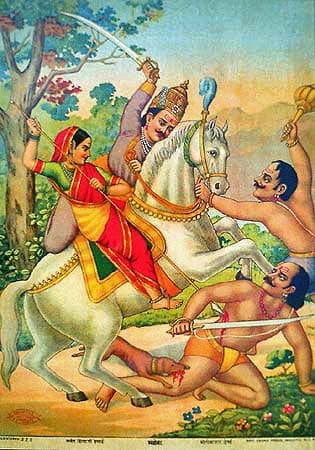
Khandoba is a prominent Hindu deity, primarily worshipped in Maharashtra and Karnataka, often seen as a manifestation of Shiva. He is revered as a family deity (Kuladevata) and the patron deity for various castes, including warriors, farmers, and tribal communities. Khandoba is known for his victory over demons Mani and Malla and his marriages, with his worship reflecting syncretic traditions that include Jain and Muslim influences.