
Ancitif
Ancitif is a demon associated with the 1647 Louviers possessions in Normandy, France. He is specifically named as possessing the body of Sister Barbara of St. Michael during this mass demonic possession incident. The Louviers events, characterized by public exorcisms and confessions of sexual encounters with demons, are often viewed by modern scholars as a blend of religious theater and psychological phenomena.
Key Facts
- ›Ancitif was identified as a demon possessing Sister Barbara of St. Michael during the Louviers possessions.
- ›The Louviers possessions occurred at a convent in Normandy, France, in 1647.
- ›The incident involved accusations of sexual intercourse with demons, particularly one named Dagon.
- ›Madeleine Bavent was a central figure in the Louviers possessions, whose confession detailed a marriage to the Devil and acts at a Witches' Sabbath.
- ›The events at Louviers were similar to earlier mass possession cases in Aix-en-Provence and Loudun.
- ›Modern interpretations suggest the Louviers possessions were a form of religious and political theater, possibly influenced by mass hysteria and psychological factors.
- Histoire De Magdelaine Bavent, Religieuse De Louviers, Avec Son Interrogatoir, Etc.
Sister Barbara of St. Michael, Madeleine Bavent, Father Thomas Boulle, Mathurin Picard, Dagon
About Ancitif
Ancitif is a demon known from the accounts of the Louviers possessions, a mass demonic possession incident that occurred at the Louviers Convent in Normandy, France, in 1647. While the events at Louviers involved multiple nuns and clergy, Ancitif is specifically identified as the demon possessing the body of Sister Barbara of St. Michael.
The Louviers Possessions
The Louviers possessions, similar to earlier incidents in Aix-en-Provence (1611) and Loudun (1634), gained notoriety through public exorcisms and the detailed confessions of the supposed victims. Central to these confessions was Madeleine Bavent, a nun who claimed to have been abducted, married to the Devil (referred to as "Dagon"), and forced into sexual acts during a Witches' Sabbath. These confessions and the accompanying dramatic displays of possession, such as contortions and speaking in tongues, led to investigations and trials.
Modern Interpretations
Contemporary scholars widely interpret the Louviers possessions and similar events not as literal demonic manifestations but as complex social and psychological phenomena. They are often viewed as a form of religious and political theater, influenced by mass hysteria, religious fervor, and the societal pressures of 17th-century France. The lurid sexual themes present in the Louviers case distinguish it from some other possession accounts of the era, and modern analyses often consider factors like sexual hysteria, epilepsy, and other psychological disorders as potential explanations for the observed behaviors.
Source: Wikipedia ↗
Frequently Asked Questions
What was the Louviers possessions?
The Louviers possessions were a series of events in 1647 at a convent in Normandy, France, where multiple nuns were believed to be suffering from demonic possession. This incident is notable for its public exorcisms and the detailed confessions of the supposed possessed individuals.
Who was Ancitif in the Louviers possessions?
Ancitif was a specific demon identified as possessing the body of Sister Barbara of St. Michael during the Louviers events. While other demons, like Dagon, were mentioned in connection with the nuns' alleged experiences, Ancitif is specifically named as being in control of Sister Barbara.
What were the key events during the Louviers possessions?
The Louviers possessions were marked by public exorcisms, dramatic displays of supposed demonic influence such as contortions and speaking in tongues, and confessions by the nuns involved. These confessions often detailed sexual encounters with demons and participation in Witches' Sabbaths.
How are the Louviers possessions interpreted today?
Modern scholars widely view the Louviers possessions, along with similar incidents like those in Loudun and Aix-en-Provence, as a form of religious and political theater. They are often attributed to factors such as mass hysteria, psychological distress, and the social and religious climate of 17th-century France, rather than literal demonic influence.
What was the role of Madeleine Bavent in the Louviers possessions?
Madeleine Bavent was a key figure whose confession was central to the investigation of the Louviers possessions. She claimed to have been abducted, married to the Devil (whom she called Dagon), and forced to participate in sexual acts during a Witches' Sabbath.
Related Demons
Leonard
The Dictionnaire Infernal is a foundational book on demonology, first published in 1818 by Jacques Collin de Plancy. It details various demons, often organized by hierarchy, and is notable for its illustrated editions, particularly the 1863 version featuring sixty-nine depictions of demons by Louis Le Breton. The book reflects the author's evolving views on superstition and the supernatural, moving from initial skepticism to a later embrace of Roman Catholic theology.

Yan-gant-y-tan
Yan-gant-y-tan is a demon from Brittany, France, known for wandering the nights and carrying five candles on his hand. His name is thought to mean 'Wanderer in the Night' or 'John with the Fire,' and encountering him is considered an evil omen. Despite his ominous nature, he is sometimes depicted as offering light to travelers.
Belphegor
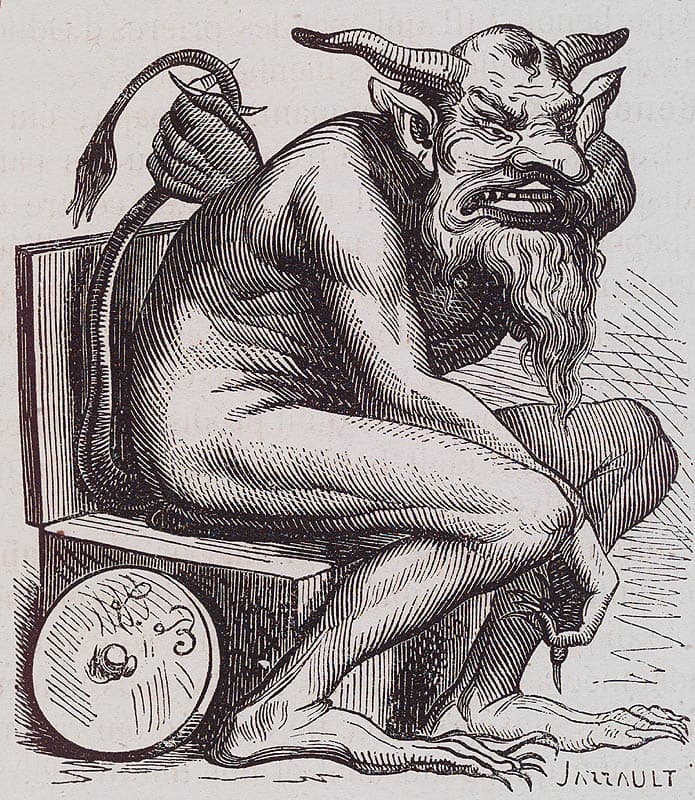
Belphegor is a demon in Christian demonology associated with the deadly sin of sloth, though some traditions link him to gluttony. He is known for tempting people with promises of wealth through incredible inventions, thereby sowing dispute and leading them to evil. Historically, Belphegor is derived from Baal-Peor, an ancient deity worshipped in Moab.