
Leonard
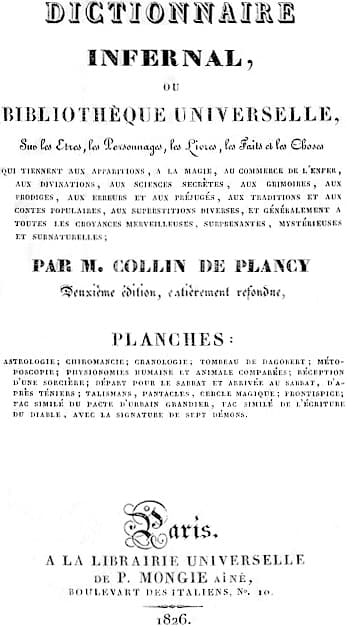
The Dictionnaire Infernal is a foundational book on demonology, first published in 1818 by Jacques Collin de Plancy. It details various demons, often organized by hierarchy, and is notable for its illustrated editions, particularly the 1863 version featuring sixty-nine depictions of demons by Louis Le Breton. The book reflects the author's evolving views on superstition and the supernatural, moving from initial skepticism to a later embrace of Roman Catholic theology.
Key Facts
- ›The Dictionnaire Infernal was first published in 1818.
- ›It was written by Jacques Collin de Plancy.
- ›The 1863 edition is famous for its sixty-nine illustrations by Louis Le Breton.
- ›The book attempts to catalog knowledge about superstitions and demonology.
- ›Its content evolved over multiple editions, reflecting de Plancy's changing beliefs.
- ›The Dictionnaire Infernal influenced later works on demonology, including some associated with the Lesser Key of Solomon.
Superstition, Demonology, Occult Sciences, Magic, Divination
Dictionnaire Infernal
Jacques Collin De Plancy, Louis Le Breton, Jacques Paul Migne, S. L. Macgregor Mathers
Superstition, Rationalism, Faith, Occult Beliefs
About Leonard
The Dictionnaire Infernal
The Dictionnaire Infernal, first published in 1818, is a significant work in the field of demonology, compiled by Jacques Collin de Plancy. This comprehensive dictionary aimed to catalog and describe a wide range of supernatural beings, superstitions, and occult practices known at the time. It is particularly renowned for its various editions, each reflecting the evolving beliefs and understanding of its author and the era.
Evolution and Content
Initially, de Plancy approached the subject with a degree of skepticism, influenced by Enlightenment rationalism. However, his views gradually shifted, especially after he embraced Roman Catholic theology. This transformation is evident in the later editions of the Dictionnaire Infernal, most notably the sixth and final edition published in 1863. This edition, revised and expanded, sought to reconcile demonological accounts with Catholic doctrine and is celebrated for its striking illustrations.
Illustrations and Influence
The 1863 edition of the Dictionnaire Infernal is perhaps the most famous due to its inclusion of sixty-nine engravings by the artist Louis Le Breton. These images provided visual representations of many of the demons described, greatly influencing popular conceptions and later artistic depictions. Some of these illustrations were later incorporated into S. L. MacGregor Mathers's edition of The Lesser Key of Solomon, further cementing their place in occult literature. The Dictionnaire Infernal remains a key reference for those studying demonology and the history of occult thought.
Source: Wikipedia ↗
Frequently Asked Questions
What is the Dictionnaire Infernal?
The Dictionnaire Infernal is a book on demonology that describes various demons, often organized into hierarchies. It was written by Jacques Collin de Plancy and first published in 1818.
Who wrote the Dictionnaire Infernal?
The book was written by Jacques Collin de Plancy, a French author interested in superstitions and the occult. Initially skeptical, his views evolved over time, influencing later editions of his work.
Why is the 1863 edition of the Dictionnaire Infernal significant?
The 1863 edition is particularly famous because it included sixty-nine illustrations by Louis Le Breton, depicting the appearances of many of the demons described in the text. These images have become iconic in demonological literature.
What kind of information does the Dictionnaire Infernal contain?
The book aims to provide an account of all knowledge concerning superstitions and demonology. It covers beings, characters, books, deeds, and phenomena related to magic, divination, occult sciences, and supernatural beliefs.
Did Jacques Collin de Plancy always believe in demons?
No, Jacques Collin de Plancy initially held skeptical views influenced by rationalism. However, over time, his beliefs shifted, and he revised the Dictionnaire Infernal to align more closely with Roman Catholic theology, affirming the existence of demons.
Related Demons
Ukobach
Ukobach is a demon described in Jacques Collin de Plancy's Dictionnaire Infernal, a comprehensive work on demonology first published in 1818. This demon is notable for its depiction in the illustrated editions of the Dictionnaire Infernal, which influenced later occult literature and iconography.
Ancitif
Ancitif is a demon associated with the 1647 Louviers possessions in Normandy, France. He is specifically named as possessing the body of Sister Barbara of St. Michael during this mass demonic possession incident. The Louviers events, characterized by public exorcisms and confessions of sexual encounters with demons, are often viewed by modern scholars as a blend of religious theater and psychological phenomena.

Yan-gant-y-tan
Yan-gant-y-tan is a demon from Brittany, France, known for wandering the nights and carrying five candles on his hand. His name is thought to mean 'Wanderer in the Night' or 'John with the Fire,' and encountering him is considered an evil omen. Despite his ominous nature, he is sometimes depicted as offering light to travelers.