
Toul Cathedral
Diocese of Toul·Roman Catholic·France
Toul Cathedral, officially the Cathedral of Saint Stephen of Toul, is a significant example of Flamboyant Gothic architecture located in Toul, France. It holds the distinction of possessing the second largest cloister in France and has been a vital stop on the pilgrimage route to Santiago de Compostela since the Middle Ages, reflecting its enduring religious and historical importance.
Key Facts
- ›The current Gothic cathedral's construction began in 1221, intended to rival Metz Cathedral.
- ›It features the second largest cloister in France, with construction commencing around 1240.
- ›The cathedral suffered significant vandalism during the French Revolution and severe damage during World War II.
- ›Major restoration efforts began in 1981 to repair war damage and preserve the Gothic structure.
- ›It was formerly the seat of the Diocese of Toul, now part of the Diocese of Nancy-Toul.
- ›The church has been an important stop on the pilgrimage route to Santiago de Compostela since the Middle Ages.
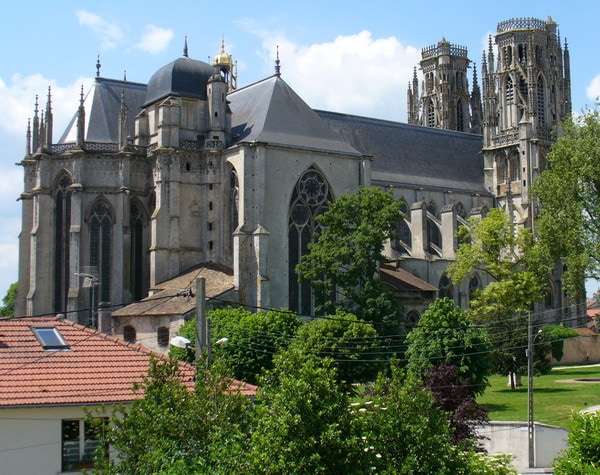
- Second Largest Cloister In France
- Flamboyant Gothic Windows In the Transept
- Rib Vaulted Ceiling
- Glass Wall Effect In the Transept
- Pilgrimage Stop On the Route To Santiago De Compostela
About Toul Cathedral
Toul Cathedral, officially the Cathedral of Saint Stephen of Toul (French: Cathédrale Saint-Étienne de Toul), is a significant Roman Catholic cathedral located in Toul, Lorraine, France. It stands as a prime example of Flamboyant Gothic architecture and is particularly renowned for housing the second largest cloister in France. For centuries, it served as the seat of the Diocese of Toul and has been an important site on the pilgrimage route to Santiago de Compostela since the Middle Ages, underscoring its continuous historical and religious relevance.
History and Construction
The origins of the site stretch back to the 4th century AD, with early structures including a Roman temple. Following the Roman period, the location hosted several Romanesque churches. A significant expansion between 963 and 981 merged existing structures into a basilica that was consecrated in 981 and later by Pope Eugene III in 1147. The impetus for the current Gothic cathedral, begun in 1221, was to rival Metz Cathedral. Its plan drew inspiration from the Champagne Gothic style of Reims Cathedral while incorporating elements of the earlier Ottonian layout. The seven-sided choir was completed by 1235, and construction on the cloister commenced around 1240. The transept and a sculpted porch were added in the latter half of the 13th century, followed by the demolition of the old Romanesque nave. Construction paused for nearly fifty years due to conflict but resumed around 1460, with work continuing into the 15th century in the Flamboyant Gothic style. The façade, towers, and initial bays of the nave were erected, with the building largely considered complete by 1496.
During the Renaissance, the cathedral saw the addition of a dome and bell towers, aligning with evolving architectural trends. New chapels were also integrated into the aisles during the 16th century. The late 18th century brought destruction during the French Revolution, with revolutionary forces vandalizing sculptures and repurposing the church as a Temple of Reason. Further damage occurred during World War II when an artillery shell caused a fire that destroyed the roof, organ, and rose window. Extensive restoration efforts began in 1981, focusing on rebuilding the roof structure and continuing with exterior repairs until 1995.
Architecture
The exterior of Toul Cathedral showcases significant elements of late Gothic Flamboyant and Renaissance styles. The transept features exceptionally large Flamboyant Gothic windows, some measuring up to 22 meters high and 8 meters wide, which represent a key innovation in regional Gothic design. The cathedral's overall style combines influences from Verdun Cathedral's choir and Reims Cathedral's towers and façade. The interior is characterized by its reconstructed ribbed vault ceiling and transept, which incorporates large stained glass windows spanning the full height of the wall, creating a striking 'glass wall' effect. The cloister, built in a Rayonnant Gothic style, is considered one of the largest in France, with its galleries measuring significant lengths and comprising numerous bays, reflecting the scale of a major medieval bishopric.
Source: Wikipedia ↗
Frequently Asked Questions
What is the architectural style of Toul Cathedral?
Toul Cathedral is a classic example of Flamboyant Gothic architecture. It also exhibits elements of the Renaissance style, particularly in later additions. The design was influenced by Champagne Gothic styles, such as that of Reims Cathedral.
When was Toul Cathedral built?
Construction on the current Gothic cathedral began in 1221. While essentially considered complete by 1496, additional work continued into the 15th century. Significant rebuilding and restoration have occurred throughout its history.
What is special about the cloister at Toul Cathedral?
The cloister at Toul Cathedral is notable for being the second largest in France. Construction began around 1240, and it is built on a scale reflecting the importance of the bishopric and chapter during the Middle Ages.
Has Toul Cathedral been damaged historically?
Yes, Toul Cathedral suffered vandalism during the French Revolution, leading to the destruction of sculptures and ornaments. It also sustained severe damage during World War II from an artillery shell, which destroyed the roof, organ, and rose window.
Is Toul Cathedral a pilgrimage site?
Indeed, the church has been an important stop on the pilgrimage route to Santiago de Compostela since the Middle Ages. This historical significance continues to draw visitors on religious journeys.
Related Cathedrals

Auxerre Cathedral
Auxerre Cathedral, officially Cathédrale Saint-Étienne d'Auxerre, is a Roman Catholic cathedral located in Auxerre, Burgundy, France. Constructed primarily between the 13th and 16th centuries on the site of an 11th-century Romanesque cathedral, it is renowned for its extensive 13th-century stained glass windows and the 11th-century Carolingian frescoes preserved in its crypt. Since 1823, it has served as the seat of a diocese united with that of Sens Cathedral.

Limoges Cathedral
Limoges Cathedral, officially the Cathédrale Saint-Étienne de Limoges, is a significant Roman Catholic cathedral in Limoges, France. Its construction spanned centuries, beginning in 1273 and concluding in 1888, resulting in a blend of architectural styles including Romanesque, Gothic, and Renaissance. It serves as the seat of the Bishop of Limoges and is a notable national monument.

Rouen Cathedral
Rouen Cathedral, officially Cathédrale primatiale Notre-Dame de l'Assomption de Rouen, is a significant Catholic church in Rouen, Normandy, France, serving as the seat of the Archbishop of Rouen. Renowned for its three distinct towers, the cathedral showcases a rich architectural history, evolving from Early Gothic to Flamboyant and Renaissance styles over more than eight centuries. It holds notable importance in art history as the subject of Claude Monet's impressionist series and in architectural history, having been the world's tallest building from 1876 to 1880.