
Limoges Cathedral
Limoges Cathedral, officially the Cathédrale Saint-Étienne de Limoges, is a significant Roman Catholic cathedral in Limoges, France. Its construction spanned centuries, beginning in 1273 and concluding in 1888, resulting in a blend of architectural styles including Romanesque, Gothic, and Renaissance. It serves as the seat of the Bishop of Limoges and is a notable national monument.
Key Facts
- ›The current Gothic cathedral's construction began in 1273 and was completed in 1888, though it incorporates elements from earlier Romanesque structures.
- ›It showcases a MIX of architectural styles, including Gothic, Romanesque, and Renaissance, particularly evident in its Flamboyant façade, bell tower, and rood screen.
- ›The cathedral houses the Renaissance rood screen, a rare surviving example in France, featuring intricate sculptures of mythological themes, including the exploits of Hercules.
- ›Vestiges of earlier churches, including a 5th-century baptistry and Romanesque foundations, have been discovered on the site.
- ›A 2005 terrorist explosion severely damaged over three thousand pieces of stained glass, with restoration efforts ongoing.
- ›The bell tower, dating from the 11th-century Romanesque cathedral, was integrated into the Gothic structure and later enhanced with Gothic levels.

- Renaissance Rood Screen With Reliefs of the Labors of Hercules
- Flamboyant FaçAde of the Transept
- Vestiges of Romanesque Architecture, Particularly In the Bell Tower
- Remains of 11th-Century Murals In the Crypt
- Traces of A 5th-Century Hexagonal Baptistry
Jean De Deschamps
About Limoges Cathedral
Limoges Cathedral, officially known as Cathédrale Saint-Étienne de Limoges, is a prominent Roman Catholic cathedral situated in the city of Limoges, France. It holds the distinction of being a national monument and serves as the episcopal see for the Bishop of Limoges. The cathedral's history is marked by continuous construction and modification, with its current Gothic form initiated in 1273 and finally completed in 1888. This extended construction period has resulted in a rich architectural tapestry, blending Romanesque, Gothic, and Renaissance elements.
Historical Context and Evolution
The presence of a bishop and a cathedral in Limoges dates back to at least 475 A.D. Gregory of Tours documented an early church on the site. Archaeological discoveries during renovations have revealed subbasements from the Carolingian period and the nave of a Romanesque church, suggesting the site may have previously housed a Roman temple, palace, or villa. Evidence of a 5th-century hexagonal baptistry has also been unearthed.
The Romanesque cathedral, consecrated by Pope Urban II in the late 11th century, was built in the form of a Latin cross, measuring approximately sixty meters in length. It suffered damage from fires in 1074 and 1105, after which its wooden nave was rebuilt with a vaulted stone roof. Vestiges of this Romanesque structure, including the crypt and lower sections of the bell tower, still exist.
By the mid-13th century, the Romanesque cathedral was deemed too small. Bishop Aymeric de la Serre initiated plans for a grander Gothic cathedral inspired by contemporary structures in the Île-de-France. Although the architect is unknown, Jean de Deschamps, who worked on other southern French cathedrals, is a likely candidate. Construction of the Gothic chevet began in 1273 under Helie de Mamemort. The project faced challenges due to the steep terrain and the city's growth. Work was halted by financial shortages in the early 14th century but resumed later that century, focusing on the southern wing and transept. By 1444, the Gothic chevet and transept were connected to the Romanesque nave. The Portal of Saint John, a masterpiece of Flamboyant Gothic style, was added to the northern transept between 1516 and 1530. The highly decorated Renaissance rood screen, separating the choir and nave, was created between 1533 and 1534.
19th-Century Completion and Modern Era
Significant restoration work occurred between 1847 and 1852. The cathedral was officially recognized as a historic monument in 1862. Further work to complete the original medieval plan, including the addition of three traverses to the nave and the final storeys of the bell tower, took place between 1876 and 1888. A narthex was also added to connect the church with the bell tower's porch.
In 2005, a powerful explosion caused extensive damage to over three thousand pieces of stained glass, with restoration efforts continuing for many years.
Architectural Highlights
The cathedral's exterior showcases a blend of styles. The sixty-two-meter high bell tower, slightly off-center to the north, retains its Romanesque core but is topped with Gothic octagonal levels. The Portal of Saint John on the north transept is a prime example of Flamboyant Gothic architecture. Internally, the Renaissance rood screen stands out for its intricate sculptures, many depicting the labors of Hercules, and its Italianate decorative elements.
The crypt, built by Bishop Alduin in 1013, contains remnants of 11th-century murals. The cathedral also houses two organs, a modern neoclassical instrument and an older choir organ, both protected as historic French sites. Numerous tombs from the cathedral's early history are preserved, including notable examples of Renaissance sculpture.
Source: Wikipedia ↗
Frequently Asked Questions
When was Limoges Cathedral built?
The construction of the Gothic cathedral began in 1273 and was completed in 1888. However, the site has hosted churches since at least the 5th century A.D., with a Romanesque cathedral existing before the current Gothic structure.
What architectural styles can be seen at Limoges Cathedral?
Limoges Cathedral is noted for its combination of architectural styles. These include Romanesque elements, particularly in the bell tower and crypt, Gothic architecture which forms the main structure, and Renaissance features, most notably the rood screen.
What is the significance of the rood screen at Limoges Cathedral?
The Renaissance rood screen, created between 1533 and 1534, is one of the rare examples still existing in France. It is elaborately decorated with sculptures, largely depicting ancient and mythological themes, particularly the exploits of Hercules.
Has Limoges Cathedral suffered any major damage?
Yes, in 2005, a powerful explosion from a terrorist device attached to a gas canister caused significant damage to more than three thousand pieces of stained glass. Restoration of these windows was still underway in 2024.
What is notable about the bell tower of Limoges Cathedral?
The bell tower originates from the 11th-century Romanesque cathedral and was incorporated into the Gothic structure. It stands sixty-two meters high and features a mix of rectangular Romanesque levels and octagonal Gothic upper levels. It famously lost its bells in a fire caused by lightning in 1571.
Related Cathedrals

Rouen Cathedral
Rouen Cathedral, officially Cathédrale primatiale Notre-Dame de l'Assomption de Rouen, is a significant Catholic church in Rouen, Normandy, France, serving as the seat of the Archbishop of Rouen. Renowned for its three distinct towers, the cathedral showcases a rich architectural history, evolving from Early Gothic to Flamboyant and Renaissance styles over more than eight centuries. It holds notable importance in art history as the subject of Claude Monet's impressionist series and in architectural history, having been the world's tallest building from 1876 to 1880.

Auxerre Cathedral
Auxerre Cathedral, officially Cathédrale Saint-Étienne d'Auxerre, is a Roman Catholic cathedral located in Auxerre, Burgundy, France. Constructed primarily between the 13th and 16th centuries on the site of an 11th-century Romanesque cathedral, it is renowned for its extensive 13th-century stained glass windows and the 11th-century Carolingian frescoes preserved in its crypt. Since 1823, it has served as the seat of a diocese united with that of Sens Cathedral.
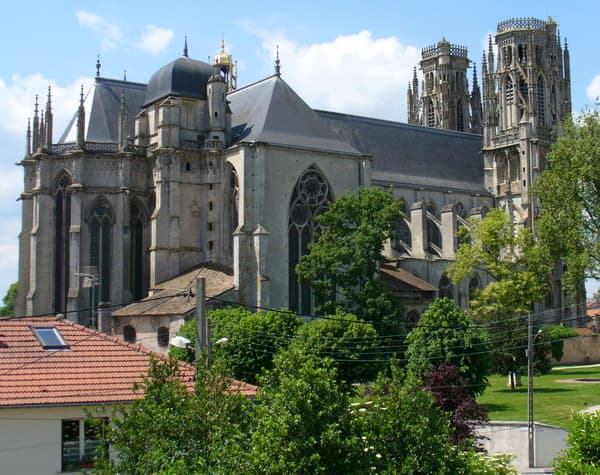
Toul Cathedral
Toul Cathedral, officially the Cathedral of Saint Stephen of Toul, is a significant example of Flamboyant Gothic architecture located in Toul, France. It holds the distinction of possessing the second largest cloister in France and has been a vital stop on the pilgrimage route to Santiago de Compostela since the Middle Ages, reflecting its enduring religious and historical importance.